Wednesday, August 21, 2019

Against the Crowd: "Murrain"

Maybe there is just something in the air, in the water, or buried deep in the ground, but with the recent release of Ari Aster’s Midsommar, the upcoming autumn release of Robert Egger’s The Lighthouse, and the inclusion of such films as The Ritual (David Bruckner, 2017) and Apostle (Gareth Evans, 2018) on Netflix, it seems that Folk Horror is back on the big and small screens with a vengeance.


I’d never heard of the term, Folk Horror, until a few years ago. After I’d picked up Andy Murray’s book, Into the Unknown: The Fantastic Life of Nigel Kneale, I was looking for more information on an episode of the ITV series Against the Crowd that was written by the British script writer. A few internet searches and multiple hyperlinked portals later and I felt as though I’d stumbled into a mysterious society that existed (and thrived) just beyond the ken of our own. The more I read, the more I felt like an outsider, a stranger in a strange land. And then, before I knew what was happening, they’d got me - I was hooked! In short, I felt very much like a character in a Folk Horror movie.

Like film noir, Folk Horror is a term created by critics to describe the films of a particular time and place: Britain in the late-1960s and early 1970s. Many Folk Horror enthusiasts and scholars (like Mark Gatiss, Howard David Ingham, Adam Scovell, and Andy Paciorek) will point to that era’s “Unholy Trinity” as the fountainhead of the sub-genre. These three films - The Witchfinder General (Michael Reeves, 1968), The Blood on Satan’s Claw (Piers Haggard, 1971), and The Wicker Man (Robin Hardy, 1975) - portray the deleterious effects of the landscape on isolated individuals and communities. Witch covens seem to spring forth from the furrows and fields, pagan rituals soon follow, and, more often than not, a little human sacrifice is needed to set things right.

Like film noir’s flashier, modern cousin, neo-noir, Folk Horror is also subject to updated takes on those older texts. These new novels and films take Folk Horror on the road. You can head off to Sweden to check out the cult surrounding the weird human-elk offspring of Loki in The Ritual. Cross the pond to the New World and spend some time in the Colonies with The VVitch (Robert Eggers, 2015). After that, you can head up to Canada and read about the movies featuring the not-so-friendly Wendish mythological figure “Lady Midday” in Gemma Files 2015 novel Experimental Film.

Films and literature aren’t the only art forms allowed to play in the Folk Horror sandbox. Music, too, gets its hands dirty and builds ritualistic stone circles. Old film soundtracks (like those for the “Unholy Trinity”), the electronic work of the BBC Radiophonic Workshop, and the folk-, psychedelic-, and prog-stylings of bands such as Pentangle, Comus, and Hawkwind all seem to map out a territory of terror where rural, pagan rituals stand shoulder-to-shoulder with modern, industrial society. Present-day musicians use this map to meander through the moors of Folk Horror. Bands like The Hare and The Moon, Pye Corner Audio, and The Advisory Circle all to varying degrees play with the folk-electronic sounds of the past, while artists like Klaus Morlock, The Heartwood Institute, and Thorsten Schmidt create soundtracks to “lost” films and tv series. Perhaps the main reason they are “lost” is that they never existed in the first place?

These “lost” sounds would not seem out of place playing over the opening credits of, say, an episode of Play for Today, Shadows, The Mind Beyond...or the 1975 Nigel Kneale-penned episode of Against the Crowd entitled “Murrain.”


Nigel Kneale is best known for his creation of the intrepid and indefatigable head of the British Experimental Rocket Group, Professor Bernard Quatermass. The old boffin’s adventures in such 1950s BBC television series as The Quatermass Experiment and Quatermass and the Pit cast a long shadow over any filmmaker looking to explore the bleak territory where science-fiction and horror intermingle. If it wasn’t for Kneale’s special blend of science and terror, we wouldn’t have films like John Carpenter’s The Thing (1982) and Prince of Darkness (1987).

After working at the BBC for the previous twenty-five years, Nigel Kneale spent most of the 1970s writing scripts for newcomers ITV. His first produced script would be for the network’s seven-episode series Against the Crowd. While none of the episodes are connected by characters or storyline, all deal with the same basic situation: a lone individual standing against the majority. Kneale’s contribution, “Murrain,” was the third episode and was originally broadcast on ITV on July 27, 1975. It was rebroadcast (along with the rest of the series) two years later in early 1977.

After experiencing Kneale’s tv work on the Quatermass series, as well as his scripts for Hammer Films (1957’s The Abominable Snowman and 1966’s The Witches), you’d be excused for expecting something more explicitly sinister and wyrd. “Murrain” has the feel of a fairly straightforward drama. As the story develops, however, we get a sense that behind this perceived normality lies a world that is more in line with what we consider to be “Knealean,” a worldview that is akin to William Faulkner’s: “The past is never dead. It’s not even past.” By the end of the program, the viewer (like the very modern main character of the story) is left staring at an ever-widening crack in what had once been the smooth facade of reality.

(WARNING: Beyond this point there be spoilers!)

David Simeon as "Alan Crich"
Things begin in an ordinary, even mundane, manner. Mr. Crich (David Simeon), a veterinarian, is making a follow-up visit to the pig farm of Mr. Beeley (Bernard Lee). Tests have been made, precautions taken, but Beeley’s pigs are still dying, and Crich is unable to discover the cause. Crich preaches patience, he assures the farmers that it is only a matter of time before science solves the problem. Beeley and his men, however, have another solution in mind.

Crich is escorted around the farm and the surrounding area by Beeley and his men. In addition to the sick hogs, Crich is shown empty pipes where water used to flow. He is introduced to Mr. Leach’s (David Neal) sick and bedridden child (Philip Gilman). Mr. Coker (John Golightly) walks with a noticeable limp on a twisted leg. According to Beeley, all of these problems and ailments have been caused by the same thing – a murrain. Murrain is an archaic word meaning quite literally death. It is a term used to describe a number of infectious plagues affecting animals, as well as humans. And the cause of the murrain? Simple – a witch.

Bernard Lee as "Beeley"
Next door to Beeley’s farm is the dilapidated house of Mrs. Clemson (Una Brandon-Jones). It was Mrs. Clemson who gave blackberries to Leach’s son for trespassing on her land. It was Mrs. Clemson who passed a pot of jam into Mr. Coker’s hands, paralyzing his body and making him lame, after he confronted her about drying up the farm’s water supply. “How do you suggest she did that,” Crich asks with a sardonic smile on his face. “Oh, she’s got her ways,” Beeley replies.

Beeley and his men have chosen Crich, because of his outsider status, to deal with Mrs. Clemson and her murrain. The men empty Crich’s doctor’s bag onto the ground and fill it with grit, gravel, and dirt. Once invited into her house, Crich is to dump the detritus onto the old woman’s head, thus breaking the spell.

Una Brandon-Jones as "Mrs. Clemson" 
Crich refuses to partake in Beeley’s archaic ritual and tosses the bag aside. In the ramshackle stone house, he finds not a witch, but merely a lonely old woman made lonelier due to isolation from the surrounding community. The Leaches won’t sell her goods from their store; Beeley cut off her water supply for his piggery. Crich is appalled at Mrs. Clemson’s treatment and determined to help her. He promises to bring her back supplies from Leach’s store.

As he shops at the store, Crich is surrounded by Beeley and his men. They demand to know what he saw in Mrs. Clemson’s house. Crich promises to notify the authorities about their treatment of their old pensioner neighbor. The men put two and two together, notice that Crich is purchasing supplies for the old woman, and chase him out of the shop empty-handed. Mrs. Leach (Marjorie Yates) screams when she realizes that the money that Crich handed her was from Mrs. Clemson.

Marjorie Yates as "Mrs. Leach"
The following day, Crich returns to the old woman’s house with a box of supplies. The men at the nearby farm watch him from afar. As Crich makes another trip to his car for more goods, Beeley drags the vet to Leach’s store. There, Mrs. Leach sits in a daze next to her son, suffering from the same sickness, her hands swollen and useless. The men are sure that Mrs. Clemson passed some sort of spell to Mrs. Leach through the pound notes she gave Crich.

Determined to put a stop to events once and for all, the men gather up their farming implements and charge off to Mrs. Clemson’s. Crich cuts through the dried creek bed between the properties to head them off. He shouts a warning to the old woman. As the men approach her, Mrs. Clemson raises her hands and speaks an incomprehensible phrase. Beeley drops dead from an apparent (at least to Crich) heart attack. The men stare at Mrs. Clemson in awe. Crich looks up, and Mrs. Clemson pronounces an emphatic “Yes!” in answer to their gazes. As the end credits roll, the men take Beeley’s body away, and Crich is left unsure of what he has just witnessed.
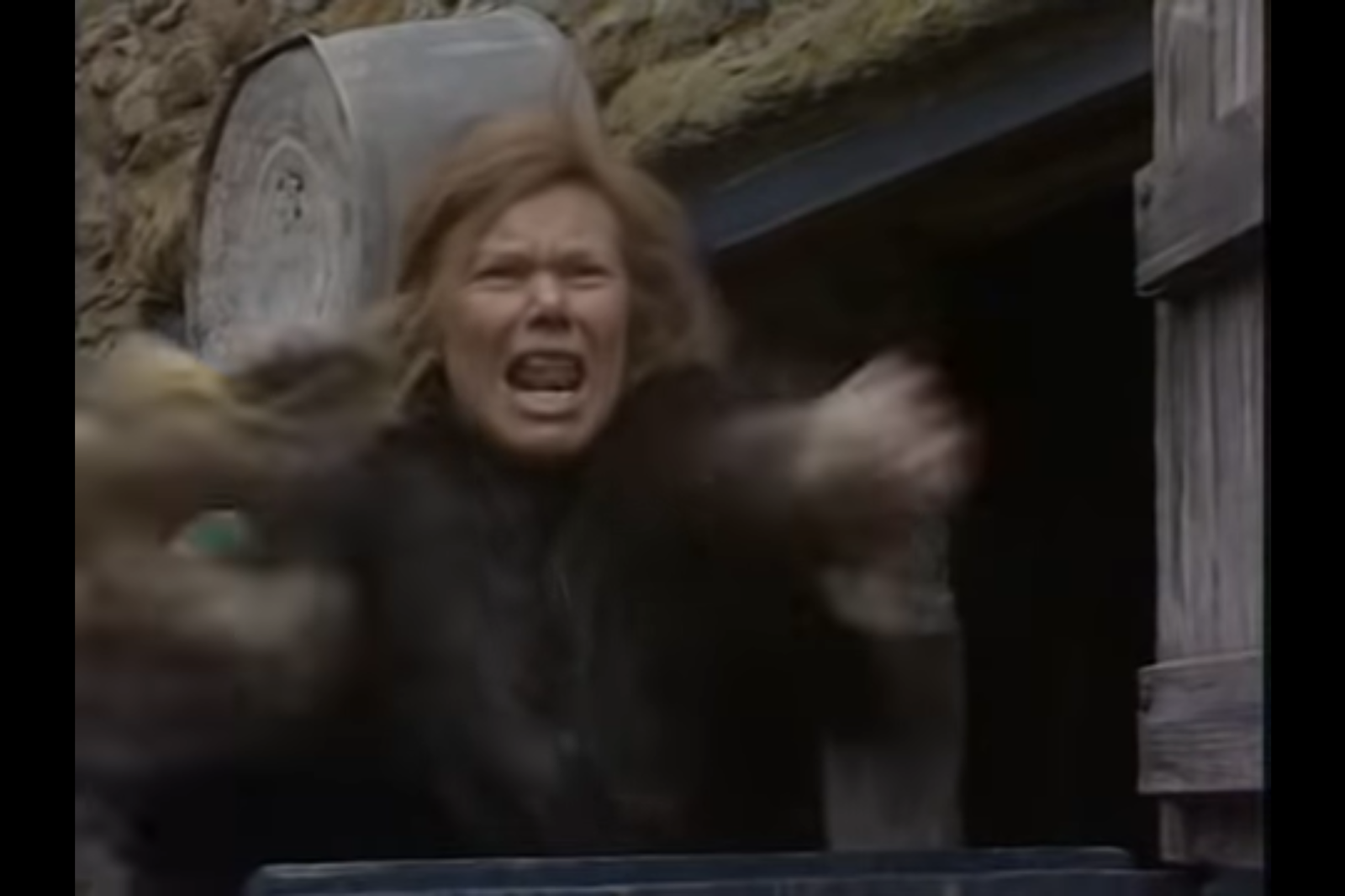
"YES!"
What makes the foregoing Folk Horror, you may well ask? Writer Adam Scovell lists several links in what he calls the “Folk Horror Chain.” These include:
  • the use of the landscape and the environment as an isolating influence
  • the skewed morality and belief systems of communities that develop in these environments
  • the violent manifestations that proceed from these belief systems
On the surface, “Murrain” follows the Folk Horror Chain from one end to the other without missing a beat: Beeley’s pig farm sits far outside the urban center of Buxton. Not only that, but outside of the farm are signs warning off trespassers due to the sickness in the pigs. This double isolation, in turn, encourages the farmers to look for the cause of their bad luck outside of accepted, rational, scientific explanations. Their belief in witchcraft, then, causes the death of Beeley at the end of the program. It’s all pretty straightforward, no?

Well, yes and no. The “isolated community that harbors strange beliefs” was a pretty standard trope of the horror genre by the time “Murrain” hit British tellies in 1975. The late-1960s and early-1970s was a time period when so many members of the counterculture sought greener pastures in hopes of leaving behind the damaging influences of urban society. Many hippies hoped to live off the fruits of the land and to create utopias in the country. Others, not quite so extreme, just looked to start their lives over in simple, rural settings. What tends to happen in these types of horror films and books is that what is viewed as “simple” or “utopian” is, in fact, much more complex and, in the long run, dystopian. The danger of country living soon rears its head and the city-dweller finds out that the rural dirt roads are every bit as deadly as the city streets. Think: Thomas Tryon’s novel Harvest Home (1973), Bryan Forbes’s 1975 film version of Ira Levin’s 1972 novel The Stepford Wives, and John D. Hancock’s 1971 film Let’s Scare Jessica to Death, which you can read about (...cough, cough...shameless self-promotion) here on this very blog.

What “Murrain” does so well and why it is a paragon of the genre is not that it embodies the links in the Folk Horror Chain (it obviously does), but that it does so in many, complex ways – not just narratively-speaking.

"Who lives there?"
Taking the first link as an example, the isolation apparent in “Murrain” happens on many levels. For instance, aside from the opening and ending credits, there is no musical soundtrack. Instead of musical stingers and leitmotifs and sound bridges between scenes to guide us, we are left to the sounds of the wind blowing through the trees or the sounds of galoshes on muddy pathways. The lack of a music in “Murrain” leaves the viewer in the position of the main character Mr. Crich: we are unsure how to react to what is happening around us.

The color palette, too, adds to the overall tone of creepiness. The colors are muted, which may be down to the digital transfer of the original video, but I don’t think so. The faded browns, blues, and greens, match the mood and atmosphere. It is either the fall or winter of the year. A chill is in the air. The trees are bare. There seems to be more mud than grass on the ground. Death stalks the land, and we shouldn’t hold out any hope for springtime to return anytime soon.

"The name's...Mrs. Clemson."
The cast is phenomenal, as well, and their performances create a sense of worlds (and worldviews) clashing. David Simeon’s earnest portrayal of the upstanding and well-meaning Mr. Crich seems utterly out of place amongst the men of the farm and Mrs. Clemson next door, which is as it should be. Crich and men move differently from one another. When Crich arrives at the farm, he calls out to Mr. Coker, who turns to him like a man living in slow-motion. Crich and the men speak differently, too. When asked a simple yes or no question, the men answer Crich with a drawn-out and ambiguous “I dare say so.” There is also a generous use of repetition when the men speak to one another that stretches time out. As Beeley and Crich go off to look at the pigs, the men hang back to watch a fellow farmhand, Jimmy, work in the distance (what he is working on is withheld from the viewer):
Start (Raymond Platt): Do you remember that wireless? That old wireless he took to bits? 
Leach: Jimmy’s wireless. 
This type of repetitive and laconic dialogue would not be out of place in a Harold Pinter play. It further serves to point out the differences between Crich and the men.

"Jimmy's wireless..."
The deliberate positioning and movement of the camera, too, is another tool used by the filmmakers to create tension. Director John Cooper uses simple set-ups to capture the action. There is only one instance of handheld shooting, so far as I can tell, and that is a brief shot from Crich’s point-of-view as he walks down the street. Outside of that single moment, the camera is kept in a fixed position and captures action either through panning left and right or by allowing the actors to move through the frame, from one side to the other or walking towards or away from the camera. Although this would be standard shooting protocol at the time, to modern viewers, who are used to shaky, documentary-style camerawork that flies over, under, or through the scenery and actors, it is disconcerting and isolating.


The ways in which Cooper fills his frame is equally effective in creating tension. Scenes with multiple characters are filmed by using either the tried-and-true shot/reverse shot method or by framing multiple characters at once. This latter method is especially effective when Beeley and his men crowd around Crich. By framing more than one or two characters in a single shot, the pressure being brought to bear upon Crich is expressed visually. Cooper places his actors in different fields within the frame, as well. For instance, when the men drag Crich to Leach’s home so that he can look at Leach’s bedridden son, there is a shot that includes the boy and his mother in the foreground and Crich, Beeley, and Leach between them in the background. This shot gives added visual dimension to the cramped bedroom, as well as to the danger that the viewer feels is slowly encompassing poor Crich. Indeed, in several scenes like this one, there are always men between Crich and a door, as if the farmers are trying to entrap him.

"He got given stuff."
The second link in the Folk Horror Chain, the isolated community’s skewed morality and belief systems, is also dealt with by Kneale et al. in a complex fashion. On a narrative level, Kneale pays out information in a way that keeps the viewer from ever knowing what really is going on. There are quite a few scenes in which Crich and Beeley square off, the one trying to convince the other that he is right. Mr. Crich represents modern, scientific, rational thinking; Beeley is an agent of the older ways, of superstitious, magical thinking. In other horror films, the viewer would be granted a scene, early on, in which Beeley’s position is shown to be the correct one. The viewer would then carry that knowledge into every scene to follow. In this way, Crich’s position is undermined, and we are merely waiting for the other shoe to drop.

“Murrain,” on the other hand, keeps the viewer on Crich’s side up until the very end. Until the moment Beeley keels over, we assume that the farmers are crazy and that Mrs. Clemson is a poor, old woman being tormented for simply looking the part of a witch. When Beeley hits the ground, the viewer’s certainty falls with him.

How Beeley and his men relate to what they are experiencing is also off-center, but not in the way other films have portrayed rural paganism. In an earlier scene, Beeley and Crich argue for and against the possibility that Mrs. Clemson is responsible for laying the murrain on the farm:
Beeley: It’s what I got in my pigs, like a plague on them. And your science can make nothing of it. Well, when that happens you got to look around for other reasons. And when it takes on people, too. And young kids. 
Leach: By God, yes! 
Crich: Then you find somebody to blame. 
Beeley: Find out who is to blame. 
This is a very subtle, semantic distinction. On the one hand, Crich is speaking of superstition and witch hunts, of the majority finding a minority (any minority) to lay their bad feelings and hatred upon. On the other hand, Beeley and his men speak with the certainty of the old ways, of just plain knowing what the truth is without proper evidence:
Beeley: “All this talk! You’re tryin’ to prove there’s no such thing. Well, you won’t prove it to us. We know there is. They got you trained to thinking nothing’s true if you can’t find it in books or shove it in a bottle and analyze it! You work out the rules, and what the rule don’t fit, don’t happen! Then you find out you got the rules wrong! 
Crich: Then, we change the rules-- 
Beeley: Oh, that’s handy! 
Crich: --for better rules. But we don’t go back! 
"Now they got another name..."

Up to this point, this argument is by-the-book stuff, breaking across “city vs. country” and “science vs. magic” lines. Crich is a forward-thinking, college-educated, urban-dweller; Beeley and his men are backward, uneducated, country folk. What pushes these distinctions into new, complicated territory is Beeley’s insistence that his and Crich’s positions are not that far from one another.
Crich: You’re trying to justify the persecution of some poor, half-witted, old biddy. And how do you do that? Kill her cat in the name of magic and then go home and watch your color telly. 
Beeley: Magic’s a dirty word, then. 
Crich: Aye. 
Beeley: Scrying is magic. 
Crich: Eh? 
Beeley: In the olden times, they took a picture miles away, then it come before them on a bit of glass. Scrying it was called. Now they got another name. 
Start: Double Your Money. 
Leach: Coronation Street. 
"Double Your Money...Coronation Street..."

This exchange is another form of the old saying that can best be summed up by the Leigh Brackett quote from her short story “The Sorcerer of Rhiannon”: “Witchcraft to the ignorant,...simple science to the learned.” The technology of television is just another form of mystical scrying to Beeley and his men. Later, Beeley will expand upon this naturalist view of the supernatural:
Beeley: There’s dreadful strains in the land. Always has been. There still is. Just waiting there, see? Until someone has the trick to come along and use them...It’s like finding oil and gas under the sea...They said there were none, and then there it was, once they had the cunning to tap it and put it to use. Now that’s the same with the other. Learn how, and you take a man’s breath away, spoil him, stop him all roads! 
This skewed morality isn’t formed in quite the same way as the witch’s coven being formed due to the skull found in the fields in The Blood on Satan’s Claw or Lord Summerisle and his family introducing pagan worship to the islanders as a form of social control in The Wicker Man. For Beeley, witchcraft is a natural part of the land, like fossil fuels. Whoever finds it, can use it. What Beeley and his men fear is that Mrs. Clemson has found a way to tap into these “dreadful strains in the land” and use them against the farm.

"He don't believe in North Sea gas."
This leads to the third link in Scovell’s Folk Horror Chain: the violent manifestations that proceed from the skewed belief system of the isolated community. On the face of it, the death of Beeley is caused by Mrs. Clemson’s witchcraft. His death, then, proves that everything that he and his men have told Crich is true. Again, in other films of the period, this is certainly the case, but in “Murrain,” Kneale has offered the viewer a slightly off-center perspective, one that complicates such a simplistic reading.

After Crich delivers groceries to Mrs. Clemson, he is dragged back to Leach’s store by Beeley. There, Crich is confronted with Mrs. Leach, who is exhibiting symptoms similar to her sick son: she is pale and unresponsive; her hands looked bloated and waxen. Beeley attributes her condition to her handling of Mrs. Clemson’s money, but Crich says it is due to something else:
Crich: Suggestion! 
Beeley: What? 
Crich: Well, that’s what’s done it. The power of suggestion. She’s brought it on herself through hysteria, if you like. She believes this influence to exist and that it can do this to her, and so it has. 
The possibility that Mrs. Leach’s sickness is her own fault, that it was conjured up by her own mind and not by Mrs. Clemson’s witchcraft, sends a shockwave through the men. But, here, Kneale adds another twist to the tale:
Beeley: It’s a powerful thing, belief. 
Crich: It is. Very. 
Beeley: Suppose her over there. 
Crich: Mrs. Clemson. 
Beeley: Aye. Suppose she believes, too, that she’s...that. 
If Mrs. Leach can believe herself to be sick, then why couldn’t Mrs. Clemson believe herself to be a witch? After being accused time and time again by Beeley, after being cut off from the community, after having her last friend, her cat, killed, why shouldn’t she finally succumb to believing what the rest of the community believes? It’s only logical, after all.


This double-edged belief is what is manifested during the violent attack on Mrs. Clemson. Beeley believes that the old woman has the power to do him harm; Mrs. Clemson believes what the men believe, and so lashes out, killing Beeley with her words. Was it witchcraft? Was it a psychosomatic-induced heart attack? Kneale offers no comfort as he leaves the viewer to ponder those questions as the credits roll. Mrs. Clemson’s final, “Yes!” is no answer. It could mean, “Yes, I am a witch” or “Yes, I believe that I am a witch.” There is no relief that comes from knowing one or the other is true.


In a way, both are true at the same time, which is a frightening proposition for Mr. Crich as well as the viewer. For Crich, the happenings at Beeley’s farm seem to throw everything he thinks he knows about the world into disarray. For the viewer, “Murrain” is a horror show in straight drama clothing. Or is it the other way around? Nigel Kneale complicates the tropes of the genre and forces the viewer to constantly question what is happening on screen. Is “Murrain” about the existence of witchcraft or is about the belief of the existence of witchcraft? Folk Horror, it seems, lives in the shadows of such distinctions.

Sunday, November 11, 2018

Let's Scare Jessica To Death

Even though everyday is Halloween as far as my movie-watching and book-reading preferences go, I find that the weeks leading up to Conal Cochran's favorite holiday always make everything a little spookier, a little weirder, and a little creepier.

Certainly watching and reading the news this past October seemed that way.

I also find that, as I've gotten older, I get more enjoyment out of movies that thrill me with atmosphere and mood instead of blood and guts. I want fewer jump scares and more just plain ol' creeping terror.

One movie that ticks those boxes and has quickly become one of my “must-watch” favorites for the Halloween season is a classic creeper from the year I was born: Let's Scare Jessica to Death (John D. Hancock, 1971).


Let's Scare Jessica to Death is a film that I only recently discovered, even though I'd been aware of it for a long, long time. I might have read about it in Fangoria back when I was reading Fango religiously in the mid- to late-1980s. I seem to recall it playing on Commander USA's Groovy Movies, but I don't think I watched it (which is weird because I watched just about everything that the Commander showed back then). I also have vague recollections of seeing the VHS box art at my local video store in Cranberry Township, PA. Those skeletal hands reaching up from the blood-red water to the edge of the boat is an image that my eyes — not to mention my $0.99 for the rental fee at the local Phar-Mor — would have been drawn to.

Alas, I never watched it.

I am not sure why that is exactly. Maybe it was because the woman on the VHS box looked more like Miss DiPesto from Moonlighting than star Zohra Lampert? Maybe it was the typeface used for the title that made it look more like a rom-com than a horror movie? Maybe it was the title itself that kept me at arm's length? I was quite the gorehound in them thar days, and Let's Scare Jessica to Death isn't really a title that gets the blood racing...or spurting for that matter. (The original screenplay was entitled It Drinks Hippy Blood, which is just as weird and silly, but at least it puts the red stuff up front.) The title makes it sound like a campy, self-aware horror film. Back then, I was sure that “real” horror movies could only have names like The Evil Dead (Sam Raimi, 1981) or Friday the 13th (Sean S. Cunningham, 1980) or The Texas Chain Saw Massacre (Tobe Hooper, 1974).

What'd'ya want from me?  I was fifteen.


Flash forward to the present, and it seems that yours truly isn't the only one to reconsider the importance of John D. Hancock's pseudo-vampire picture. After Paramount released the movie on a barebones DVD back in 2006, folks from FangoriaVideoscope, and a host of other genre movie mags have written about it glowingly. Indeed, Rue Morgue, that fine Canadian horror mag, gave Jessica the front-cover story treatment back in December 2016. There's even a really super (and really old school lookin') website dedicated to the picture. Not bad for a nearly 50-year-old film!

So, what's all the hubbub?  Let's take a look...


The film opens with an image that should seem familiar to anyone who (cough, cough...shameless self-promotion) read my previous post about Steven Spielberg's Duel (1971): a bloody sun hovering just above the horizon. In fact, we see not just one sun, but two. The second, just below the first, is reflected in the misty surface of a lake, which gives it a smeared and distorted cast. In Duel, the setting sun represented the main character's loss of humanity. Though we can't be sure of what it is representative (as we haven't met any of the characters yet), it’s an eerie opening shot nonetheless.


Then, as the sounds of crying birds and the whispering wind rises, there comes an electronic tone, like a bell chiming dissonantly, and the image of a woman sitting in a rowboat comes to the fore through a slow cross-fade. She does not have her hands on the oars. She drifts just beyond a bed of reeds. As she floats, she speaks to us via voice-over:
"I sit here, and I can't believe that it happened. And yet I have to believe it. Dreams or nightmares? Madness or sanity? I don't know which is which."
There is another off-key peal of the electronic bell, and the image takes on a watery, undulating quality that should be the tip-off to any regular movie-watcher that we are entering the land of the memory. The image of the woman in the boat cross-fades with the image of two men pushing what looks to be a coffin into the back of a hearse.

And that's just the first minute of the picture!

Even though we have no idea who anyone is or what they are doing, we have the perfect distillation of what a spooky movie is: creepy natural surroundings, strange visuals, weird sounds, mentions of madness and nightmares, and a coffin. Talk about starting off on the front foot!

Once the hearse is loaded up, it takes off for parts unknown. As it travels along the highway, a sparse piano score starts up on the musical soundtrack. Its solemnity matches the setting. It is autumn; the leaves on the trees are sere and many shades of gold and red. It is either early in the morning or late in the afternoon, because the shadows are long and thin. After exiting the highway, the vehicle moves over narrow back roads. Soon, the car comes to a graveyard, where it stops, and its passengers alight.


This small section of the picture (it takes less than a minute) feels like a reference to the beginning of Night of the Living Dead (George A. Romero, 1968). As Johnny (Russell Streiner) and Barbra (Judith O’Dea) make their way to their father’s grave, Romero uses the backdrop of the cemetery as a recognizable, traditional, horror movie trope to lull its audience into a false sense of security. The cemetery in Night of the Living Dead is itself a reference to the old Universal horror pictures of the 1930s and 1940s. As the years passed and Universal made their back catalog of films available for television syndication via the Shock Theater movie package, those films had become jokey, campy fun to audiences. In fact, Johnny does a passable Boris Karloff impersonation as he chases poor Barbra around the gravestones, laughing at her fright. Soon, however, no one — not Johnny, Barbra, or the audience — is laughing at anything anymore. Romero performs a bit of sleight-of-hand magic and substitutes a horror film that is shocking, dangerous, and bleak for the safe and well-known horror to which audiences had grown accustomed.

Let's Scare Jessica to Death, too, will turn horror movie conventions on their heads, though not in the revolutionary way that Romero's film did. John Hancock uses the cemetery as a way to establish his horror movie street cred, but he also knows that audiences, thanks to Romero, no longer see this space as "safe." Horror movie traditions had changed over the past few years. Cemeteries — as well as the movies — were dangerous again.

The back of the hearse opens and out pops a young woman. Was she in the coffin?  Is she one of the living dead just visiting some relatives? No, this is Jessica (Zohra Lampert). As she runs into the graveyard with a roll of papers in her hand, the hearse's other occupants get out, too. Her friend, Woody (Kevin O'Connor), is a decidedly hippie-ish looking fellow, complete with sideburns, mustache, and colorful scarf. The other man is her husband, Duncan (Barton Heyman), who is slightly older, balding, and more staid looking. They both watch Jessica run amongst the gravestones as she takes rubbings of their markings. Woody tells Duncan not to worry about her. "The farm," he says, "will be great for her. The apartment was beginning to scare me, too."

It is at this point that Let's Scare Jessica to Death does something very interesting. As Jessica gambols through the graveyard, we hear what she is thinking:
"For the first time in months, I'm free. Forget the doctors. Forget that place. I'm okay now. We'll start over."
Voice-over narration in cinema had kinda fallen out of vogue by this point. The various "New Wave" movements had shifted away from it and moved towards a Hitchcockian, "pure cinema," visual storytelling style of filmmaking. Think: show, don't tell. When one thinks of voice-overs, one tends to think of the film noir pictures of the 1940s and 1950s. The use of voice-overs in these films made sense since so many of them were based on novels and short stories, and the filmmakers wanted to keep that first-person narrator feel that the written word had. The use of flashbacks also tended to make voice-over narration necessary.

The voice-over at the beginning of Let's Scare Jessica to Death makes sense when we look at it from a "framing device" perspective. The person in the rowboat (we think that is who is talking to us — maybe it is, maybe it isn't) tells us that what we are about to see has already happened and that she is remembering it. We don't expect to hear voice-over narration again, and we certainly don't expect it to be so personal, so internal. These aren't the words of Jessica addressing someone else, of her telling a story to an audience. What we hear are Jessica' inner thoughts. She is addressing herself. It is very disconcerting. Not only are we eavesdropping onto her private thoughts, but we also learn from them (as well as from Woody) that she has been through some traumatic event. She needed to be in "that place" with doctors for several months because she was scared of her apartment. We are listening to the thoughts of someone who possibly had a mental breakdown. Can we trust what she thinks?


The first test of our trust comes soon enough. Jessica is hard at work making rubbings of the writing and pictures on gravestones. As a deep, unsettling electronic tone plays on the musical soundtrack, she looks up and sees a young, blond woman in a white dress. Jessica attempts to tell Woody and Duncan about the woman, but cannot speak. She turns back and sees the woman is gone. As Jessica looks around for her, we hear the whispering of voices. These are not the voices of her husband and friend; they are inside her mind. The joy that was on her face only a moment ago has completely disappeared. She looks frightened, like a woman who suddenly realizes that what she is walking on is not solid ground but is actually a tightrope. She walks back to the car, and we hear her think, "Don't tell them. Act normal."

Uh-oh. Unreliable narrators are one thing. What do we do with an unsane one?

From the cemetery, the graveyard gang catches the ferry. Aboard the boat, an old man asks them where they are headed. "Other side of Brookfield," Duncan says, "It's a farm on Cove Road called the Old Bishop Place. Do you know it?" The old man's face becomes a frozen mask, and his easy bonhomie fades away. “Yes, I do,” he says as he walks quickly away. Once on the other side of the water, Jessica and her friends stop in town and meet their new neighbors. The old men outside the local general store (and they are all old men) look them up and down disdainfully. "Damn hippies," one of them says. "Good riddance," another says as the hearse drives away.

I guess the town's welcome wagon won't be showing up at the Old Bishop Place with a casserole anytime soon.


After leaving town, the three newcomers head to their new home. As the hearse pulls up the driveway, we see a Victorian house with a tall tower swathed in fog. It’s an incredible image; it’s romantic and spooky all at once. Like the scenes in the graveyard and the trio’s encounter with the locals — which felt like an echo of the meeting between Renfield (Dwight Frye) and the Innkeeper (Michael Visaroff) at the beginning of Tod Browning’s 1931 film, Dracula — our first glimpse of the Old Bishop Place is another well-worn horror movie trope. This is the “Bad Place,” the “Old, Dark House.” We know from countless other movies that this is a place where nothing good can ever happen. It immediately sets the viewer on edge.

But not Jessica. Jessica bounds from the car and looks at the house and the land that her husband has bought with a sense of utter delight. "Oh, God, it's fantastic!" she says.

Her excitement is short-lived, however. As she runs up the steps towards the front porch, she catches sight of a figure sitting in a chair just behind one of the columns, rocking slowly back and forth. Whereas the musical soundtrack during the shots leading up to this moment is a light, but sad, duet between guitar and piano, when Jessica sees the figure, the electronic drone begins again. It is only a fleeting buzz, but it is an effective cue signaling the strangeness of what Jessica (and the audience) is seeing. Jessica looks to her husband for help, but he and Woody are too busy unloading the car. When she looks back, the figure is gone, but the chair continues to rock.

The camera cuts to a close-up of Jessica as the whispering voices return. As in the cemetery, Jessica looks frightened and forlorn. From the cacophony of mutterings, a women's voice (not Jessica’s) calls out: "Jessica, why have you come here?" Jessica presses her hands against her head in hopes of keeping the voices out and her sanity in.

As she approaches the front porch, she notices that the door is already unlocked. The sounds of insects buzzing and birds chirruping fill the air. She pushes it open, but does not enter the house. Woody and Duncan come up behind her and ask if everything is okay. "Don't tell them," we hear Jessica tell herself. "They won't believe you."


Inside, as the two men unload the boxes and bags they've carried, Jessica stops dead and gazes up the stairs. Duncan, worried, asks her what's wrong. He looks up the stairs and sees a figure run away, as another electronic buzz plays on the soundtrack. "It's okay, Jess," he says, "I saw it, too." The sense of relief that Jessica (and the viewer) feels is palpable.

Throughout these scenes (and for the rest of the movie), Zohra Lampert's ability to project Jessica's anxiety and terror is heartbreaking to watch. Her performance is a collection of sad smiles, nervous twitches, and slumped shoulders. Jessica is a character who is fully aware of the tenuous hold she has on her sanity. She often stands outside of herself and sees the danger she is in. Her emotional state swings back and forth like a pendulum between childlike joy to paralyzing depression, from self-confidence to neurotic self-doubt. Lampert expertly uses her voice and her body to convey to the viewer every shade and hue of every feeling on this emotional spectrum. It's a very natural performance in a very supernatural situation, and it draws the viewer into Jessica's plight.

Upstairs, Jessica and her friends discover a squatter living in the house. A young, red-haired woman named Emily (Mariclare Costello) says that she thought the house was abandoned, so she just moved in. She hid, because she became frightened when she saw a hearse pull up in front of the house. As Emily packs up her things to leave, Jessica asks Emily to share their dinner and to stay the night with them. After a little arm-twisting (that probably wasn't necessary), Emily agrees. There is a shot-reverse-shot between the two women as they formally introduce themselves to one another. Physically, the differences between them are striking: dark-haired, dark-eyed Jessica and pale-skinned, blue-eyed Emily. Even the color of the clothes that each woman wears seems to be at odds with one another. Emily is dressed in bright red, while Jessica wears pastel blues. Jessica's color scheme makes her blend into the rest of the scenery. Everything seems to have a soft, bluish tint. Emily, on the other hand, pops off the screen as if to say, "I don't belong here!"

As they shake hands and the scene ends, Emily casts a look at Jessica that can best be described as "hungry."

I hope for Jessica's sake that Emily is a vegetarian.


During dinner, the dialogue fairly drips with double and triple meanings. When asked if she doesn’t live somewhere, Emily replies in a dreamy way, “Oh, yeah, sure, but I haven’t been there for a long time, and I’m not sure I’m ready to go back yet.” Is she talking about a hometown or something more sinister? And Jessica nods her head in agreement, as if she, too, recognizes herself in Emily’s answer.

Emily begins playing what looks to be a lute. She is very hippy-esque in her speech and manner, but the lute (or whatever it is) gives her character a slight dissonant feel to the viewer. We would expect her to pick up a guitar and start singing folk songs, but the look of the instrument she has gives her an older, more exotic look, as if she doesn't quite belong. Emily strums her instrument and sings a song whose lyrics speak to the counterculture on one level, but which also have a sinister quality to them:
Stay forever, my love, my love
We’re together, my love, my love
Leave the world you know about
And stay with me, my love.
Duncan leaves the room and comes back with what was in the large, coffin-shaped box: a double bass (more doubling!). He and Emily begin an improvised duet as Woody (who has taken a shine to Emily) and Jessica watch. Jessica seems sadly fascinated at her husband’s easy ability to join Emily in song. The music and Emily’s singing echoes and reverberates on the soundtrack. “He likes her,” Jessica says to herself.


To hide her pain, she begins to clean up the dirty dishes. Looking down at the remains of a steak on one of the plates, the voices in her head (not her own voice, but one that sounds mysteriously like Emily’s) tell her, “It’s blood, Jessica. It’s blood.” Then, echoing that phrase, Jessica’s internal voice repeats, “Blood, blood.” Her eyes flutter and she winces sadly at the internal dialogue (not monologue). This is a woman who is fighting for her sanity every minute of the day.

The party moves to the living room, and we discover the reason the three friends have moved to the country. Duncan was a member of the Philharmonic in New York City. It’s a life he has left behind so that he can, as Woody tells Emily, “farm, raise apples, have a garden, get back to nature.” Emily has always wanted to go to New York, but Duncan assures her that it is a “mad city.”

What we have here, then, is another example of the 1970s horror trope about the dark side of the “back to nature” movement. This usually entails an individual or group of people who leave the city for the country in hopes of a cleaner, simpler life. Oftentimes, the group in question is a family looking for a better environment in which to raise children.

This shift from the city to the country came at time in America’s history when many major metropolitan areas were in dire straits. Many people (usually of the hippy variety) saw the city as the decadent dead-end of civilization. The infrastructural collapse and bankruptcy of cities like New York was a sign that western civilization was sick and dying from its own excesses. In order to become fully human and live as people were meant to live (or so they believed), those who left the crime- and poverty-ridden cities viewed the countryside as a space where people were more real.

But, as The Who sang, it’s just a case of “Meet the new boss / Same as the old boss.” The new surroundings are just as dangerous, however, as the old ones. The people who live in the country are not as welcoming to new folks as one would hope.

For a nation that prides itself on its mobility (economic as well as physical) there seem to be an awful lot of movies whose horrors are based in movement within America. Whether it is a case of people leaving the big city to live in the country/small town (The Dark Secret of Harvest Home, The Stepford Wives, Pet Semetery, etc.), or people are just passing through rural areas (Psycho, The Hills Have Eyes, Duel, etc.), there seems to be a deep-seated fear and distrust of rural America. It is very rare that a horror movie moves in the opposite direction: country folk move to the city and are terrorized (so rare, that I can’t think of one). Dramas and melodrama seem more adept at telling the story of the country mouse that is corrupted when s/he moves to the big city. Horror just seems more interested in the opposite. Perhaps it is the isolation in the country that allows horror to take hold of such a story.

While Jessica and her friends tell Emily about the dangers of city living, Emily, in turn, tells the trio about her life in the country, in the Old Bishop Place. Her answers to their questions have many meanings. When asked how long she has been living in the house, Emily says, “Ages.” Does she ever get lonely, Woody wonders? “Sure,” Emily says,
“but sometimes it’s not lonely. Sometimes, I hear things. Like, you know, when I’m alone, and it’s very quiet, like now. You can let you imagination go and listen to the stillness and watch it get dark, and the shadows come to life. You know what I mean?”
When Emily says she hears things, we are shown a close-up of Jessica’s face and an electric piano begins to jangle on the musical soundtrack. Zohra Lampert’s acting in this moment is understated, but sad. Indeed, Jessica knows exactly what Emily means. Jessica is terrified that her imagination will make the shadows she sees come to life. But Lampert doesn’t play it in such an obvious manner. A smile plays on her face, and she seems intent on hearing what Emily has to say, as if it were a confirmation of her own experience, no matter how out of the ordinary it may be.

“Have you ever had anything like that happen to you?” Emily asks. Jessica looks to her husband for guidance on how to answer. “Once,” she says,
“I was going to your concert, and I was afraid I was going to be late, and I was very exhausted around that time because my father had just passed away. And I woke up, and suddenly I saw my father. And I heard his voice. He was calling to me: ‘Jessica.’”
Although the voice that calls to her, says her name — Jessica — throughout the movie is a woman’s voice, could her father be one of the myriad voices she also hears whispering in her mind? Now we begin to wonder if Jessica is really crazy. Could she just be a woman who is attuned to the spirit world?


Speaking of tuning into the spirit world, Emily seizes on Jessica’s story and suggests they conduct a séance. “Nothing is completely dead,” she says. One begins to get the idea that Emily is speaking from direct experience. The four of them hold hands, and Emily begins:
“I’m calling on the spirits of everyone who ever died in this house. If you’re present, give us a sign. Give us a sign. All the dead, come to us.”
All we hear are insects chirping in reply. Emily encourages Jessica to call to the dead, as well. (Was this the plan all along?) “Give us a sign,” Jessica says. There is another close-up of her face, and she is very earnest. She wants to make contact. Maybe it would mean she wasn’t crazy if everyone could hear what she hears. “Give us a sign,” she says again.

The camera pans across the ceiling and the walls of the room. The wind howls, and from out of the sound comes the whispering of voices. “I’m here, Jessica,” a woman’s voice says. “Jessica, I’m here.” The camera stops on an old photographic portrait of a baby. Jessica does not look frightened; she looks ecstatic and at peace. “Come to us,” she says.

Bells begin to toll, and a man’s voice says, “A toast to my bride, Abigail, and to all the Bishops.” The camera cuts directly to a close-up of Emily, who is watching Jessica very intently. We cut back to Jessica’s blissful face, then back to an extreme close-up of Emily’s blue eyes. The camera begins to pan around the room again. A ghostly clock chimes and a woman begins to sob. “Abigail,” a man’s voice says. “My Abigail.” The camera stops on a clock on the wall. The chiming of the real clock overtakes the sounds of the spectral one.

Jessica is in close-up again, and she is crying. “Oh, God, it’s sad,” she says as she and Emily share a look. Emily seems to know more than she is letting on. “We gave a séance, and nobody came,” Woody says as a joke to lighten the mood.

But is it a joke? And if it is, who is it on?

What I have outlined above is only the first twenty minutes of the movie. I don't want to go overboard (as if I haven’t done so already!) and discuss the entire movie. It would be so satisfying to do so, though! There is nothing particularly original happening here — this is stock, spooky story territory — yet the tension that is created is delicious. There doesn’t seem to be a wasted frame of film. Every scene in this picture either moves the plot forward or creates an atmosphere of dread. Every line of dialogue seems to point to something important, some clue to Emily’s past and Jessica’s future.


I haven’t even touched upon the very, old photo that Jessica finds in the attic that seems to be of a woman who looks just like Emily. I haven’t discussed what Mr. Dorker, the antiques dealer, tells Duncan and Jessica about Abigail Bishop drowning in the lake behind her house in 1880. “They never found her body,” he says as Duncan tries to interrupt him for Jessica’s sake. “The legend is that she’s still alive. Some say she’s a vampire.”

I haven’t told you about the strange scars that all the old men in town seem to have on their necks.

Or the reappearance of the woman in white that Jessica saw in the cemetery.

Or the thing that floats just beneath the surface of the water. The thing that reaches up and tries to grab hold of Jessica.

Or the fact that I don’t think the filtration mask and goggles that Woody wears as he sprays poison all over the apple trees are gonna keep him safe and healthy.


Let’s Scare Jessica to Death is a deeply terrifying, deeply sad movie. While the musical soundtrack and the sound effects generate a mood of spine-tingling horror, it is the acting of Zohra Lampert that really creates something special to watch. I don’t think I’ve ever seen a performance in a horror movie that was so naturalistic and filled with such pathos. Normally, performances in horror films tend to be over the top (in a good way). The fear and melancholy that Lampert exudes throughout the film seems very real. Her every look and movement works to create a fully realized character.


Zohra Lampert is an actress that you’ve probably seen many times before as she has loads of TV work under her belt. If you’re a fan of Kojak, Quincy, M.E., and Hawaii Five-O, then you’ve seen her do her thing. (Personally, I’m disappointed she never appeared on Murder, She Wrote, like her co-star Mariclare Costello. Seems like a perfect match for her.) She starred opposite Natalie Wood and Warren Beatty in Elia Kazan’s Splendor in the Grass (1961). I remember her from an episode of the PBS series American Playhouse entitled The Cafeteria. This hour-long program is based on the short story of the same name by Yiddish writer, Isaac Beshevis Singer. In it, Lampert plays Esther Mirkin, a Holocaust survivor who claims to have seen Adolf Hitler in a New York City automat. Like her work in Let’s Scare Jessica to Death, Lampert is wonderful in portraying a deeply troubled and wounded woman.


As I’ve said, I could talk about every scene of Let’s Scare Jessica to Death. I could pick apart every shot, talk about the music, the sound effects, the camerawork, the acting (I feel as though Mariclare Costello as Emily is getting short shrift in this post. She is as good as Lampert, and the two women work off each other very well). All of it is excellent. Each part complements the others to create a nearly perfect film. There is good reason why so many viewers have reevaluated Let’s Scare Jessica to Death and have concluded that it is a classic. I pay tribute to it and to the great Zohra Lampert by watching it every Halloween. You should, too!


...or else Mr. Dorker is gonna get you!