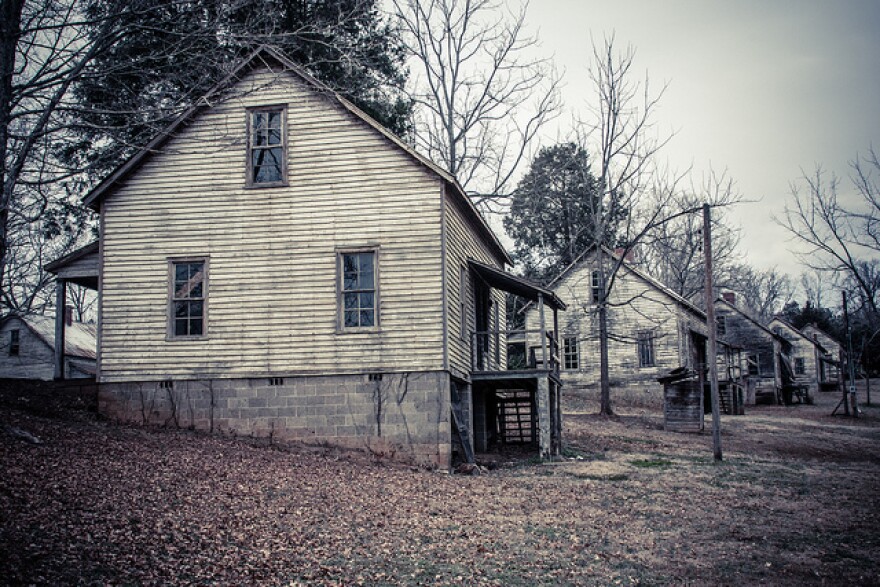
Danny and Ralphie Glick do not return from their sojourn to Mark Petrie’s house. Their parents are at turns furious and terrified. Mr. Glick begins to retrace his sons’ steps when Danny stumbles out of the woods. He seems drugged, but unharmed. He does not remember anything, only that something bad happened. A week later, Danny is found collapsed in the hallway of his house. He is rushed to the hospital. Meanwhile, a search party combs the woods and surrounding area. There is no sign of Ralphie to be found.
Straker pays Larry Crockett a visit. He gives the real estate man orders to pick up a collection of antiques that are to be taken to the store in the middle of town. Included in the haul is a valuable Hepplewhite sideboard that is to be taken to the Marsten House and locked in the basement. Larry sends Hank Peters and Royal Snow in a truck to do the work. At the Marsten House, Hank Peters sees something he wished he hadn’t.
Short and sweet selection today, no?
Danny Glick’s mystery “illness” is a standard trope of the vampire novel. In Bram Stoker’s Dracula, poor Lucy Westenra is fretted over and diagnosed with any number of causes for her paleness, lethargy, and giant canine teeth before Doc Van Helsing shows up. We, the readers, of course, know the cause, and we spend page after page yelling at the characters to throw garlic and crucifixes around the room, and if Lucy doesn’t like it, tell her to lump it! We’ll see if Danny Glick fares better than ol’ Lucy. Maybe he’s just a little anemic.
You know…if I haven’t missed my guess, then Larry Crockett is not 100% on the up and up, is he? In Section 3, we get a detailed look at Larry’s finances and how he accrued his money. Whenever I see a trailer park, I often think of this section and how Larry skirted around not only the Lot’s zoning laws, but also the general business ethics of selling homes to the elderly at usurious rates. Watching Larry sweat it out when Straker comes calling is always enjoyable. What a jerk!
The section detailing the picking up and delivering of the furniture is another of those classic moments where the reader is ahead of the characters. That’s not just a sideboard that Hank and Royal have to take to the Marsten House, is it? I don’t think so. Hank Peters doesn’t really think so either. He notices that the big box and the invoice are missing their custom stamps. I wonder how they get into the country then?
One detail that the keen reader may notice is showing up here and there throughout the novel so far is the presence of rats. Dud Rogers, the custodian of the town dump, shoots rats by the truckload in the hills of trash. Here, Hank Peters and Royal Snow are warned by the guard at the docks to take care of the rats in the warehouse:
“You want to watch out when you go in there. Turn on the lights. There’s rats.”
“I’ve never seen a rat that wouldn’t run from one of these,” Royal said, and swung his work-booted foot in an arc.
“These are wharf rats, sonny,” the watchman said dryly. “They’ve run off with bigger men than you.”
Later, after delivering the sideboard (yeah…right…a sideboard), Hank thinks he sees a pile of clothing that matches the description of what Ralphie Glick was wearing when he vanished. He tells Larry about it, but ol’ Lar calms Hank’s nerves with 50 bucks and a shot of Johnny Walker. That night, in bed, Hank has a dream of giant rats pouring out of Hubie Marsden’s open grave.
Keep an eye out for more rat references.
One last thing before I dismiss class for the day — I love the mention of “girlie books from Sweden.” It’s part of a joke that Royal plays on Hank at the warehouse. He reads the invoice aloud, stating that the boxes they are picking up contain, amongst other things, Scandinavian pornography. This was a longstanding trope in American books, movies, and TV. Back in the 1950s and 1960s, movies began to flow out of Sweden that were much more sexually liberated than what Hollywood was putting out. (Pun intended!) These movies offered audiences views of nudity and sexual mores that they just couldn’t get elsewhere. Magazines like Time also painted a portrait of Sweden as sexually hip by reporting on the so-called epidemic of unwed mothers, abortion, and sexual promiscuity happening in the fjords. (Here's a link to the 25 April 1955 story.) After a while, the stereotype of “Swedish porn” was ingrained in the American consciousness, and it became ubiquitous in pop culture.
That’s it for today. As I said, we kept it short and sweet. Tomorrow is the first of our “free days,” so no reading to do. Instead let’s talk about the influences on Stephen King’s decision to drop vampires into small town America.
The town, from sunup to sundown. We see the townsfolk at work and at play. We meet several characters, some will figure largely in what is to come, some will remain only shadows:
A boy despises getting up and going to school. A milkman makes his deliveries, dreaming of the day he can retire. A woman eats her breakfast and plans her day of work in her boarding house. A young mother screams at her crying baby. A man finds a dead dog hanging from the cemetery gates. The town drunk has a moment of clarity. A boy stands up to the school bully. A man shoots rats at the town dump, imagining them to be the people who bedevil him. A real estate agent thinks about deals with the devil. A woman gets her hair done. Another woman has an affair. A writer sits at his desk. A high school teacher listens to rock’n’roll in his car. A man meets the parents of a woman he is dating. A bartender spreads a little gossip. Two boys meet their fates in the woods off the beaten path. A woman sits in her house and spies on her neighbors. A man stands in the local cemetery and makes a dark sacrifice.
You see now why I had you read Chapter 3 as a whole?
There are four chapters called “The Lot,” and they are each really fine examples of how to build a large setting and people it with loads of characters that make it come to life. Each Lot chapter will give a bird’s eye (or bat’s eye, amirite?) view of the town. In this first of the four, King creates twenty vignettes — some only a few paragraphs in length, others unfurling themselves over several pages — that stitch together a tapestry of who the people who live in ‘salem’s Lot are like. We get a taste of their dreams and desires, as well as their regrets and disappointments. We find some of them pleasant — the milkman, Win Purinton, for example, just wants to retire, so he can sleep in and then go fishing with his dog. Others, like Sandy McDougall and her abuse of her infant son, Randy, are painful to read about. Yet, sadly, that is life.
At this stage in the game, we are unsure who is important and who is just included for “local color.” Obviously, Ben and Susan are main characters. Ben visiting the Norton home is a nice section. What about Hal Griffen, the boy who hates his teacher’s pet brother as much as he hates school? How about Charlie Rhodes, the driver and wanna-be dictator of Bus No. 6? Or the hanky-panky that Bonnie Sawyer and Corey Bryant are engaged in behind Bonnie’s husband’s back? Is all of that important to the story? We don’t know yet, but all of these vignettes make up a tasty Whitman’s sampler of character and setting, and I love them all.
There are a few of these snapshots that are connected. Larry Crockett, Ben Mears, Matthew Burke, and Mabel Werts all notice activity at the Marsten House. Each of them has their own reaction to said activity. For Mabel, the town gossip, she is looking for the freshest, hottest tea to spill. Both Ben and Matthew, an English teacher at the local high school, seem aghast that someone should be living there. We know Ben’s reasons, but for Matthew, the shock is that of a long time resident seeing something new under the sun.
Larry Crocket, ‘salem’s Lot’s real estate agent, on the other hand, sees the car in the driveway of the Marsten House and suddenly feels very uneasy. Larry, we learn, had sold the local haunted house and one of the empty businesses on Main Street for one dollar to a very strange man, a certain Richard Throckett Straker. Why would Larry cut such a lopsided deal? Well, Straker seems to know exactly how to play Larry’s like an accordion, and the tune he squeezes out could be “For the Love of Money” by The O’Jays. The thin end of the wedge is slid into place so cheaply.
Another section that may or not be connected to the goings on at the Marsten place (but we just know it is) is the finding of the dog at the Harmony Hill cemetery by Mike Ryerson. It is a grisly scene. Mike thinks it’s the work of vandals, while the local bartender Delbert Markey seems to think it’s Satanists. We’ll have to wait and see which one is right.
But we already know the answer to that question, don’t we kiddies?
Sections 18 and 20 neatly go hand-in-hand, and together they are the high-water mark of Chapter 3. The taking of the Glick boys is chilling, because it plays on so many fears — for both the child and the adult. How many times as a child did you take a shortcut you shouldn’t have taken? Or how many times did you tease a younger sibling with images of that old stand-by quicksand and threats of “They’re gonna getcha!” How many times did you hear a stick break behind you or something rustle through the underbrush to your left and wonder if someone…or something…was there, watching, waiting? Now, let’s take it from the perspective of Danny and Ralphie’s parents. How often do parents think that their children are in danger when they leave the house at night. Even if they are only going across the road or down the street, doesn’t your imagination sometimes bring up dark images (such as the “sex preevert” Danny heard adults talk about) that make you shout just as the door closes “Call as soon as you get there!” Suffice it to say, this is waaay before cellphones. If you wanted to be a helicopter parent, then you had to hire a helicopter.
We’re back at Harmony Hill for Section 20. Whatever happens here, happens at the stroke of midnight. One of the appendices to the Illustrated Edition of ‘Salem’s Lot includes different edits to certain scenes throughout the book. It’s like getting an extra on a Blu-Ray showing scenes that didn’t make the movie’s final cut. For this scene, we get more of a back-and-forth between the dark figure making its sacrifice and whatever it is that is being sacrificed to. It’s spooky, to be sure, but the scene as is, with its ambiguity — we only get a bit of breeze and the smell of carrion — plays much better.
One last thing I’d like to touch on — and, no, I am not referring to Larry Crockett’s choice of reading material (Satan’s Sex Slaves? Yowza!) — is the concept of the party line. In Section 19, Mabel Werts, town busybody, picks up her phone and listens in on a conversation. Mabel lives alone. It’s not like there was somebody else in her house using a phone in another room. I grew up in a house with two phones. One upstairs, the other downstairs. If a friend called me and someone else answered the phone, I’d have to make darn sure that that other phone was properly hung up before starting my conversation.
No, what Mabel is taking advantage of is what used to be known as a “party line.” A party line (also known as a multiparty line, shared service line, party wire) linked together several separate houses — sometimes entire neighborhoods — with a single telephone line. For many, this type of service was cheaper than getting an individual line. During the Second World War, party lines were the only service available due to wartime rationing and shortages. Privacy was impossible, but party lines did make it easier for areas to be made aware of emergencies, such as fires. Subscribers were urged to use the line responsibly. Many services asked that people only spend five minutes on a call. How did you know if a call on the line was for you and not one of your neighbors? Some services offered specific rings on the line to signal specific users. It was not a perfect system, as Mabel’s use of the service underscores.
That’s all for today’s class. Come back tomorrow and please read Part 1, Chapter 4: Danny Glick and Others, Sections 1-7. This is short selction — at least shorter than today’s reading. We’ll find out what Danny Glick saw (or didn’t see) in the woods. We’ll also learn more about Larry Crockett and his crooked real estate dealings. And we’ll actually go into the Marsten House. I wonder what we’ll find there?
Go straight home after class, kiddies. Stick to the roads. And if you are going to listen in on the party line late at night, remember to…
After a brief overview of the town and its history, we follow Susan Norton to her house. She is excited about her date with Ben. Her mother, Ann Norton, is less so. The two argue, but nothing is resolved, and an unease settles over the house.
Later, returning from their date, Ben and Susan discuss the Marsten House. Susan is shocked to learn that Ben tried renting the house and is even more shocked to learn that he was unable to, because someone had already bought the ramshackle building. Ben tells Susan about an experience he had in the old house as a child.
Section Four of this chapter is a bit like those shots in a movie where the camera goes up into the air and gives the viewer a bird’s eye gander at the characters and their landscape. Unlike those shots, this description of the town and its residents is necessary and not at all dumb. (Sorry, filmmakers, but just because you have access to a drone doesn’t mean you should use it.)
King’s description of the town both physically and temporally reminds me of Robert Persons’s 2009 documentary/poem General Orders No. 9. Persons’s film, a Chris Marker-esque rumination on the State (and state) of Georgia, is about the loss of identity and innocence as life moves from the rural to the urban, or as Persons’s says in the film as “deer trail becomes Indian trail becomes county road becomes interstate.” The narration for the film has been transcribed as a poem here, and there are a few stanza’s at its beginning that resonate with King’s writing on ‘salem’s Lot:
Where the roads of the county intersect, there is a town.
The town is at the center of the county.
From the center, the town extends
for one mile in every direction.
It’s a pattern, a pattern of point and periphery,
star and satellite, being and witness.
The courthouse is at the center of the town.
It’s a brick building on a granite foundation.
It has a clock tower and a weather vane.
The clock tower has four faces
addressing each of the principle directions,
and the weather vane is high above,
brutal in its aspect and high in the air.
The building stands in the middle of the square
and the square is formed by four streets
running north and south, east and west.
Here, there is a sense of order
from above and below, from within and without.
This shall be the center post of the world,
the pillar of Heaven…
Section Four’s history and geography lessons speak not to Persons’s melancholy over the dissolution and desolation of the small town solute in the big city’s solvent. Indeed, King suggests that towns like the ‘salem’s Lot seem to exist outside of time, and that innocent, solitary existence may be dangerous:
“…the Lot’s knowledge of the country’s torment was academic. Time went on a different schedule there. Nothing too nasty could happen in such a nice little town. Not there.”
From the macro to the micro…
Susan and her mother Ann. What a pair they are, huh?
As someone who has lived with his parents at various times as an adult, I can attest to the friction that can arise under such cohabitational conditions. It’s helpful having a place to get your bearings again in the short-run, but as time accrues both parties just tend to get on each other’s nerves. It's just natural.
We will get more of this mother-daughter relationship as the novel goes on, but for now can we take a moment to pour one out for the host of The Hollywood Squares, the tv show Mrs. Norton is watching as Susan bursts in?
Peter Marshall was born in 1926 and was one of those entertainers who seemed to be everywhere doing everything. He was a night club performer, an actor, a singer, a radio personality, and, as I knew and loved him, a game show host. He hosted The Hollywood Squares from 1966 to 1981, going toe-to-toe with such celebrities as Buddy Hackett, Marty Allen, Wayland Flowers and Madame, and, of course, the king of the tactically important center square, Paul Lynne. Marshall died at the age of 98 just this year.
Driving home from the movies, we get an interesting moment between Ben and Susan where the history of the Marsten House — especially that day when the bodies of Hubert Marsten and his wife Birdie were found — is presented to us. Who is telling us this? Is it the unseen, informal third-person narrator? Is this from Ben’s perspective — he’s done an awful lot of research on the house, we will learn. Are these Susan’s memories of all the hearsay and rumors that have been told about the incident? There is a paragraph set off in parentheses just before we are dragged back to the interior of the car where we are definitely in Susan’s mind. Or is it the town itself telling us of the horrors of the Marsten House — free-floating rumors and legends and memories coalescing for a moment in a Citroën on the Interstate? Who knows?
Ben, we also learn, is not just sightseeing in the Lot. He’s there to write a book, sure, but he’s also hoping to exorcise some personal demons. The story he tells Susan about breaking into the deserted Marsten House as a nine-year-old is a doozy. It reminds me of an experience I had as a kid. The house in question, however, wasn’t the town spook house, but was my own.
I was left home alone one day. My parents took my sister somewhere or other. My youngest sister wasn’t born yet. I had some friends over, and at some point one of them freaked out because they thought they saw someone in one of the bedrooms. We all screamed and ran outside, trying to get a hold of ourselves. We snuck back to the house, and I stood on tip-toe to peer into one of the windows. As I did, a hand on the other side reached up and tried to grab me. I screamed, and my terror spread to my friends, and we took off again.
Later, after my parents returned home, I checked out the bedroom in question and discovered that the person my friend thought she saw was really just a pile of clothes on a bed. And the hand that tried to grab me? Well, glass is a reflective surface. When I'd tried to look into my house, I had to put put my hands up in order to see clearly. The hand that wanted to get me was a reflection of my own. Like the nine-year-old Ben Mears, my imagination was so juiced up that it was ready to turn anything — even my own hand — into a monster.
Señor Wences...nooo!
On that note, let’s call it a day. I’m letting you out of class early, because you have a lot of work to do for tomorrow, kiddies! No foolin’ around after school for yunz guys. I want you to be prepared to discuss Part 1, Chapter 3: The Lot (I).
I feel I would be remiss if I didn’t offer a “Content Warning” for this next chunk of reading: there are descriptions of child abuse in Section 5 and animal abuse in Section 6. Read at your discretion!
So, there you have it. Not only do you have 40 pages to get through, but some of those pages are kinda oogie. But it's like I always say...sometimes you just have to...
It is 5 September 1975, and writer Ben Mears is doing what Thomas Wolfe said couldn’t be done: he’s going home again. It’s been 25 years since he was last in Jerusalem’s Lot. He only lived there for four years at that, but in that short span of time the town had placed its mark on him. Arriving, he happily finds that much is unchanged in the Lot. One thing that remains and seems to have a preternatural hold on his imagination is the local haunted house: the Marsten House.
We cut to almost a fortnight later, and Ben is out walking in the park and meets a young woman reading one of his books. This is Susan Norton, and she and Ben hit it off. They head to Spencer’s for some ice cream sodas and to reminisce about the Lot.
Watching them from afar is the local constable Parkins Gillespie and his deputy (part-time) Nolly Gardner. Nolly notes that Susan’s current boyfriend, Floyd Tibbets, won’t like hearing about her going around with another man. Gillespie mentions that Ben tried to rent the Marsten House.
Well, like I said yesterday, we are starting the novel proper today.
We get a quote — the quote — from Shirley Jackson’s famous novel, The Haunting of Hill House, to set the tone for Part One:
“No live organism can continue for long to exist sanely under conditions of absolute reality; even larks and katydids are supposed, by some, to dream. Hill House, not sane, stood by itself against its hills, holding darkness within; it had stood so for eighty years and might stand for eighty more. Within, walls continued upright, bricks met neatly, floors were firm, and doors were sensibly shut; silence lay steadily against the wood and stone of Hill House, and whatever walked there, walked alone.”
Brr! Spooky!
As we will learn, ‘salem’s Lot has a Hill House of its own, but I think King is using the quote to describe the town as a whole. Things may look sane and neat in the Lot, but something — not sane, not neat — stalks its streets.
We aren’t told outright, but I think we can add two and two together and come up with the “man” in the prologue is Ben Mears. (No sign of the “boy” yet.) Ben is engaged in the act that all of us attempt when we return home after a long period away. He’s trying to make two pictures taken years apart match up. The first is the ‘salem’s Lot of his childhood, the second is the Lot he finds 25 years later. In Ben’s case, he can slide his memories of the Lot over his present reality like a transparency on an overhead projector (remember those?) and find little difference. Lord knows I’ve played the “Do you remember…” game enough whenever I make it back to Western Pennsylvania. It can be pretty terrifying to discover just how impermanent the people, places, and things of our youth really are.
I like that the choice of car for Ben is a Citroën. Citroën is a French car company founded in 1919 by Andre Citroën (natch). We don’t know what model and year of the car Ben is driving, but that’s not important. What is important is that it’s a foreign car, not a good ol’ Amurrican gas-guzzling, muscle car. Later in the novel, much will be made of Ben’s masculinity (or perceived lack thereof). The fact that he drives a vehicle that is coded as “other” and “unmanly” and “un-American” is just another marker that places Ben on the outside looking in when it comes to ‘salem’s Lot. We will come back to the choice of vehicle for Ben when we talk about Tobe Hooper’s 1979 made-for-tv mini series.
(If you want a little more on the topic of cars and masculinity, maybe you wanna […cough-cough…shameless self-promotion…] read what I had to say about Steven Spielberg’s 1971 film Duel? You can find it on this blog here.)
We get a “meet cute” scene in the park with Ben and Susan. We also get a King staple: the writer who does not read “literary fiction.” Ben is reading a paperback Western, not a Philip Roth or William S. Burroughs or Thomas Pynchon, when he goes over to introduce himself to Susan. We’ll get more on Ben’s literary ambitions and his thoughts on the current state of literature later, but for now we get a sense that Ben is the unpretentious sort. I often wonder what book he was reading, though. Maybe a Zane Gray? Or Louis L’Amour? Or perhaps an Elmore Leonard?
At Spencer’s, over ice cream sodas, we get a strange exchange between Ben and Susan:
“I was born the year of the fire,” Susan said. “The biggest damn thing that ever happened to this town and I slept through it.”
Ben laughed. “That makes you about seven years older than I thought in the park.”
It is 1975. The fire, we will learn, happened in 1951. That makes Susan 24 years old. Ben is admitting that he thought she was 17 when he saw her in the park. He is 32.
There’s another exchange between the two that makes up for the creepiness of the above. Ben asks Susan to the movies. She accepts, and he asks what kind of movies she likes. “Something exciting with a car chase,” she replies. Bless you, Susan Norton, you are a woman after my own heart!
Much in the same way that I like imagining Ben’s choice of Western reading, I often wonder what movie Ben and Susan decided to see. Theatrical distribution was completely different 50 years ago. Movies moved slower through the cultural bloodstream. Maybe they went to see Jaws or Shampoo? Dog Day Afternoon wouldn’t open for another week, and One Flew Over the Cuckoo’s Nest was still a couple of months away from release. Or…maybe they went to see a movie that had only come out the week before…
We close out today’s reading with the town constable. Through him we get a sense of how like a fish bowl the town is. Sitting on the steps of the Municipal Building, Parkins Gillespie can see the comings and goings of just about everyone in the middle of town. This visibility will play an important role in the what is to come. Gillespie seems to know an awful lot about what is happening behind the scenes. He knows that Ben has three books in the library. He knows that Ben tired to lease the Marsten House. (“What is he, crazy?” Nolly says to that.) And he knows that Larry Crockett, the town real estate agent (who we will meet later), has been a busy bee lately. In a town with less than 1,500 people, it is difficult to fly under the radar. People are curious, and people will talk. The way that information is gathered and dispersed is of the utmost importance in this book. This information is a type of currency. There are things in the town’s past that only a select few know. But there are also things that no one knows. There are secrets in ‘salem’s Lot. Dark secrets. Secrets that may ruin individual people and the town as a whole.
Quick little observation before we break for the day. These are New Englanders, so they speak in a certain way. King (as a native New Englander) captures this patois really well. When Nolly asks Gillespie where Ben Mears is living, the constable replies “Down to Eva’s.” Not “Down at” or simply “At,” but “Down to Eva’s.” I find that grammatically fascinating. We will get more of this New Englandese throughout the novel, and I’ll try to catch it and point it out. Maybe we could all trying using it in our day-to-day conversations? For instance, if you ask me where I rent movies from, I’ll tell you “Down to Cinefile.”
That’s enough for today. The end of class bell is about to ring. Come back tomorrow, and we will discuss Part 1, Chapter 2: Susan (I), Sections 4-8. This is another quickie selection, only 18 pages.
A man and a boy (who are not father and son, though many people think they are) travel a southwesterly route across the United States from New England to California. They stick to secondary roads, making extended stops here and there along the way. Whenever and wherever they stop, the man is sure to track down a copy of a Maine newspaper, the Portland Press-Herald. He scans this newspaper for stories concerning a small town called Jerusalem’s Lot. The boy does his level best not to look at the newspapers and won’t talk about the town at all. The man is a writer — or was one a long time ago. While they travel, he writes the first draft of a book. His agent sells the book, and with the advance, the boy and the man cross the border into Mexico.
While living in a small town south of the border, the boy decides to be taken into the Catholic Church. Soon thereafter, the man finds a story in the Press-Herald that scares both him and the boy. Its headline reads “Ghost Town in Maine?” It is about Jerusalem’s Lot, or ‘salem’s Lot as it is colloquially known. What disturbed the article’s writer, as well as the man and boy, is that it seems as though the people of ‘salem’s Lot simply walked out of their homes and disappeared. Authorities can find no traces of many of the town’s former resident. Those that can be found refuse to discuss the reasons for their leaving, refuse to talk about or even mention the town.
A few months later, the boy makes his first confession to the local priest and confesses everything. The priest is troubled by what the boy has told him, about what he says the man and he did back in Maine. The priest speaks to the man about it. The man assures him that it is all true. The priest asks what the man plans to do about it. A week later, the man and boy begin the long journey back to…
See…didn’t I tell you this first day would be easy going?
I like a book that begins at the end and goes back to the beginning, as this one eventually will with the start of the next section. I like being in the dark about the characters and their motivations. It’s like seeing an artist begin a painting. We see only the faintest outlines of the subjects and their backgrounds, but those rough designs enough to draw us in and want to see more.
King does that here — we don’t have names, we only know we are dealing with a “man” and a “boy.” They are not related. How, then, did they fall in with one another? Why are they on the run? Why is the boy so averse to talking about ‘salem’s Lot? What have they done back in that small town that is so terrible? So many questions! And they are all delicious.
I am also a big fan of the inclusion of other media in a story. In his first novel, King filled out the sad tale of high school scapegoat and telekinetic Carrie White with snippets from other books, television interviews, magazines, official reports, and the like. It’s like a literary mosaic that allows us different points-of-view. Here, King gives us a newspaper article from the Portland Press-Herald. Now, in all honesty, if I am going to be one of those people who loves to pick nits, I’m going to say that the language and structure of this article isn’t exactly newspaper-like. It gets a little florid here and there — referring to the increase in population as “a gain of exactly 67 souls” seems a bit fancy. If this is from a Sunday supplement, then I’m willing to go along with it. Regardless, this article does a fine job of giving an outsider’s view of the situation in ‘salem’s Lot. We have no idea what is happening there or why, but it seems that it is something very odd. This is a nice initial peeling away of the first skin of the onion that is ‘Salem’s Lot.
There is something else that happens in this article that I really love — the use of local legend. In the second paragraph of the article, the writer equates the emptying of ‘salem’s Lot not only to the ghost towns of the Old West, but to a strange disappearance much closer to home: the town of Momson, VT. It’s such a throwaway little story, that it feels true. Those of us old enough to remember the television series In Search of… will immediately hear host Leonard Nimoy read this paragraph. If you try to look for any official mentions of Momson, however, you’ll find that King just made the whole thing up. This brief tale adds a little spice to this prologue. Its strangeness is another lens through which we can view what is to come.
Let’s see…what else should we talk about?
Younger readers may question how the man in the story is able to get copies of a Portland, ME, newspaper across the country. As someone who used to work in bookstores (and was the Newsstand Lead in quite a few of them), I can assure you that there was a time — back when physical newspapers were an important source of information and local identity — when you could have copies of just about any newspaper in the country sent to you, either directly or through a service. I used to love reading the Chicago and Seattle newspapers at my old job. Newspapers were a wonderful window into those other cities. I don’t get the same…frisson…with the internet.
One other person that gets mentioned: Wolfman Jack.
Robert Weston Smith was a radio disc jockey for thirty years beginning in the early 1960s. Adopting the name “Wolfman Jack” due to his love of horror movies, Smith was hired by one of the “border blaster” radio stations that sat across the border in Mexico. These stations broadcast on 150,000 watts (three times what was used in the U.S.) and could be picked up all over North America, even going as far away as Europe and the Soviet Union. Thus, I find it strange that the man and boy only sporadically are able to pick up the Wolfman’s show on their radio. C’mon! He was the world’s DJ, baby!
Later, Wolfman Jack would record his show in his offices on Sunset Boulevard, Hollywood, CA, and syndicate it to stations all over the country. He became popular enough to make appearances in movies and television, including, George Lucas’s 1973 film American Graffiti, The Odd Couple, Vega$, Married…with Children, as well as regularly hosting the TV musical variety series The Midnight Special.
That’s enough for our first day of class. I hope this gives you a taste of what you can expect for the rest of the Horror High Howl-idays. (...heh-heh-heh...) Tomorrow, we will start the novel proper. I mean…we get names of characters and everything! So in preparation, why don’t you read Part 1, Chapter 1: Ben (I) through Chapter 2: Susan (I): Sections 1-3. It’s about 15 pages or so. Easy-peasy!