We are getting closer and closer, Blog-o-weeners. Halloween is so close you can almost taste the Charleston Chews and Necco Wafers. Or maybe that’s just the pumpkin spice talking. Studies indicate that ingestion of five or more grams of nutmeg causes acute nutmeg poisoning, which includes giddiness, hallucinations, and feelings of depersonalization. Now, there’s science for ya. Always taking the fun outta things. Why, I’ve been chugging pumpkin spice lattes with extra nutmeg the whole time I’ve been writing this and nothing weird has happened yet.

See! It’s business as usual here at LARPing Real Life! Anyone wanna do the William Tell routine with me?!
Speaking of freaky hallucinations, let’s jump right into today’s Blog-o-ween 2023 entry. We’ve got four stories from a writer who lived and died in genteel poverty eighty years ago, but who has gone on to become one of the most influential artists in the horror and science-fiction genres. Indeed, it seems strange to say that twenty-first century horror owes a large debt to an early twentieth century pulp fiction Anglophile who styled himself after 19th century writers and who wished he'd lived in 18th century, pre-Revolution America. Yet, here we are, and here is H.P. Lovecraft with his ideas about “cosmic horror” and elder gods from beyond time and space and black magic being indistinguishable from science and all that stuff that horror fans eat up across all media: movies, music, comic books, board games, video games, role-playing games, etc.

Any discussion of H.P. Lovecraft and his influence today, however, needs to address the elephant-sized Old One in the room: Lovecraft, the man, was not very nice. And that’s putting it mildly. Name a race, a gender, a sexual orientation, a national origin, attach the suffix “-phobe” to the end, and you’d have a pretty accurate description of Lovecraft. His depictions of African-Americans are disgusting. His portrayal of Eastern Europeans and Asians would put World War One and World War Two propaganda posters to shame. His monsters are thinly veiled (if they are veiled at all) stand-ins for everything that terrified white Americans in the early-20th century.

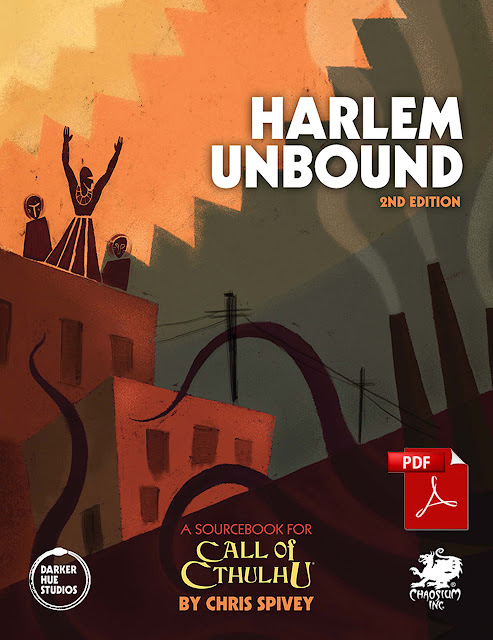
Yet there’s something about Lovecraft's work, his description of the creatures from “outside” our world, and our petty human understanding of them that inexplicably draws people to them. Everyone — be they black, white, gay, straight, men, women, and every point on the spectrum these terms try to define — everyone, it seems, finds something in Lovecraft that they can use in their own work and in their own way. For instance, HBO’s series Lovecraft Country, Victor LaValle’s novel The Ballad of Black Tom, and Chris Spivey’s Harlem Unbound (an excellent sourcebook for the RPG Call of Cthulhu), are all works by black artists about the black experience that use Lovecraft’s world, but not his worldview.

Perhaps one of the ways in which people find a way into Lovecraft’s work is via his overarching sense of “cosmic horror.” The opening paragraph of today’s first short story, “The Call of Cthulhu” (1926), serves as a good definition of what that terms meant for him:
“The most merciful thing in the world, I think, is the inability of the human mind to correlate all its contents. We live on a placid island of ignorance in the midst of black seas of infinity, and it was not meant that we should voyage far. The sciences, each straining in its own direction, have hitherto harmed us little; but some day the piecing together of dissociated knowledge will open up such terrifying vistas of reality, and of our frightful position therein, that we shall either go mad from the revelation or flee from the deadly light into the peace and safety of a new dark age.”
How’s that for an opening, huh?

“The Call of Cthulhu” is told in three parts by a man named Francis Thurston, a Bostonian who is investigating the recent death of his great-uncle Professor Angell in Providence, Rhode Island. The professor’s notes suggest an ancient cult is at work in the world.
The first part of the story, “The Horror in Clay,” tells of a mysterious bas-relief created by local sculptor, Henry Wilcox, in 1925. Wilcox complained of dreams and visions at the time, as did many other local artists in New England.
Wilcox’s creation is similar to a figurine described in the next section, “The Tale of Inspector Legrasse.” Here, the good inspector crashes an archaeological society's symposium and shares his story of a raid on a religious sect in the swamps of Louisiana. Among the items recovered was a figurine supposed to depict the ancient god Cthulhu.
The last section, “The Madness from the Sea,” purports to be the story of a Norwegian sailor, Gustaf Johansen. The sailor tells of the discovery of a hitherto undiscovered island in the South Pacific. There, the laws of geometry and physics do not apply. On that island the men of the ship Emma found an ancient city, and in the middle of that city sat an immense building with a pair of large doors. The doors were opened and out stepped...
You’ll just have to listen to HorrorBabble’s reading of it below to find out for yourself what the sailors discovered behind the doors.

Next up is “The Colour out of Space.” Written in 1927, it is a story told by an unnamed narrator about his attempts to discover the truth behind an area in the hills west of Arkham, Massachusetts. This part of the wild country is known to the locals as the “blasted heath”,and is shunned by everyone. One local, a farmer by the name of Ammi Pierce, tells the narrator the story of Nahum Gardner and a meteorite that fell to earth near his farm in 1882. The meteorite wasn’t just a simple piece of space debris, however. It brought with it something that begins to affect the forest around Gardner’s farm, the crops in his fields, and, finally, Gardner and his family.
What is it that fell from the sky? Why do the scientists that examine it claim that it emits a strange color when it falls outside of the range of anything in the visible spectrum? What are the changes brought upon Gardner and his farm?
Again, HorrorBabble offers an excellent rendition of Lovecraft's story below.

Let’s head over to jolly olde England now and visit the De La Poer family at Exham Priory. They’re a fun bunch, but I hear they’ve been having a problem with rodents.
Written in 1923 and first published the following year in the pages of Weird Tales, “The Rats in the Walls” is the story of an American named Delapore. He’s just come into his family’s ancestral estate. While restoring the old homestead, Delapore hears the scurrying of rats behind the walls. Upon further investigation, Delapore not only learns of a secret passage leading to an underground complex, but he also learns the truth of his family’s history. Like the Sawyers in The Texas Chain Saw Massacre, Part 2, it seems that Delapore’s family has always been in meat.
Guess what? That's right! Our good friends over at HorrorBabble have an audio version available below.

Our last story is possibly my favorite of the bunch. Like “The Call of Cthulhu,” “The Dunwich Horror” (1929) combines scientific jargon, occult rituals, back fence gossip, and factual reporting into a cohesive, dread-drenched story of cosmic horror.
“The Dunwich Horror” takes place in Massachusetts not far from Arkham and its seat of higher learning, Miskatonic University. A family in the backwoods, the Whateleys, have a dark history of necromancy and black magic. Something strange came into the world with the birth of Wilbur Whateley, and it is up to Miskatonic’s librarian, Dr. Henry Armitage, to make sure that whatever it is is sent back from whence it came.
Just what is Wilbur keeping in the old farmhouse? What do the Whateleys need so many cattle — and where do they keep them? Why does Wilbur need Miskatonic’s copy of that ancient text, the Necronomicon?
You can find out by listening to this excellent adaptation by the old time radio show Suspense from 1945. It stars Academy Award winner Ronald Colman in the role of Dr. Armitage.
That’s it for today, Blog-o-weeners. I hope that after reading today’s selections you don’t become too pessimistic and feel that all is for naught. Sure, we may live on a placid island of ignorance in the midst of black seas of infinity, but that doesn’t mean that, come nightfall, we can’t enjoy...pleasant dreams? Hmmmm? Heh-heh-heh!