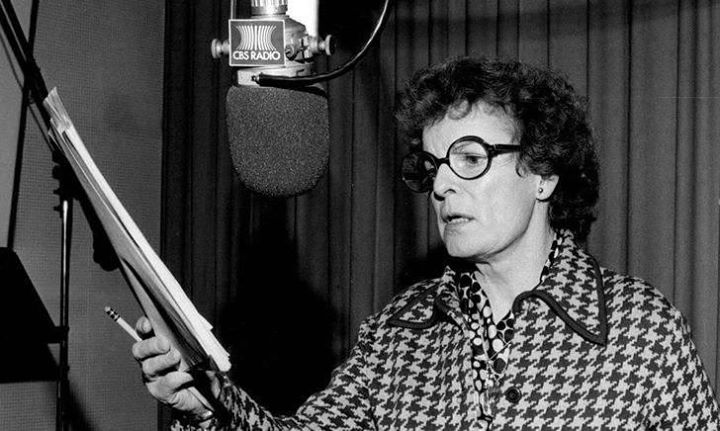
Showing posts with label Lights Out. Show all posts

Thursday, October 27, 2022

Blog-o-ween 2022: Lights Out

Four days, people, FOUR DAYS! Can you believe it? Halloween is right around the corner, and what better way to get in the right frame o' mind than with some old time radio? Today's Blog-o-ween entry is a bit of a return to how we started the month off. Cast your mind back, if you will, and recall that on Day One we listened to a short tale from Arch Oboler called "A Day at the Dentist." Now, that tale was from a 1962 album called Drop Dead!: An Exercise in Horror!, which was a collection of plays that Mr. Oboler originally presented on the radio in the 1930s and 40s. Today, we will be going back to the source, to the show for which Mr. Oboler is most famous, Lights Out.

Created in 1934 by Wyllis Cooper, Lights Out originally began as a series of 15-minute shows on Chicago's WENR, an NBC affiliate. For the two years that Cooper produced the program, Lights Out was often a tongue-in cheek, Grand Guignol type of show. By the time Cooper left in 1936, Lights Out was broadcast nationally and had around 600 fan clubs.

After Cooper left the program, young writer Arch Oboler stepped to the fore. Oboler's work often used stream-of-consciousness narration and highlighted the author's dedication to antifascist liberalism. (In other words, Oboler was woke!) Under Oboler's aegis, Lights Out became radio's premier horror and supernatural fantasy radio program. Even while garnering much praise, Oboler always made sure he credited Cooper for being "the unsung pioneer of radio dramatic techniques."

Oboler left the series in 1938, and the show carried on without him for another year. In 1942, Oboler revived the series, breathing life into the show for another year. Lights Out was revived from time to time over the next few years, using scripts from previous iterations. From 1949 to 1952, Lights Out made the jump to television as a live program. And while there have been many attempts over the years to resuscitate the show on TV, Lights Out remains a program best enjoyed by the ear and not the eye.

For our first episode today, we are going back to the year 1938. Arch Oboler says in his introduction to "Super Feature" (also known as "Monster off the Screen" and "Creature off the Film"):

"Someone asked me what's the most frightening thing in the world. My answer was 'The familiar.' The common, everyday thing that is no longer commonplace."

I think that is an answer that Richard Matheson and Stephen King would understand very well. In "Super Feature," two men bring a motion picture show to a small town. One of the films is a monster movie, but it seems that the silver screen isn't big enough to hold the creature!

Next, we have the story "Knock at the Door" from 1942. It's a tale as old as time: a young woman decides to murder her mother-in-law for gain. If you heard it once, you heard it a million times, amirite? The one difference to this story is the older woman doesn't stay dead.

Our last Lights Out episode is from 1943. It is called "The Dream" (not to be confused with another episode by the same name starring Boris Karloff). A woman refuses to sleep in order to avoid a recurring nightmare about a child asking for his father. Unfortunately, her doctor prescribes sleeping pills, and she soon comes face to face with her fear. What is real...and what is the dream?

Wednesday, October 19, 2022

Blog-o-ween 2022: Boris Karloff

The subject of today's Blog-o-ween entry has got to be the most famous horror icon of them all. If a Mt. Rushmore of Horror was every created, then Boris Karloff's face would have to be included. Not only is Karloff's face instantly recognizable, whether in or out of the Frankenstein Monster's make-up, but Karloff's voice, with its soft yet oddly sinister lisp, is known by adults and children alike thanks to his narration of the Television adaptation of Dr. Seuss's The Grinch Who Stole Christmas. Not only is Karloff the face of classic horror, he is also the voice -- why else would Johnny's (Russell Streiner) impersonation of the venerable actor as he taunted his sister Barbara (Judith O'Dea) in the cemetery in Night of the Living Dead work so well?

Boris Karloff was born William Henry Pratt in Dulwich, Surrey, England (now a part of London) in 1887. In 1909, after leaving King's College London with graduating, he went to Canada where he worked in various fields (sometimes literally as a farm worker) until he began appearing in theatrical performances in 1911. It was at this time that he chose the stage name that would forever follow him in his new career. There are many theories about why he chose the name "Boris Karloff" in particular, but there can be no doubt about why he chose to change his name at all. Karloff was afraid of causing embarrassment to his family with his chosen career. While his brothers were all distinguished members of the British Foreign Service, Karloff felt as though he was the black sheep of the family. It wasn't until many years later, when he returned to England in 1933, that he discovered that his family were very proud of him and considered him a boon to the family, not a bane.

To list all of Karloff's theatrical performances and film, TV, and radio roles would take much more time than we have at present. In fact, to list the movies Karloff made in the twelve years before he became an "overnight" success for Frankenstein would be a feat in itself. Needless to say that Karloff put in years and years of work as a jobbing actor (as well as a ditch digger and construction worker) bfore James Whale saw him in the Univeral Studios commissary eating lunch.

For tonight's first old time radio show, we have an episode of Creeps By Night. In "Final Reckoning," Karloff portrays George Miller, a man released from prison after twenty years who is determined to get his revenge.

Next up is "Cat Wife," an episode of Lights Out. In it, Karloff plays a man who accuses his wife of being a heartless cat (as you do), only to see his words become flesh as she begins a strange and terrible transformation.

Last but not least, we have an episode of Inner Sanctum. Karloff plays a sick man stuck in the hospital. After being dropped off by his son, the man finds himself walking down an long hallway towards a door...a door with his name on it! What will Karloff find behind the door at the end of..."The Corridor of Doom?"

Monday, October 17, 2022

Blog-o-ween 2022: Mercedes McCambridge

Orson Welles, who knew a little something about radio acting (besides scaring the bejabbers out of listeners with The Mercury Theatre on the Air's verion of H.G. Wells's The War of the Worlds, Welles was also the voice of Lamont Cranston, aka The Shadow), called her "the world's greatest living radio actress." Her credits include episodes of Lights Out, Inner Sanctum, This Is Peggy Drake, Studio One, and the CBS Radio Mystery Theater. She worked in film, as well, appaering in Giant (1956), Suddenly, Last Summer (1959), Johnny Guitar (1954), and All the King's Men (1949), for which she was awarded the Oscar for Best Supporting Actress. What she is most well-known for, however, is a voice performance in a film. Her vocal work as Pazuzu, the demon inhabiting young Regan's (Linda Blair) body in The Exorcist (1973), probably scared people as much as the spinning heads and spraying pea soup.

Today, Blog-o-ween shines the spotlight on Mercedes McCambridge.

Mercedes McCambridge was born in Joliet, Illinois in 1916. After graduating from Mundelein College in Chicago, she made the move to New York City where she acted on Broadway. While treading the boards, she also began acting on the radio in the late-1930s. Her radio acting career stretched well-past the sell-by date of the Golden Age of Radio. In the 1970s, she was still appearing on radio drama, acting in Himan Brown's latest auditory offering, the CBS Radio Mystery Theater.

But, really, if anyone today knows Mercedes McCambridge, it is for her work in William Friedkin's adapatation of William Peter Blatty's novel The Exorcist. Utilizing all of the tricks and tools she'd picked up in her 40-year acting career -- as well as some raw eggs, cigarettes, and booze -- McCambridge created the definitive demon vocal performance. Friedkin himself claimed that he bound her to a chair during her recordings to help her get in the mood. When she died in 2004, NPR's Fresh Air offered this remembrance of the actor and her most famous role.

First up in tonight's Mercedes McCambridge appreciation post, we have an episode of Inner Sanctum. “Blood of Cain” is a story of dark family secrets and a chilling legacy handed down through generations.

Next, we have an episode of Arch Oboler's Lights Out called "It Happened." This story concerns a wealthy girl taking a tour of Paris. She becomes fed up with her boring old tour guide and decides to find her own way. Unfortunately for her, she ends up wandering into the sewers and running into...well...that would be telling.

Last, is an episode of the CBS Radio Mystery Theater about that most 1970s of subjects: The Bermuda Triangle. McCambridge plays the sole survivor of a plane that disappeared into "The Triangle."

Saturday, October 1, 2022

Blog-o-ween 2022: "A Day at the Dentist"

Well, well, well...we meet again. It is time for another month-long celebration of the strange, the spooky, and the just plain weird. If you're asking yourself, "Doesn't this blog do that the rest of the year, too?" then I can only answer with a definite...

While we are waiting for the tubes in the ol' Philco to warm up, let's drop the needle on a collection of some of the Golden Age of Radio's most terrifying tales. While there are scores and scores of radio programs that were recorded, saved, and made available for listening, the truth of the matter is that the majority of broadcasts are lost to us. Maybe some lucky sod on a rock orbiting Proxima Centauri got to hear them and was fast enough with the record button on their reel-to-reel (or whatever they got up there), but for us on Earth, we can only imagine what they sounded like. Because of this blasé attitude at the time towards "low" forms of media, some radio producers recreated their most famous programs decades later for posterity. Our first foray into Blog-o-ween 2022 is one such recreation. In 1962, one of the masters of radio horror, Arch Oboler, gathered a few friends together and recorded Drop Dead!: An Exercise in Horror! Let's start spooky season off right with a short, sharp story on side two of that Capitol Records LP. Let's go and spend "A Day at the Dentist."

It's a very simple story: Fred Houseman is in need of an emergency trip to the dentist. Unfortunately for Freddie, he is, like so many people are, a dentophobe - he is afraid of the dentist. He's chosen Dr. Charles's practice, because the good doctor advertises himself as "the painless dentist." Unfortunately (again!) for Freddie, Charles was bought out by a man who knows Freddie and his fear all too well. It seems that Freddie did something in the past to the new dentist's wife, something "very special...worth remembering, worth talking about, worth slobbering over." After the doc has strapped Freddie into the chair to keep him absolutely still - you know...for sake of keeping everything "painless" - the sound of the drill revs up and Freddie's frantics pleadings fill the air. Before you can ask "Is it safe?" the story ends.

We won't spend too much time right now discussing Arch Oboler and his impact on radio (Oboler will appear again later this month), but for now let's just say the man knew the power of suggestion and sound. In his book Danse Macabre, Stephen King singles out Oboler and his radio program Lights Out as the pinnacle of the genre. King says that

Oboler...utilized two of radio's great strengths: the first in the mind's innate obedience, its willingness to try to see whatever someone suggests it see, no matter how absurd; the second is the fact that fear and horror are blinding emotions that knock our adult pins from beneath us and leave us groping in the dark like children who cannot find the light switch. Radio is, of course, the 'blind' medium, and only Oboler used it so well or so completely.

Even though it is only a couple of minutes long, "A Day at the Dentist" is long enough for Oboler to use both of these tricks against the listener. Using sound and suggestion, Oboler first creates the most mundane of settings, a dentist's office, in the mind of the listener. Then, slowly, inexorably, this setting is turned into a theater of pain and horror.

Another strength of Oboler's work in general and "A Day at the Dentist" in particular, is that it forces the listener to consider a few important facets for him/herself. First off, what is it that Fred Houseman did to the dentist's wife, Mary, and what about it was "worth slobbering over?" Second off, where did the dentist apply his drill? Oboler does not offer any concrete answers to those questions. The mind of the listener, however, comes up with quite a few interesting possibilities, but mileage may vary depending on how well he or she understands ol' Freddie's trangressions. As Stephen King says in Danse Macabre,

My first thought was that the dentist had almost surely used the drill on one of Houseman's temples, murdering him with a little impromptu brain surgery.

But later, as I grew up and grew into a better comprehension of just what the nature of Houseman's crime had been, another possibility began to suggest itself. An even nastier one.

Hmmm...what could that be, I wonder? Why not listen for yourself and make up your own mind...