Wednesday, October 7, 2020

It is 7 October. There are 24 days until Halloween.

My reading tastes skew toward horror throughout the year. I’ll throw in a British cozy mystery, a western, or anything Joe R. Lansdale writes from time to time as a palate cleanser, but I’ll always return to the darker, spookier fare on my bookshelves. (And that also includes anything Joe R. Lansdale writes.)

During the month of October my horror reading gets turned up to 11. There are quite a few mainstays in my Halloween reading list, titles that I’ve turned to again and again throughout the years, but I do try to fold in some new authors and works into the mix. 

Here’s what’s on my bedside table – and just about every other flat surface in my apartment. Some of these I read from cover to cover; others I dip into for a scene or two.

I think I am going on at least ten years in a row reading Stephen King's 1975 vampires-in-a-small-town novel, 'Salem's Lot. I love the way he deftly moves amongst the people of the Lot, writing vignettes outlining the terrible things they do, allowing them to accumulate until you get a full picture of the town. Then, he jumps back into the main story without missing a beat. Great stuff!


I had a Horror Literature class in undergrad. One of the stories we read was "Carmilla" by J.S. LeFanu. Very good female vampire story that Hammer Studios turned into The Vampire Lovers with Ingrid Pitt.


This one's another Halloween no-brainer. You gotta read Lovecraft if you're gonna do Halloween right. There's so much Lovecraft in the air, I wasn't sure if I was going to include any this year. But then I thought of "The Dunwich Horror" and knew I had to read it again.


This is bargain bin special I bought when I worked in a corporate bookstore chain that shall go unnamed. I mainly bought it because it included "The Human Chair" by Edogawa Rampo. That Harlan Ellison introduced the story was just an added bonus. Great stuff all around in this collection.


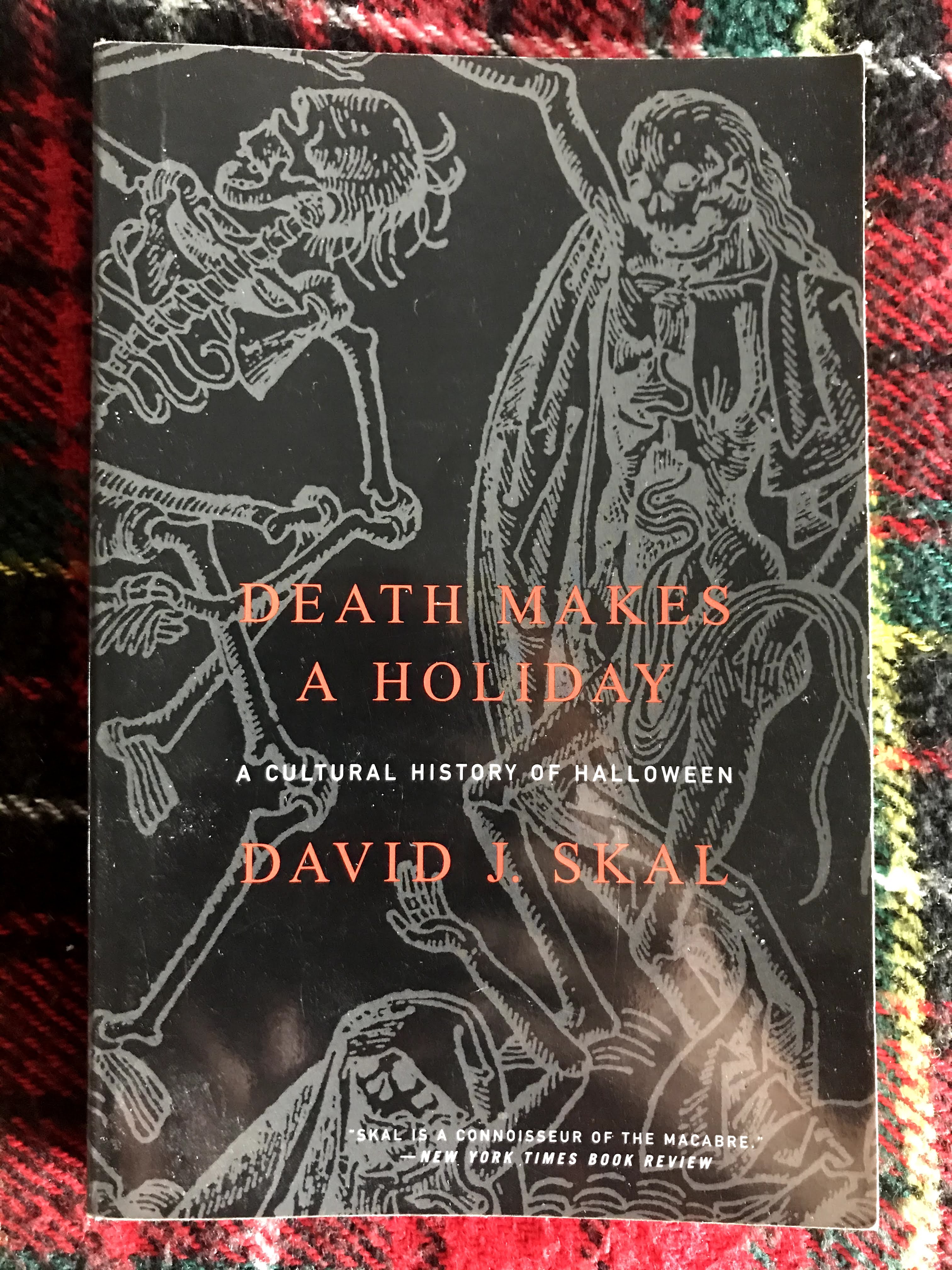
David J. Skal has written at length on spooky movies, so it was only a matter of time until he turned his attention to the holiday made for horror movies. Did you know that at the time this book was written that the only known and documented case of candy tampering was in the 1970s by a Texas father who poisoned his own kids with cyanide in a Pixie Dust straw?


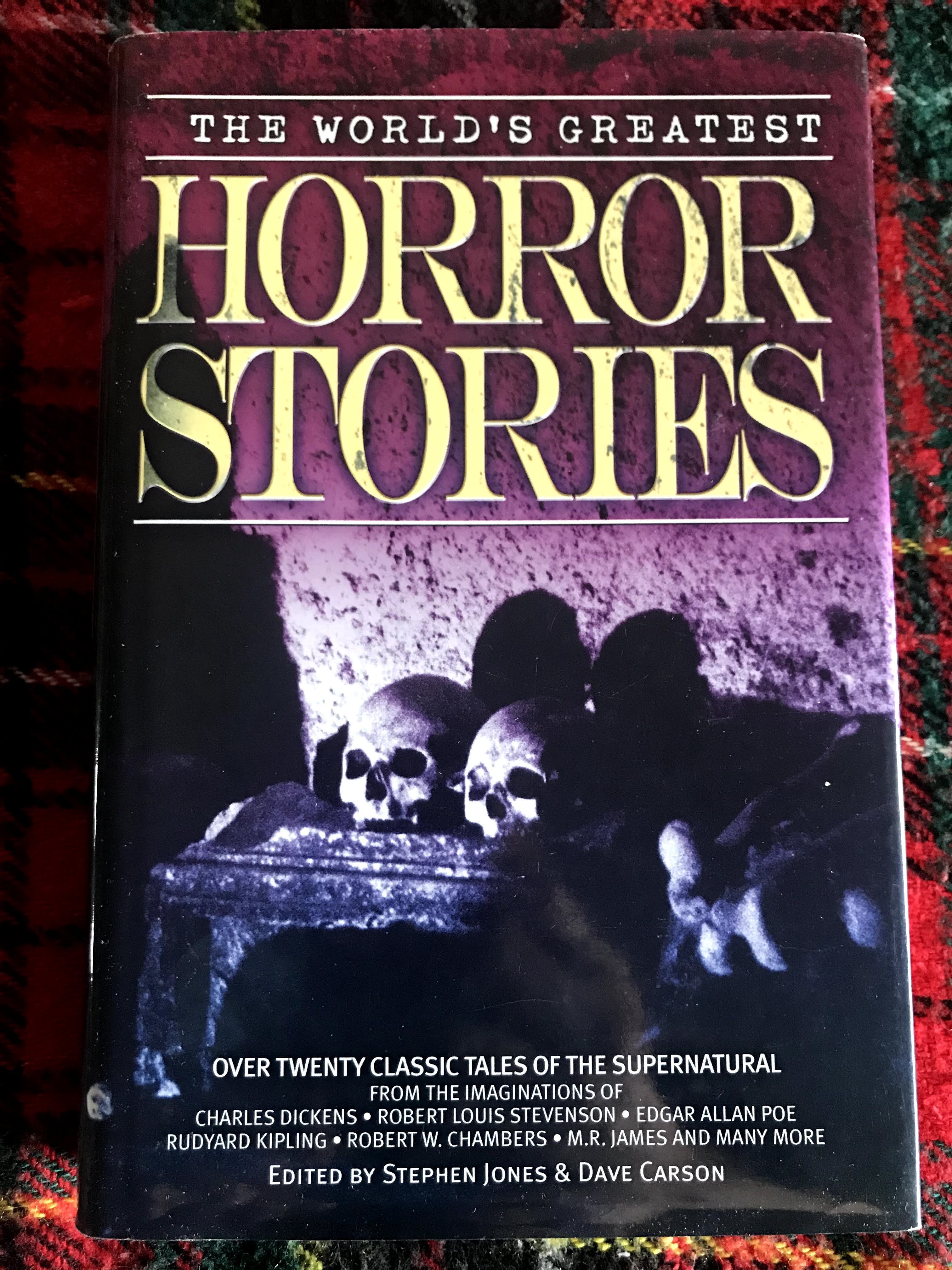
Another bargain bin special. The World's Greatest Horror Stories is actually made up of the stories that H.P. Lovecraft discussed in his landmark essay "Supernatural Horror in Literature." Every story in this collection is a winner, especially E.F. Benson's "Negotium Perambulans."


I mentioned Dark: Stories of Madness, Murder, and the Supernatural in an earlier post. It's worth a second mention. Loads of great stuff here from across the spectrum of literature (with a lower and uppercase L).


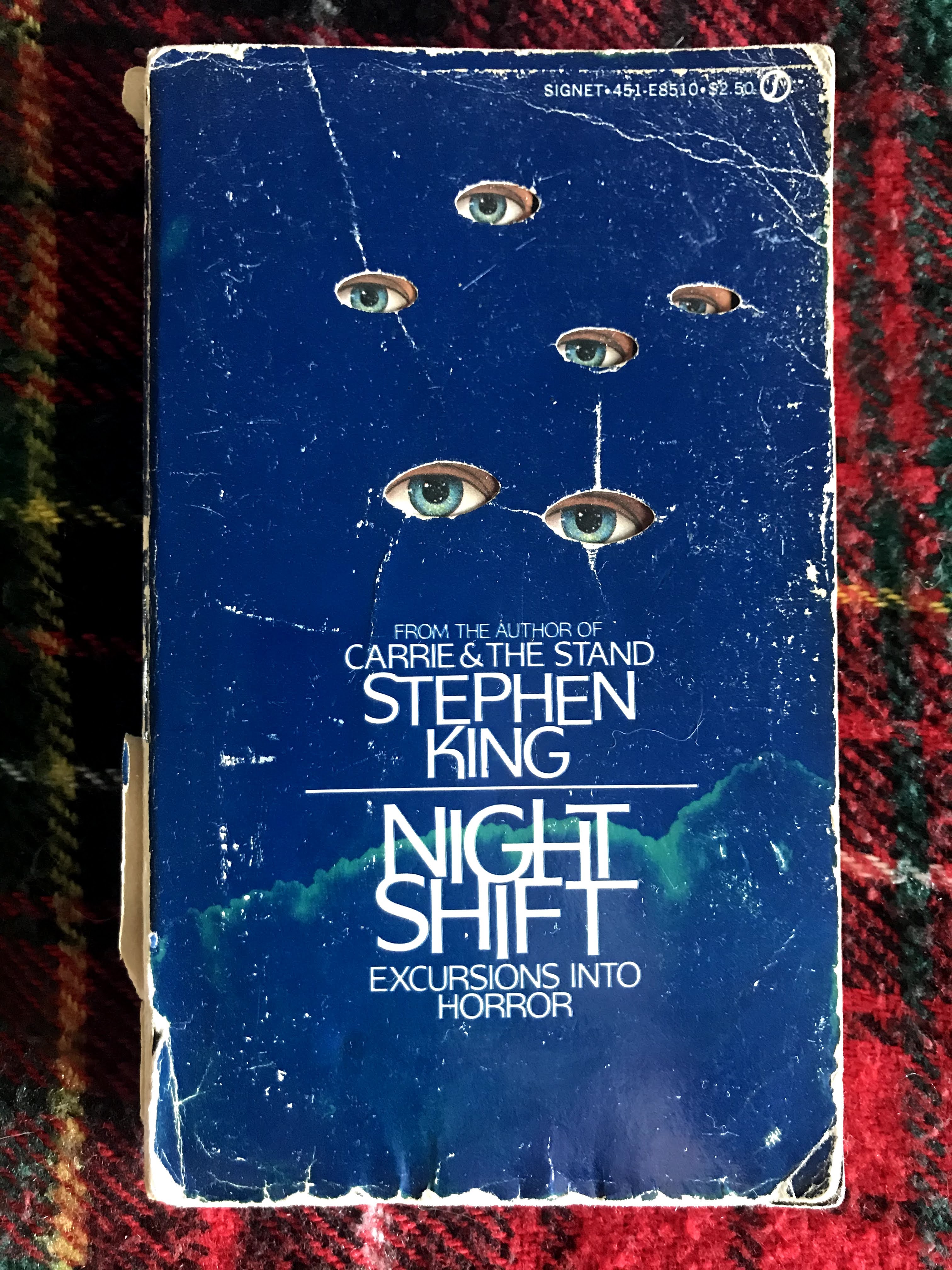
Night Shift is a Paperbacks from Hell special guest star this Halloween. It's been a while since I jumped into these stories, but early Stephen King is a writer who wears his love of the pulps and E.C. Comics on his sleeve.


Plus, get a load of what's under the cover!


I mean...look at it!


Swan Song by Robert R. McCammon is a book and an author that I've never read. I've been sitting on this paperback for quite a while. Time to check it out!


Forgotten Horrors is one of my favorite podcasts. Michael H. Price and John Wooley talk about (mainly) horror films from (mainly) the middle part of the 20th century. The podcast is based on a amazing collection of books that share the same main title: Forgotten Horrors. I've got the first one and it looks at the genre from the late twenties until the end of the 1930s. Great pocket reviews that I aspire to. 


I don't think you can celebrate Halloween properly without these two books handy. They are fun to just pick up and run through a handful of pages, allowing Bradbury's particular style to sweep you off your feet. Also, it always surprises me that he has such a dark vision for a guy who looked like everyone's favorite uncle.


Tuesday, October 6, 2020

It is 6 October. There are 25 days until Halloween.

One of the (many) criticisms levied against television is that it erodes attention spans. That was certainly the case in the 1980s. Growing up, all I heard was people belly-aching that the quick-cut, high-speed editing techniques of MTV and other television networks aimed at “the kids” was weakening the abilities of those who watched their pablum to focus, to concentrate on the task at hand, to…to…

…is that a squirrel wearing a Halloween mask?


Where was I?

Oh, yeah…shortening attention spans…

On the other hand, keeping the attention of MTV viewers taught a generation of writers, directors, and editors to cut the fat, to trim away the unnecessary bits and stick to lean, bite-sized chunks of information. Those unable to reduce what they had to say to a more manageable size dared the viewer to do her worst – to switch channels!

The movie trailer was one such slab of information that needed to be trimmed down to fit on the end of a fork for easy TV digestibility. There was no time to engage in high-falutin’ “artistry.” Not a second could be wasted if you wanted the viewer to look forward to what was coming this Friday to a theater near them!

If you watched TV in the 1980s, then you know that horror was king, and the undisputed champion of the genre was Stephen King. It seemed that everything that King signed his name to was fodder for the movies and TV. In some cases, the 30-second TV spot had more pace, was more exciting, and made more sense than the movie it advertised. Speaking for myself, I know my skin crawled when the TV spot for Maximum Overdrive came on the air. Yeardley Smith screaming “What is going on?!” over that pulsating, synth-driven score made me break out into gooseflesh. Quite a different experience when I actually got to see the movie.

So, let’s celebrate the condensed horrors of the TV spot by looking at how the films of Stephen King were sold to TV viewers in the 1980s. The films themselves were sometimes good and sometimes bad, but the mini movies of the 30-second TV spot were all pure gold.

The Shining (1980), dir. by Stanley Kubrick


Creepshow (1982), dir. by George A. Romero


Cujo (1983), dir. by Lewis Teague


The Dead Zone (1983), dir. by David Cronenberg


Christine (1983), dir. by John Carpenter


Children of the Corn (1984), dir. by Fritz Kiersch


Firestarter (1984), dir. by Mark L. Lester


Cat's Eye (1985), dir. by Lewis Teague


Silver Bullet (1985), dir. by Dan Attias


Maximum Overdrive (1986), dir. by Stephen King


Stand By Me (1986), dir. by Rob Reiner


Creepshow 2 (1987), dir. by Michael Gornick


The Running Man (1987), dir. by Paul Michael Glaser


Pet Sematary ( 1989), dir. by Mary Lambert


Monday, October 5, 2020

It is 5 October. There are 26 days until Halloween.

Those of us who happened to have grown up during the 1980s are usually referred to as the “MTV Generation.” You’ll get no argument from me about that appellation. God knows I spent more than my fair share of time before the television set demanding my MTV.


Decades before the ‘M’ in the name fell silent and it became the “All Ridiculousness, All the Time” network, MTV was where you went to find the newest and hippest music. Granted, MTV was less than diligent in playing music by black artists in its early years (as David Bowie pointed out in his interview with Marc Goodman), but the network learned over time how to pull in music from a (fairly) wide range of genres – alternative music featured on 120 Minutes, Yo! MTV Raps played the latest hip/hop videos, and even the kooky, twenty-year-old schtick of someone like Arthur Brown found room in the rotation.

There was also a time when the ‘M’ in MTV stood not only for music but for monsters, as well. Monster kids had plenty of spooky fare to choose from. Artists from across the musical spectrum used the stars of the creature features for their videos, even if the songs didn’t really have much to do with horror.

Frankenstein’s Monster and his Bride appeared in “Doing It All for My Baby” by Huey Lewis and the News – an 8-minute video with a nearly 4-minute, non-musical lead-in.


For his video “Think I’m in Love,” Eddie Money played a Dracula-like lead character who has his toothsome tables turned on him.


Men at Work delivered a Jekyll and Hyde video (natch) for “Dr. Heckyll & Mr. Jive” that owed more to Jerry Lewis’s The Nutty Professor than the Robert Louis Stevenson story.


Ozzy Osbourne went the Hammer Film Studios route for his video “Bark at the Moon.”

Sheena Easton threw all of the monsters into a blender (including King Kong, the Hunchback of Notre Dame, and Thing from The Addams Family) for her black-and-white, Gothic-flavored video “Telefone (Long Distance Love Affair).”


While these (white) musicians looked to the monsters of the past for their imagery and inspiration, hip/hop artists DJ Jazzy Jeff and the Fresh Prince used a monster of a more recent vintage for “A Nightmare on my Street.”


To be continued next Monday…

Sunday, October 4, 2020

It is 4 October. There are 27 days until Halloween.

One of my all-time favorite pictures is John Carpenter’s The Fog. Sure, it’s a spooky movie, and it’s got POTA (Pittsburgh’s Own, Tom Atkins), but the main reason for my love is Stevie Wayne, as played by Adrienne Barbeau. Why? Because she’s got the perfect job and the perfect workplace, that’s why. Stevie is the sole owner/sole operator of AM radio station KAB (located on your dial at 1340), broadcasting the smoothest of jazz from atop a lighthouse hugging the rocky coast near Antonio Bay, CA.


The fact that she drives a Volkswagen Thing to work everyday and lives in a town where you can get a Stomach Pounder and Coke for lunch is just an added bonus.

While living and/or working in a lighthouse holds a certain amount of romantic appeal, there are numerous dangers. Like Ms. Wayne, you could be attacked by leprous ghost seeking revenge. You could be surrounded by semi-sentient, carnivorous plants that have taken over the world (Day of the Triffids). You and a friend could lose your minds, drink the fuel meant for the light, and kill each other (The Lighthouse). Or, as is the case in today’s featured radio drama, your little island could be overrun by rats. Hundreds, maybe thousands of rats.

What a choice!


It’s a bit ironic when a radio program asks its listeners if they “want to get away from it all,” then proceeds to tell a story filled with such paranoid, insular, cramped, asphyxiating horror as “Three Skeleton Key.” This radio play takes place in a single setting, a lighthouse, but as the action progresses, the setting shrinks until you are trapped along with the men in a single room.

The programs of the Golden Age of Radio had at their disposal a frightening array of actors. Men and women like Boris Karloff, William Conrad, Mercedes McCambridge, and Agnes Moorehead lent their vocal skills to scores of radio drama. “Three Skeleton Key” was performed many times on the air with many great actors (including the aforementioned William Conrad). The version I’ve chosen, stars the one and only Vincent Price. A man more well known to radio audiences for playing the suave Robin Hood-type criminal, Simon Templar, otherwise known as The Saint, Price uses his mellifluous voice to play the rough-and-ready, Jean. As the stakes get higher and the rats get closer and closer, Price matches the terror and horror of the situation. Through him, the listener can feel the vermin that came ashore aboard the unmanned ship nip at their heels.


The tale was based on a short story written by French author Georges-Gustave Toudouze. It was published in 1937 in Esquire, the same magazine that, a year later, would publish another “man vs nature” classic, Carl Stephenson’s "Leiningen Versus the Ants." (Stay tuned to this blog for more on that story!) If you want to read the story yourself, click here for a copy. Click here to listen to the 1950 version as aired on Escape. You can follow along with the script by clicking here. As usual, HorrorBabble offers a wonderful reading of Toudouze’s short story. There is also a short film made from the story over on Vimeo.

This play may not be the usual Halloween fare. There are no ghosts or vampires or anything supernatural, but I’ve always found it to be chilling and terrifying. The sound of the rats gnawing their way into lighthouse will stay with you for good long time.

Now, if you’ll excuse me, I have to jump into my VW Thing and run out to get a Stomach Pounder and a Coke…


Saturday, October 3, 2020

It is 3 October. There are 28 days until Halloween.

I used to work at the circulation desk in a public library. It was a great job to stumble upon new books and music. One day, someone returned an audio book with an interesting cover. It was a close up of a pair of eyes. The picture had the grainy quality of a blown-up photograph. It wasn’t quite black-and-white because there was just the suggestion of blue in the color of those eyes. The light and shadow dappling the face gave it a quality of a Maya Deren film. It seemed to be a collection of ghost stories spooky poems. I recognized some of the names. Intrigued, I quickly checked it in and just as quickly checked it out to myself.


On my day off, I listened to it. I didn’t get very far, because the first story pinned me to my chair. It was by A.M. Burrage, and it was called “Smee.” I’d never heard of either Burrage or his tale. Twenty minutes or so later, and, along with a cold shiver up my spine and gooseflesh on my arms, I felt that A.M. Burrage was a writer that I must know more about.

“Smee” is an example of the “Christmas Ghost Story” that was once so popular in England during the 19th century. It has a simple story-within-a-story construction: a group of friends prepare to play a post-dinner game of hide-and-seek on Christmas Eve. One of the party, Jackson, refuses to play. In turn, Jackson tells the group (and the reader) his tale of why he chooses to play the spoil-sport.


It seems that Jackson had a bad experience some years before at another friend’s house playing a similar game:

‘I wonder if any of you have played a game called “Smee”. It’s a great improvement on the ordinary game of hide-and-seek. The name derives from the ungrammatical colloquialism, “It’s me.” You might care to play if you’re going to play a game of that sort. Let me tell you the rules.

‘Every player is presented with a sheet of paper. All the sheets are blank except one, on which is written “Smee”. Nobody knows who is “Smee” except “Smee” himself—or herself, as the case may be. The lights are then turned out and “Smee” slips from the room and goes off to hide, and after an interval the other players go off in search, without knowing whom they are actually in search of. One player meeting another challenges with the word “Smee” and the other player, if not the one concerned, answers “Smee”. 

‘The real “Smee” makes no answer when challenged, and the second player remains quietly by him. Presently they will be discovered by a third player, who, having challenged and received no answer, will link up with the first two. This goes on until all the players have formed a chain, and the last to join is marked down for a forfeit.’

A simple game, no? Burrage uses the rules of the game – the dark house, the silence, the solitude – to chilling effect. “Smee” has a wonderful ending that, although you see it coming, is still powerful enough to elicit a shudder. Along the way, there are many moments where Jackson and his fellow players rub up against the uncanny and outré. One moment, in fact, on a staircase, involving the accidental (?) miscount of the number of players in the game made the bottom fall out of my stomach. It was described so matter-of-factly that it hit me between the eyes before I knew what had happened.


You can find a copy of “Smee” here. Don’t have the time to sit down and read it? There is a terrific audio reading by the folks at HorrorBabble, and the old South African radio program Beyond Midnight produced a great “modern” version in 1968.

Friday, October 2, 2020

It is 2 October. There are 29 days until Halloween.

Look, I get it. Silent films are hard to get into for the average moviegoer. Even someone like myself – and I studied film in undergrad and graduate school (I’m a professional, folks) – finds the majority of silents to be stodgy, stagey, and so slowly paced you’d rather watch something exciting like paint drying or Major League Baseball.


The silent era comedies are probably your best bet for finding ingress into the world of movies before Al Jolson uttered his first “Mammy.” The works of Chaplin, Keaton, and Lloyd rely on a fast pace and lots of surreal sight gags to keep their audiences engaged. Buster Keaton having a house front fall around his ears is worth any number of histrionic “artistic” performances in other silent films.


So, I get it. Who the heck wants to waste their time on a silent movie?

Well…what if said silent picture had loads of torture, demons, and folks smooching the butt of Satan? 

Got your attention now, don’t I?


The Danish film Häxan: Witchcraft Through the Ages has got the above and a whole lot more. Writer/Director Benjamin Christensen’s 1922 movie is essentially a dramatized documentary about the history of witchcraft and the witch hunting hysteria that swept Europe in the Middle Ages.

Everything about Häxan has got it going on. The sets are gorgeous. All the buildings and rooms look like they’ve been in existence for hundreds of years. The use of color tinting lends of different touch to each of the parts of the movie. The special optical effects are amazing. The scenes of the sabbath, as the witches take flight and cavort with beasts and demons is wonderfully achieved. For a 1922 film, the violence in the movie is disturbing to see, especially the way that pious monks tortured alleged witches into confessing their nefarious (and more than likely non-existent) association with Old Hob.

And if all that isn’t enough for you to click here and start watching, then how’s about you track down the cut of the film that came out in 1968 narrated by William S. Burroughs? 

Talk about scary!


Thursday, October 1, 2020

It is 1 October. There are 30 Days until Halloween.

Halloween has always been my favorite holiday, but not for the usual, popular reasons. I am not, for instance, one of those adults who try to recapture some nostalgic notion of Halloweens past by purchasing every lawn decoration at the store. I don’t like parties, and I don’t like dressing up, so I am not into buying costumes. Aside from picking up a decoration or two to stick in the windows, carving a jack-o’-lantern, and buying a bag of candy just in case a few trick-or-treaters come a-knockin’, I don’t really engage in any outward celebration of Halloween.

That’s not the reason for the season, so far as I’m concerned.

Halloween is the film noir of holidays. It is a celebration of a mood and an attitude more than a specific event or person. As the end of October nears, shadows get a little longer, and the daylight hours get a little shorter. The air in the mornings as you walk to the bus stop (either for school or for work) is crisper and cooler than it was a month before. Sweaters and jackets come out of the cedar closet. The leaves - brittle, sear, and the colors of a 1970s basement rumpus room - fall from the trees to form crackly and crunchy drifts.

Like the colors of the leaves, attitudes become muted in this spooky atmosphere. You won’t find the hope of springtime here or the raucous energy of summer. In the fall, as Halloween approaches, there is a general turning away from our busy “outdoor” lives as we prepare for the slower pace and more introspective nature of our “indoor” lives during the winter.

Personally, I’ve always enjoyed the darker, second half of the year to the sunnier first half. I prefer the hibernation of winter to summer’s hedonism. The quiet and the dark are places and states of mind that allow the imagination to wander, to speculate, to assume the worst. In the autumn, that sound you hear in the middle of the night isn’t the house settling: it’s the step of the thing in the closet. The light in the basement not coming on when you flick the switch isn’t due to a burned-out bulb, it’s the shadow monster dining on the light and hoping to make you dessert.

I’m a horror junkie, so Halloween is that time of year when the trappings of nature finally match my interior mood. The long shadows, cool air, and quiet streets lend an extra layer of creepiness to the movies I watch, the books I read, and the music I listen to. If you feel the same way, if you are tired of seeing Halloween celebrated, in the words of Ebenezer Scrooge about another holiday, as “a false and commercial festival,” then for the next 30 days this blog may be your one-stop shop for everything weird, creepy, and outré.

Wednesday, September 30, 2020

It's the Most Wonderful Time of the Year!

No, just because the stores have started to celebrate Christmas doesn’t mean I have. Christmas stopped being a big deal for me ‘round about the time I became more excited to find a pair of socks in my stocking instead of a Star Wars action figure. The most wonderful time of year that I am alluding to is centered around eating candy, wearing masks in public, watching tons of movies, and getting the pants scared off of you.


Hmmm. It seems that Halloween and life in 2020 have a lot in common. I guess COVID is just another of life’s drear events that horror movies prepared me for.

Normally, I would be spending the coming month posting all sorts of spooky nonsense on Facebook for my friends and family. Having recently left Facebook for good, however, my celebration of Halloween will take place here at LARPing Real Life. So, for the next thirty days, I want to share some Halloween memories, movies, and stories with you.

As someone who read the HBO guide religiously as a kid, marking off every airing of every film that promised adult situations, adult language, and graphic violence, I thought I’d give you a schedule of sorts so you can tune in when you want. Here’s what you can expect for the next month:

  • Thursdays will be all about my personal feelings and remembrances of Halloween.
  • Fridays you’ll get a spooky movie.
  • Saturdays will bring a short story (maybe even one of my own!)
  • Sundays we’ll listen to an old-time radio program or new-fangled audio drama podcast.
  • Mondays we’ll listen to music.
  • Tuesdays are for movie trailers and tv spots.
  • Wednesdays are wild cards. I have no idea what we’ll do!

Honestly, I hope I can complete this project and make it through to Halloween in one piece. Being a very slow writer, this is going to be quite the gauntlet for me. I am, hopefully, setting myself up to succeed. Unlike the other writings you’ll find on LARPing Real Life, my Halloween posts will be short, sweet, and to the point (if they even have one). I want them to be more like the oral tales you tell around the campfire. They won’t be anything you’ll have to spend too much time with, but, hopefully like those fireside stories of old, they’ll affect you and stick with you.

So, get ready, folks, the show is about to begin!


Monday, August 26, 2019

Midsommar

While writing (and writing and writing and writing) my latest post on “Murrain” (Nigel Kneale’s contribution to the 1970s ITV series Against the Crowd), I was struck by how Adam Scovell’s “Folk Horror Chain” manifested itself in Ari Aster’s Midsommar (2019). I just want to quickly share these thoughts in this brief aside before they flit off into the ether. Think of this blog post as being kinda like Dumbledore’s pensieve.


For those of you who are new to the subject, Folk Horror is a genre of film that usually depicts the violent return of pagan rites to a more modern era. Most critics point to the “Unholy Trinity” of films made in England during the late-1960s and early-1970s as the genre’s starting point: The Witchfinder General (Michael Reeves, 1968), The Blood on Satan’s Claw (Piers Haggard, 1971), and The Wicker Man (Robin Hardy, 1975). It can be argued that the genre has a much older tradition – certainly Nathaniel Hawthorne’s short story “Young Goodman Brown” could be seen as being an antecedent to the “Unholy Trinity” – but the films, television programs, novels, and music of the above time period were particularly pungent with an odd combination of a desire to return to a simpler past and a fear of the rituals that past entailed. In short, to paraphrase Kurt Vonnegut, it seems like the late-1960s were just Folk Horror time.


In his book, Folk Horror: Hours Dreadful and Things Strange, critic Adam Scovell theorizes that the genre manifests itself in a particular film in three ways:
  • the use of the landscape and the environment as an isolating influence
  • the skewed morality and belief systems of communities that develop in these environments
  • the violent manifestations that proceed from these belief systems
Each of these elements is linked to the others, so that they form what Scovell calls the “Folk Horror Chain.”

In my review of “Murrain” (which...cough, cough...shameless plug...you can read here), I tried to show the ways that writer Nigel Kneale and director John Cooper play it straight with Scovell’s “Folk Horror Chain,” while at the same time they keep things ambiguous enough to make the viewer wonder if what is happening is real or not. Kneale and Cooper utilize a naturalism in their romanticism (or is it the other way ‘round?) knowing that each of these generic strains will cause fiction (and frisson) with the other.

As I wrote about “Murrain,” I was reminded of Ari Aster’s Midsommar. While I thought that Aster’s film was beautiful if a bit by-the-book, upon reflection, I was struck by how the writer-director also used the “Folk Horror Chain” in unique ways. What Aster is able to do in Midsommar is to equate the violence inherent in Hårga society that Dani (Florence Pugh) and her friends enter with the neglect inherent in the society they just left – America. In a sense, Dani is neither saved nor damned by joining the commune. What she experiences in Sweden is merely the flip side of the coin to what her life in America was.

In Midsommar, the events that unfold at the commune in Hälsingland, Sweden, follows Scovell’s chain very closely. The rural landscape acts as an isolating influence on the community of Hårga, as well as on Dani and the other newcomers. This isolation, in turn, allows the commune’s rituals to grow and flourish. The ease with which the academics in the group, Christian (Jack Reynor) and Jack (William Jackson Harper), accept the horrors of the ritual suicide of the community’s elderly members is nearly as cult-like as the cult that spawned it. These rituals build to a head with the violent finale of the film.

That’s Folk Horror, folks!


Where Aster adds a wrinkle to the Folk Horror goings-on in Midsommar is in his depiction of Dani’s trauma and the ways in which her community deals with it. Before we ever get to the psilocybin-induced undulating amber waves of grain in sun-bright, rural Sweden, we witness Folk Horror of a different kind in the dark and snowy (and in Dani’s case, Ativan-medicated) streets of urban America.

Midsommar begins with Dani unable to get into contact with her family. Her sister, Terri (Klaudia Csányi) sent Dani a troubling email that, when viewed through the lens of Terri’s bipolar disorder, causes Dani to worry about her and her parents’ safety. Dani reaches out to her boyfriend, Christian, who is also getting “medicated” (if you know what I mean) with his friends. Unfortunately, Christian is of no help to Dani. He downplays her sister’s email and assures her that everything is fine.

Famous last words...


Later, as Christian and his friends sit around a table at a local bar discussing Dani’s neediness and Christian’s inability to break free from her and her drama, Dani’s name appears in the caller ID of Christian’s phone. Christian is met with Dani’s howls of sorrow. The worst has come true: Terri has committed suicide. Worse still, she has also killed their parents.

If we take the “Folk Horror Chain” into consideration here, we see that this prologue serves as Folk Horror of another kind. First, the landscape we are presented with in the beginning of Midsommar is utterly isolating. Dani is alone in her apartment. Her only contact with others comes via the digital landscape of email on her computer and calls on her cellphone. On the one hand, she cannot get an answer from Terri via email; on the other, she gets no real empathy from her friends on the phone. Dani is also isolated by the environment. Outside her apartment, it isn’t exactly soothing and welcoming as it is dark and snowing furiously. One can only assume that this landscape and the environment was just as isolating to Terri. What Midsommar presents us with in this prologue is not so much an isolated community like Hårga, but a social system that isolates its members from each other – there is no connection between neighbors, friends, lovers, and families.


This brings us to the second link in Scovell’s chain: the belief systems that develop in these isolated communities. The “rugged individualism” of America is of no help to people who require human contact and empathy. When Mark (Will Poulter) tells Christian that Dani needs a therapist, Christian informs him that she has one. That doesn’t stop Mark from further denigrating Dani by saying that by calling Christian instead of her therapist she is abusing Christian and their relationship. As Mary Beth McAndrews points out in her Polygon articleMidsommar takes a step forward and a step back in its portrayal of mental illness,”
Mark equates having a therapist as having enough help and support for mental health issues, reflecting real world misunderstandings and attitudes about mental health care and support. Unfortunately, most therapists aren’t just a phone call away and can’t be reached 24/7. Boundaries are important, but you still need someone to talk to when your thoughts are racing and you just need a distraction. That’s why support systems are key to living with a mental illness.” 
There are no support systems in Dani’s community. Each person is on their own. Anyone who cannot pull themselves up by their own bootstraps doesn’t count. In fact, it might be better for those who can forge ahead under their own steam if the weaker members of the community left them alone.

This leads us to the third link of the “Folk Horror Chain:” the violent manifestations that proceed from these belief systems. When people are isolated from one another to the extent that Dani and Terri are, the possibility of self-harm must be taken seriously. The murder-suicide ritual Terri performs is extreme and, from a real-world diagnostic point-of-view, out of the ordinary. Indeed, as McAndrews, herself diagnosed with “rapid-cycling bipolar disorder,” notes,

“There are stereotypical behaviors associated with [Terri’s] diagnosis, and the one Aster chose for [her] adds to the perception that people like myself are inherently dangerous and on the precipice of snapping...I try to tell myself my diagnosis does not define me, but in films such as these, it is difficult not to feel despair, and difficult to feel that my diagnosis may strike fear of such acts into the minds of those I choose to tell. The images from Midsommar only reinforce my own personal fears about myself and what people expect from me.”

From a dramatic standpoint, however, the violence that blooms from American soil is shocking, but to be expected. As Scovell says in Folk Horror: Hours Dreadful and Things Strange,

“Folk Horror is often about death in the slowest, most ritualistic of ways, occasionally encompassing supernatural elements, where the group belief systems summon up something demonic or generally supernatural.”

Isolated individuals who sense that they have no connection to anyone else will feel that their lives do not matter in the grand scheme of things. The group belief system that encourages this kind of thinking shouldn’t be surprised when “The Savage God” is summoned into their midst.


In Midsommar, Aster presents the viewer with not just one Folk Horror community, but two. Neither is to be thought superior to the other, and both are to be feared. While America is shown to be dark and cold, Hälsingland is bright, sunny, and warm. However, during the middle of the summer, the sun only sets for a few hours a day. Even then, there is never total darkness. There is nowhere to hide from the sun’s (and your neighbor’s) glare, nowhere to be by yourself, which is just as important to a healthy mindset as connection to others is. This landscape, therefore, creates an isolation of another kind: constant connection to others and the suppression of the individual self.

The anti-isolation fostered in Hårga can be seen in every aspect of their community, and it stands as a dark, mirror image of America. Whereas in America Dani and Terri take medication to dampen their thoughts, in Hårga, the community takes psychotropic hallucinogens to open their minds. In Hårga, everyone sleeps in communal quarters. No one has their own bedroom, their own space. This open space is a dark reflection of Terri’s and her parents’ bedrooms and shows them to be lonely and dangerous spaces.


The lack of empathy in America is supplanted by its extreme opposite in rural Sweden, as well. When Dani witnesses Christian engaged in ritualistic sex with a member of Hårga, she breaks down. The women in the community follow and surround her. As she sobs, so do they; her screams are matched by theirs. It’s not enough to tell someone else in Hårga that you understand their feelings; one must share the pain and pleasure of others immediately, without any differentiation between “yours” and “mine.”

By the end of the movie, Dani has become fully enveloped by the Hårga commune. She is their May Queen, and as such, it is up to her to choose the ninth and final sacrificial victim in order to complete the ritual that will purge evil from the community. Dani chooses Christian. The end result of communal values in America and Hårga, then, is the same: death. In America, Terri’s murder of her parents and her own suicide come about through that society’s lack of empathy for and understanding of people with depression. Like other aspects of the Hårga culture, murder and suicide are embraced by the members. Just as there are no boundaries between people in Hårga, there are no boundaries between death and life.


Viewing Midsommar through the lens of Scovell’s “Folk Horror Chain” adds an extra layer of inevitability and fate to Dani’s story. Depending on your own perspective, Dani’s laughter at the end of Midsommar can be seen as either triumphant (she’s broken away her past and found a community that supports her) or horrific (she’s given up her individuality and joined a cult). However, if one views modern America as a Folk Horror society, then Dani is still trapped at the end of the picture. In every good horror film, there comes a point when the main character thinks they have escaped from danger only to find themselves right back in the soup [think: Sally in The Texas Chain Saw Massacre (Tobe Hooper, 1974), Alice in Friday the 13th (Sean Cunningham, 1980), and the three filmmakers in The Blair Witch Project (Eduardo Sánchez and Daniel Myrick, 1999)]. Dani’s fate is no different. Thinking that she is leaving behind the trauma of America to find a new beginning in Hårga, Dani doesn’t seem to realize that there is no real difference between the two. At the end of Midsommar, she remains trapped in a society that erupts periodically into violence, which may, in the future, be turned on her.

Maybe her laughter is a sign of her recognition of that irony? Now that would be really scary.