Showing posts with label Vincent Price. Show all posts

Wednesday, October 26, 2022

Blog-o-ween 2022: Vincent Price

Halloween is a scant five days away, Faithful Reader, and we have a very special Blog-o-ween entry planned for you. Today, we celebrate the radio career of the devilishly debonair, the suavely spooky, the creepy and classy Vincent Price.

Vincent Price was born in May, 1911, in St. Louis, Missouri. In 1933, he graduated from Yale University with a degree in English and a minor in Art History. (Let's hear it for English majors!) While in London studying for a master's degree in Fine Arts, Price became interested in acting and appeared on stage in 1934. By 1935, he was performing with Orson Welles's Mercury Theatre.

Once back in the States, Price found work in Hollywood, playing in a wide variety of films like Laura (1944) and Leave Her to Heaven (1945), both with Gene Tierney, Service de Luxe (1938), The Song of Bernadette (1943), and The Web (1947). However, Price became best known for his work in horror pictures, such as Tower of London (1939) with Boris Karloff and House of Wax (1953) with Chuck Bronson(!).

In the 1960s, Price teamed up with Roger Corman and American International Pictures to make a cycle of films based on the work of Edgar Allan Poe, one of Price's favorite artists. For AIP, he made The Pit and the Pendulum (1961), Tales of Terror (1962), The Comedy of Terrors (1963), The Raven (1963), The Masque of the Red Death (1964), and The Tomb of Ligeia (1964). In 1968, he made Witchfinder General for Tigon British Film Productions. This Michael Reeves film is consider to be one of the "unholy three" (along with The Wicker Man and The Blood on Satan's Claw) of the Flk Horror movement.

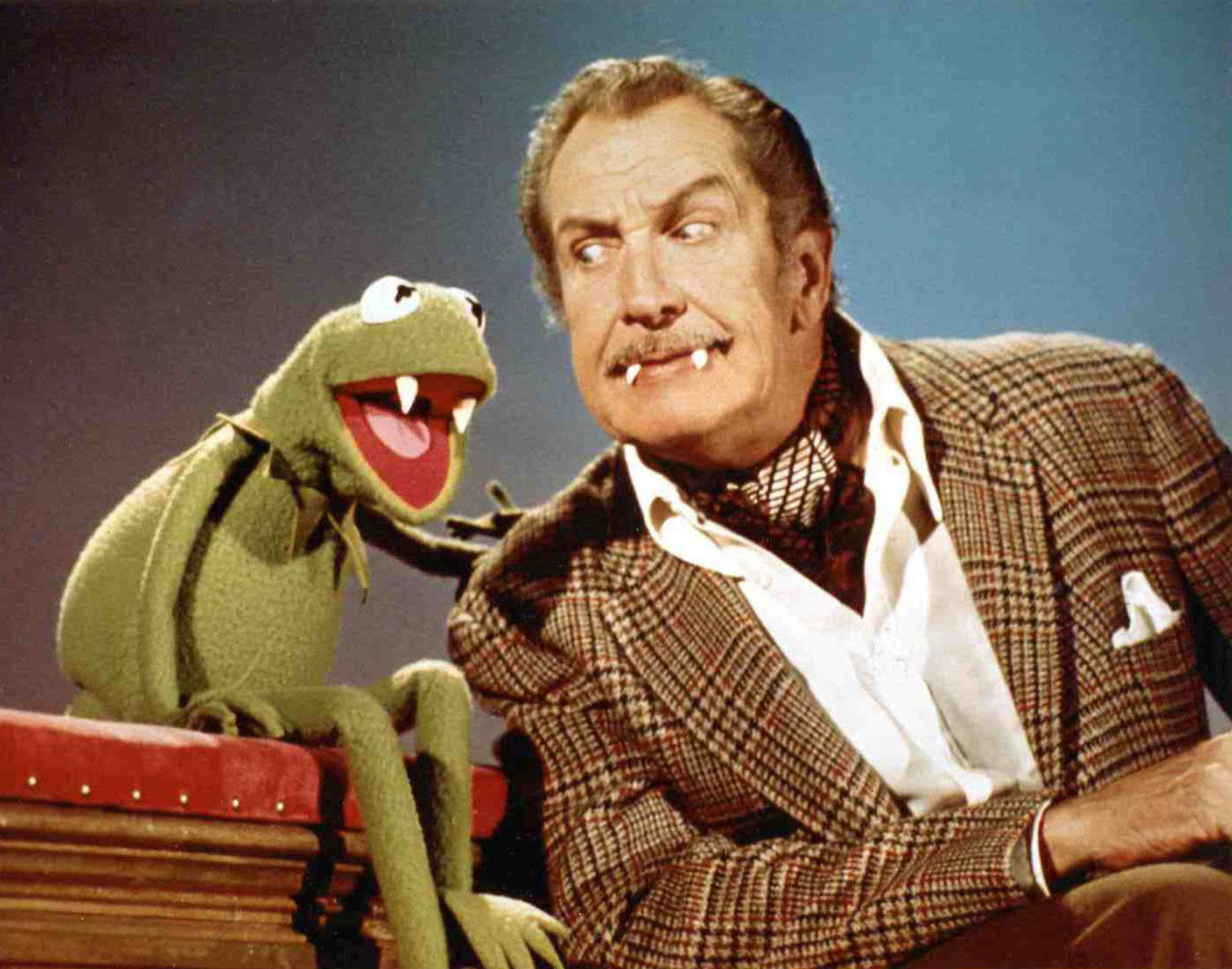
In the 1970s, Price made The Abominable Dr. Phibes (1971), its sequel Dr. Phibes Rises Again (1972), and Theatre of Blood (1973).  He also appeared in less violent fare, such as The Muppet Show and The Hilarious House of Frightenstein.

If he is known at all today by the average person, it's probably either by his voice acting on Michael Jackson's hit song "Thriller" or his last work on film, Tim Burton's Edward Scissorhands (1990).
A fantastic career on film, yes, but what about old time radio, you ask? Vincent Price spent the years 1947 to 1951 playing Simon Templar, otherwise known as The Saint. The three episodes will will listen to today have Price in less than saintly circumstances, which is really how we prefer him, no?

First up is an episode of a BBC show called The Price of Fear. It ran from 1973 to 1983. The show's episodes are all based upon the fictional adventure of a man named...Vincent Price! This episode is called "The Waxwork," and it is based on the A.M. Burrage short story. Price bumps into an old writer friend at a pub. The man has been invited to spend all night in the "Chamber of Horrors" at the local waxwork museum. One of the statues is of one Doctor Bordet, a serial killer better known as the "Terror of Paris." He escaped from the asylum he was sent to, but the authoritues presume him to be dead...and there's no reason to doubt the authorities is there?

Next is an episode of Suspense from 1959. Based on the short story by Ambrose Bierce, "An Occurrence at Owl Creek Bridge" is the tale of a man being executed during the American Civil War. He is to be hung from a railroad bridge. When he falls from the bridge, the rope breaks, and he makes his escape through Owl Creek. He tries to make it back to his wife, but his journey is a waking nightmare. Will he make it back home? What are the strange constellations he sees in the sky and the unknown language he hears whispered in his ears?

Last, we have my favorite Vincent Price radio performance. "Three Skeleton Key" is based on the 1937 short story by French author Georges-Gustave Toudouze. It was adapted for the radio many times; this particular performance is from Escape. Three men tend a lighthouse off the coast of French Guiana. An abandoned ship crashes onto the island and from it come a ravenous horde of rats. The rats swarm over the lighthouse, and the men must engage in a life-and-death struggle to survive. As the tagline for The Texas Chain Saw Massacre goes: "Who will be left...and what will be left of them?"

Tuesday, October 19, 2021

19 October: Tales of Terror & Twice Told Tales


We have an anthology of anthologies, so to speak, lined up for Cinematic Void’s 31 Days of Voidoween. Both films were made in the early 1960s, both starred that doyen of Gothic cinematic horror, Vincent Price, and both were released together on a M-G-M Midnite Movies double-sided disc. We’re talking Edgar Allan Poe’s Tales of Terror (1962) and Nathaniel Hawthorne’s Twice Told Tales (1963).


All in all, you get six spook-tacular stories for your Halloween buck, a not too shabby return. From Poe, you get "Morella," "The Black Cat," and "The Facts in the Case of M. Valdemar;" from Hawthorne, "Dr. Heidegger's Experiment," "Rappaccini's Daughter," and "House of the Seven Gables." While the Roger Corman-directed Poe picture is the better of the two, Sidney Salkow does a fair job with Hawthorne’s material, especially the first tale, "Dr. Heidegger's Experiment."

The cream of the crop is a toss-up between “The Black Cat” and “The Facts in the Case of M. Valdemar.” In the former, screenwriter Richard Matheson combines Poe’s “The Black Cat” and “A Cask of Amontillado” into a single black comedic tale. Vincent Price and Peter Lorre engage in a campy wine-tasting contest for the ages. In the latter, Basil Rathbone plays a mentalist who hypnotizes a dying Price. Caught between the worlds of the living and the dead, Price’s Valdemar has a bit of a meltdown when Rathbone finally releases him.

Both of the these pictures have stunning visuals and that bright color palette that screams early-1960s horror. Both are also a wonderful gateway to early American Romanticism. Watch the movies, then seek out the stories they were based upon. It’s a great way to pass the night during this spooky season.

Wednesday, October 13, 2021

13 October: "The Fall of the House of Usher"


"Not hear it? — yes, I hear it, and have heard it. Long — long — long — many minutes, many hours, many days, have I heard it — yet I dared not — oh, pity me, miserable wretch that I am! — I dared not — I dared not speak! We have put her living in the tomb!"

Today’s topic for Cinematic Void’s 31 Days of Voidoween is “Family Dysfunction.” The choices available to horror fans on this topic are myriad. Horror, it seems, is all about dysfunctional families. I mean, if they were functional...there wouldn’t be much horror, would there? Hereditary would have been a lot different if Toni Collette actually liked her kids, is all I’m saying. I’m going old school for my choice today. Let’s go back to America’s OG (Original Gothic), E.A. Poe and talk “The Fall of the House of Usher.”

First published in 1839 in Burton’s Gentleman's Magazine (was that the 19th Century Playboy?), “The Fall of the House of Usher” is all about familial madness and insularity. The Ushers, brother Roderick and sister Madeleine, spend their days secluded in the family home, a dark, dank mansion on the edge of a tarn. The house, according to Roderick, is as alive as he and his sister. The crack that extends from the roof to the foundation suggests that the house, like the family, is falling apart.

Both members of the Usher family are ill. Roderick can’t stand loud noises, and Madeleine falls into cataleptic-like trances that resemble death. Soon, Maddy dies (or does she?), and her body is placed in the family tomb in the catacombs beneath the house. Time passes until one night, with a storm raging outside, Madeleine appears before her brother and the unnamed narrator. She is bloodied from her time spent clawing her way out of her tomb. She falls on her brother, who dies of fright. The narrator hightails it out of the house just as the mansion crumbles and sinks into the tarn.

You can find “The Fall of the House of Usher” everywhere on the internet. You might say you can’t go anywhere on the web without “falling” over it. (Har-har!) You can read the story in its entirety here. If you like movies, check out Roger Corman’s adaptation from 1960. The script is written by the excellent Richard Matheson, and it stars Vincent Price.

If you prefer audio drama, then check out this episode of the old time radio program Escape. If you want straight up storytelling, then you can’t go wrong with this version read by the one and only Basil Rathbone.

Sunday, October 4, 2020

It is 4 October. There are 27 days until Halloween.

One of my all-time favorite pictures is John Carpenter’s The Fog. Sure, it’s a spooky movie, and it’s got POTA (Pittsburgh’s Own, Tom Atkins), but the main reason for my love is Stevie Wayne, as played by Adrienne Barbeau. Why? Because she’s got the perfect job and the perfect workplace, that’s why. Stevie is the sole owner/sole operator of AM radio station KAB (located on your dial at 1340), broadcasting the smoothest of jazz from atop a lighthouse hugging the rocky coast near Antonio Bay, CA.


The fact that she drives a Volkswagen Thing to work everyday and lives in a town where you can get a Stomach Pounder and Coke for lunch is just an added bonus.

While living and/or working in a lighthouse holds a certain amount of romantic appeal, there are numerous dangers. Like Ms. Wayne, you could be attacked by leprous ghost seeking revenge. You could be surrounded by semi-sentient, carnivorous plants that have taken over the world (Day of the Triffids). You and a friend could lose your minds, drink the fuel meant for the light, and kill each other (The Lighthouse). Or, as is the case in today’s featured radio drama, your little island could be overrun by rats. Hundreds, maybe thousands of rats.

What a choice!


It’s a bit ironic when a radio program asks its listeners if they “want to get away from it all,” then proceeds to tell a story filled with such paranoid, insular, cramped, asphyxiating horror as “Three Skeleton Key.” This radio play takes place in a single setting, a lighthouse, but as the action progresses, the setting shrinks until you are trapped along with the men in a single room.

The programs of the Golden Age of Radio had at their disposal a frightening array of actors. Men and women like Boris Karloff, William Conrad, Mercedes McCambridge, and Agnes Moorehead lent their vocal skills to scores of radio drama. “Three Skeleton Key” was performed many times on the air with many great actors (including the aforementioned William Conrad). The version I’ve chosen, stars the one and only Vincent Price. A man more well known to radio audiences for playing the suave Robin Hood-type criminal, Simon Templar, otherwise known as The Saint, Price uses his mellifluous voice to play the rough-and-ready, Jean. As the stakes get higher and the rats get closer and closer, Price matches the terror and horror of the situation. Through him, the listener can feel the vermin that came ashore aboard the unmanned ship nip at their heels.


The tale was based on a short story written by French author Georges-Gustave Toudouze. It was published in 1937 in Esquire, the same magazine that, a year later, would publish another “man vs nature” classic, Carl Stephenson’s "Leiningen Versus the Ants." (Stay tuned to this blog for more on that story!) If you want to read the story yourself, click here for a copy. Click here to listen to the 1950 version as aired on Escape. You can follow along with the script by clicking here. As usual, HorrorBabble offers a wonderful reading of Toudouze’s short story. There is also a short film made from the story over on Vimeo.

This play may not be the usual Halloween fare. There are no ghosts or vampires or anything supernatural, but I’ve always found it to be chilling and terrifying. The sound of the rats gnawing their way into lighthouse will stay with you for good long time.

Now, if you’ll excuse me, I have to jump into my VW Thing and run out to get a Stomach Pounder and a Coke…