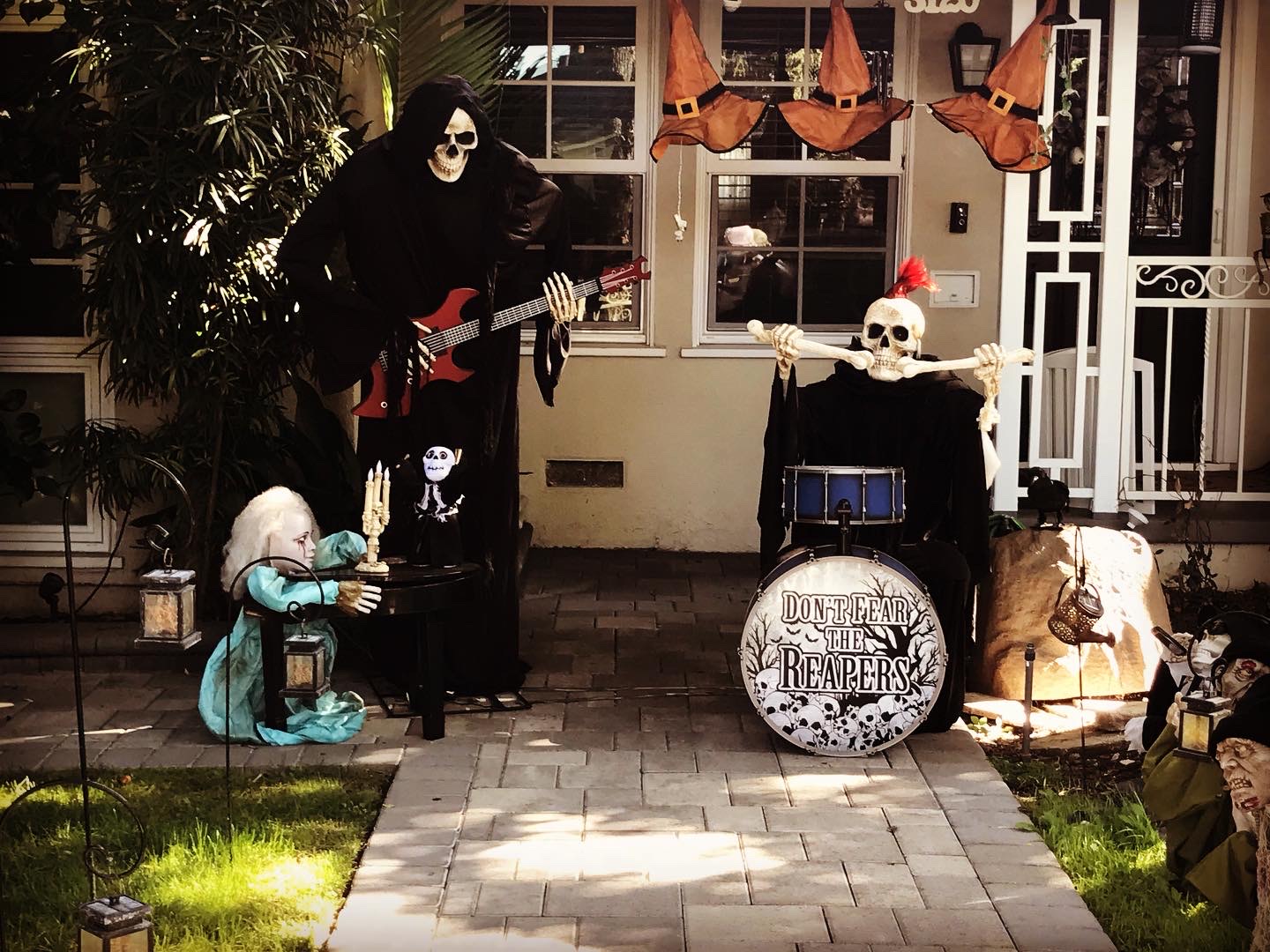
It is 6 October, and the Lot wakes up not knowing that the sickness has spread overnight. We move across the town to find that many of the characters we have come to know now sleep in attics and basements during the day.
Mark waits for Ben at Eva Miller’s boardinghouse. He breaks the bad news about Susan to Ben. As they drive along Brooks Road, they come across Susan’s car. She is not in it.
At the hospital, the remaining Fearless Vampire Killers decided what to do next. Daylight is burning, and the sun sets earlier and earlier these days…
Before we get into today’s reading, we at LARPCo would like to wish a very heartfelt and happy Silver Shamrock Day to those who celebrate. Today is, of course, 23 October, which is the day on which the action of Tommy Lee Wallace’s 1982 film Halloween III: Season of the Witch opens. Maybe this year will be the year that Dr. Challis gets that third television station to turn off the Silver Shamrock commercial?
Then again…maybe not. That song is catchy as hell, though, you gotta admit!
Onward!
We are now in Part 3 of ‘Salem’s Lot. That can only mean one thing: more epigrams!
We’ve got quotes from two of the greatest poets these United States have ever produced: Edgar Allan Poe and Bob Dylan. Poe’s “The Haunted Palace” was first published in 1839 in Nathan Brooks’ American Museum. Later, Poe re-used the poem in “The Fall of the House of Usher” as a song written by Roderick Usher. The section quoted here is the final verse and fits the action of the novel perfectly. What else are the denizens of the Lot but a “hideous throng” that “laugh—but smile no more”?
The quote from Dylan is from his song “North Country Blues” from his album The Times They Are a-Changin’. Influenced heavily by the songwriting of Woody Guthrie, “North Country Blues” tells the story of the collapse of a town and family due to the closing of a mine. This particular line is from the first verse of the song:
“Come gather ’round friends
And I’ll tell you a tale
Of when the red iron pits ran plenty
But the cardboard filled windows
And old men on the benches
Tell you now that the whole town is empty”
That line about the “old men on the benches” brings to mind the old men who hang out at Milt Crossen’s store day in and day out. I think this quote and the song that it is from is especially apt, because it supports my idea that the best vampire stories are, on a sub-textual level, about the bloodsucking nature of capitalism. In Dylan’s song, the mine and company feed upon the land and the people on it, sucking the life out of each. The narrator’s family has been decimated by the company — her father and brother have died underground, her husband has taken to drinking when work dries up. Then, one day, having satiated its thirst on the region, the company closes the mine, pulls up stakes, and leaves for South America “[w]here the miners work almost for nothing.” Left behind is an entire town — a ghost town as it were — not very much different from the Lot or Momson, Vermont, which was mentioned in the book’s Prologue.
The third epigram is from a source that King will return to again and again throughout his career: old-school rock’n’roll. A child of the 1950s, King had front row-center seats for the birth of this American art form. This particular quote is attributed as “Old Rock’N’Roll Song.” I’m not sure if that was done to give its provenance an older feel, or nobody felt like looking up who actually wrote the darn thing. After seeing poet Edwin Arlington Robinson called Edward Arlington Robinson in the pages of ‘Salem’s Lot, I’m leaning towards the latter.
These lyrics do have proper authorship, however. They are from the song “Endless Sleep” written by rockabilly artist Jody Reynolds and “Dolores Nance” in 1958. That second name was added to give the song the look of having been written by a professional songwriting team. An example of the time-honored rock’n’roll subgenre of the “Teenage Tragedy,” “Endless Sleep” tells the story of a young woman who, after fighting with her boyfriend, runs down to the shore and throws herself into the water. Demon Records in Los Angeles told Reynolds that they would record and release his single if he’d give it a more upbeat ending. So, he rewrote the last verse as:
“I looked at the sea and it seemed to say
‘You took your baby from me away’
My heart cried out ‘She's mine to keep’
I saved my baby from an endless sleep.”
For fear of alienating my already minuscule audience further — especially after my controversial “sexy vampires are dumb” opinion — I would like to go on record as saying the marriage between horror and heavy metal is equally dumb. It doesn’t make any sense to me. The best horror is when something unnatural quietly appears in the midst of natural surroundings. The strangeness sort of creeps up on you and gets under your skin. I don’t find adding an Alice Cooper or Dokken song to a scene particularly horrifying. It’s too on the nose, and it’s just noise. (It pained me to write that, because I love “Teenage Frankenstein” and “Dream Warriors” as songs on their own so much!)
But the ironic use of those moldie, golden oldies of yesteryear? Perfection, baby. Maybe it's the lyrics about obsessive love or the juxtaposition of voices happily singing in harmony while something horrifying happens on screen, but the songs of the 1950s and pre-Beatles 1960s are just inherently creepy to my ears. "Mr. Sandman" by The Chordettes in Halloween II is a good example. Sure, it only plays at the beginning and end of the movie, but it puts everything in between in a new, weird groove.
For those of you who stuck around after that diatribe…let us move on to Chapter 14.
This is another of “The Lot” chapters, which means we get a wide-angle view of the town. And said view is not pretty.
“No one pronounced Jerusalem’s Lot dead on the morning of October 6; no one knew it was…”
In a series of brief vignettes, we discover that Ruthie Crockett and Dud Rogers sleep together in an abandoned freezer in the dump, that the town librarian Loretta Starcher sleeps on the library’s third floor, that Hal Griffen’s hatred of school has become academic, and that Sheriff McCaslin found more than he bargained for when he discovered Susan’s car on Brooks Road. The vampires are spreading across the Lot quickly.
Meanwhile, Mark Petrie tracks down Ben and informs him of Susan’s fate. Ben is immediately thrust back in time to the accident that killed his wife, Miranda. We see what really happened that night, and it is nothing like the stories in the tabloid rags that Mabel Werts read to Mrs. Norton.
Mark and Ben go to the hospital and tell the rest of the Fearless Vampire Killers. There, we learn a scrap of vampire folklore that I had never heard before:
“‘…Straker performed another service for his Master before Barlow ever arrived. Do any of you know what?’
For a moment there was silence, and then Mark said quite distinctly, ‘The dog that man found on the cemetery gate.’
‘What?’ Jimmy said. ‘Why? Why would he do that?’
‘The white eyes,’ Mark said, and then looked questioningly at Matt, who was nodding with some surprise.
‘All last night I nodded over these books, not knowing we had a scholar in our midst.” The boy blushed a little. ‘What Mark says is exactly right. According to several of the standard references on folklore and the supernatural, one way to frighten a vampire away is to paint white “angel eyes” over the real eyes of a black dog. Win’s Doc was all black except for two white patches. Win used to call them his headlights—they were directly over his eyes. He let the dog run at night. Straker must have spotted it, killed it, and then hung it on the cemetery gate.’”
The Monster Kid strikes again!
And as our small group of vampire hunters begins to gather their resolve, let us call it a day. Tomorrow, we will continue with Part 3, Chapter 14: The Lot (IV), Sections 7-15. Get your rest, kiddies, because there’s a big job to do in the coming sections. Ben and Susan have a reunion of sorts. You’re gonna need your strength.
In the meantime, don’t forget to celebrate Silver Shamrock Day. I hear that Conal Cochran is giving free tours of his mask manufacturing plant out in Santa Mira, CA. And if he offers to show you his “Final Process,” just…
Susan just can’t toss aside her “can’t” thoughts, and she traipses off to the Marsten House. Alone. Still, she takes a piece of flimsy wood with her as a stake. You know, just in case. As she sits in the shade of the forest in the late afternoon and watches Straker leave the house and drive away, a hand falls on her shoulder.
Ben and Jimmy get permission from Maury Green to examine Mrs. Glick and sit up with her. Ben makes a makeshift cross out of tongue depressors. As the sun sets, Mrs. Glick’s corpse springs to life. She attacks Jimmy, but Ben fights her off. After she disappears, Jimmy fights for his life as he cleans the wound he received from Mrs. Glick’s bite.
After getting their stories straight about the lies they will tell the police, Jimmy and Ben are confronted by the county sheriff Homer McCaslin. He doesn’t believe the two men as far as he could throw them, but he has not proof. He lets them go.
At Eva’s, Ben looks out over the town and wonders if Susan is all right.
Ugh! Susan!
We knew it was coming. We knew that Susan would not be able to fight the urge to go off on her own, to prove to herself that everything that Ben and Matt believed in was a load of hooey. As I’ve said before, her rationality and her need to find out for herself are admirable qualities. A non-believer getting his or her comeuppance is usually a satisfying moment in a book or film. Here, I think the frustration I feel is fueled by how much I like Susan and admire her strength of will:
“She drove out along Brock Street, feeling a growing sense of pleasure and purpose (and a not unpleasant underlay of absurdity) as the house dropped behind her. She was going to take positive action, and the thought was a tonic to her. She was a forthright girl, and the events of the weekend had bewildered her, left her drifting at sea. Now she would row!”
Unfortunately, we all know that she is rowing her boat directly into the mouth of the shark from Jaws.
What? Y'all think yunz are better than Jaws II or something?
Slowly, she herself begins to sense the danger awaiting her. The closer she gets to the house, the more those feelings that she is doing the wrong thing seep into her mind. Her lizard brain — the limbic cortex — the most primitive part of the human brain, begins to send out its steady signals like a lighthouse warning ships away from a rocky coastline…Danger!…Stay away!…Danger!…
“As she neared the brow of the hill, she began to catch glimpses of the house through the steadily thinning screen of branches—the blind side of the house in relation to the village below. And she began to be afraid. She could not put her finger on any precise reason, and in that way it was like the fear she had felt (but had already forgotten) at Matt Burkes’s house. She was fairly sure that no one could hear her, and it was broad daylight—but the fear was there, a steadily oppressive weight. It seemed to be welling into her consciousness from a part of her brain that was usually silent and probably as obsolete as her appendix. Her pleasure in the day was gone. The sense that she was playing was gone. The feeling of decisiveness was gone. She found herself thinking of those same drive-in horror movie epics where the heroine goes venturing up the narrow attic stairs to see what’s frightened poor old Mrs. Cobham so, or down into some dark, cobwebby cellar where the walls are rough, sweating stone—symbolic womb—and she, with her date’s arm comfortably around her, thinking: What a silly bitch…I’d never do that! And here she was, doing it…”
It’s an old complaint of the horror movie viewer: “Why is that character doing that? I wouldn’t do that! That’s stupid!” It’s the same easychair criticism that the football fan engages in every weekend. The person who gets winded walking to the bathroom during the commercial breaks or who couldn’t throw a balled up napkin into a trash can from two feet away is going to know what to do on a 3rd-and-nine? Whatever.
I’m often reminded of my ex-father-in-law. An engineer. A guy who designed miniature railroad layouts and built Meccano ferris wheels and carousels. A smart man by any means of measurement. But I remember him testing our fire alarms by lighting crumpled up newspaper on our gas stove and walking the flaming torch through our apartment as ashes fell down and were ground into the carpet. Why would he do that? I don’t know. He should have known better. But still he did it.
At times like that, I often think of Edgar Allan Poe’s idea of “The Imp of the Perverse.” I think it is much more prevalent in our lives than we like to admit. Poe wrote a story by that name, but I think about his use of the perversity that runs and ruins our lives in another of his stories—“The Black Cat”…
“…And then came, as if to my final and irrevocable overthrow, the spirit of PERVERSENESS. Of this spirit philosophy takes no account. Yet I am not more sure that my soul lives, than I am that perverseness is one of the primitive impulses of the human heart -- one of the indivisible primary faculties, or sentiments, which give direction to the character of Man. Who has not, a hundred times, found himself committing a vile or a silly action, for no other reason than because he knows he should not? Have we not a perpetual inclination, in the teeth of our best judgment, to violate that which is Law, merely because we understand it to be such?”
Maybe it’s because I am a horror fan and have traveled this road many times with many characters that I am more forgiving of the dumb choices that are made. I’m willing to chalk up a lot of what happens in a horror tale to a kind of nightmare logic. Why is that character going up into the attic? They are asking themselves the same thing. It’s is because they have no choice in the matter. The dream into which they are locked demands it.
Mrs. Glick.
Holy cats!
I know I keep saying this, but this is one of the scenes that will pop into a horror fan’s mind when ‘Salem’s Lot is mentioned. And, again, it’s thanks to Tobe Hooper’s made-for-tv adaptation. (Can’t wait to talk about it!)
This section — No. 10 — moves at a quick pace. There’s no need for King to dance around the hot pie any longer. We know the vamps are about—bring us the vamps! Sentences and paragraphs are short and sweet, moving us forward towards the nightmare as if we are on the back of a runaway horse we can no longer control. And when we finally are brought to the moment when Mrs. Glick sits up and calls for her son, it is terrifying:
“A slow, choked voice spoke in the stillness, as grating as shards of broken crockery: ‘Danny?’
“Ben felt his tongue cleave to the roof of his mouth. The form under the sheet was sitting up. Shadows in the room moved and slithered.
“‘Danny, where are you, darling?’
“The sheet fell from her face and crumpled in her lap.
“The face of Marjorie Glick was a pallid, moonlike circle in the semidark, punched only by the black holes of her eyes. She saw them, and her mouth juddered open in an awful, cheated snarl. The fading glow of daylight flashed against her teeth.”
Looks like Mrs. Glick got up on the wrong side of the mortuary table!
Like the other vampires we’ve encountered in the Lot, Mrs. Glick is no longer human. Her movements, the noises she makes — everything about her is uncanny, inhuman, and animal-like. She reacts to Ben and Jimmy with “a snarl, a dark silver sound, doglike.” When presented with the make-shift cross Ben made,
“Her features seemed to draw together, twitching and writhing like a nest of snakes…The sounds that were wrenched out of her were inhuman gibberings and hissings and glottals, and there was something so blindly reluctant in her withdrawal that she began to seem like some giant, lumbering insect.”
Ben holds her at bay with his homemade cross, but she sinks her teeth into Jimmy’s neck. Ben pulls Mrs. Glick off of Jimmy, and he comes face-to-face with the undead:
“Her breath in his face was foul beyond measure, the breath of tombs. As if in slow motion, he could see her tongue lick across her teeth.
“He brought the cross up just as she jerked him forward into her embrace, her strength making him feel like something made of rags. The rounded point of the tongue depressor that formed the cross’s downstroke struck her under the chin—and then continued upward with no fleshy resistance. Ben’s eyes were stumped by a flash of not-light that happened not before his eyes but seemingly behind them. There was the hot and porcine smell of burning flesh. Her scream this time was full-throated and agonized. He sensed rather than saw her throw herself backward, stumble over the television, and fall on the floor, one white arm thrown outward to break her fall. She was up again with wolflike agility, her eyes narrowed in pain, yet filled with her insane hunger. The flesh of her lower jaw was smoking and black. She was snarling at him.
“‘Come on, you bitch,’ he panted. ‘Come on, come one.’”
Not a bad bit of work for a holy symbol made from tongue depressors and tape!
There is something more to be made from the homemade quality of Ben’s cross. Later, we will see a more official-looking cross fail in its duty to its wielder. What is the difference? Isn’t a cross a cross?
One of the things to keep in mind as we ponder these questions is to remember what Father Callahan was thinking to himself as he cleaned up his spilled whisky. He was pondering the changes in the Catholic Church that had happened only ten years earlier. The Second Ecumenical Council of the Vatican (or Vatican II, which makes it seem like a movie sequel — Vatican II: Electric Boogaloo!) was called together by Pope John XXIII in 1962 to update the Church for an increasingly secularized society. That was all well and good, but Father Callahan bemoans the loss of the purpose and tradition by such a change.
What we will see happen as the novel continues is this battle between Ben’s faith and Father Callahan’s. One is rooted in the heart of the believer and is much older than churches and councils, the other is caught up in the gewgaws of officialdom. You can think of it as a battle between punk rock and corporate rock, and y’all know which side of that divide LARPing Real Life falls on…
Whew! What a day! I didn’t expect to go on as long as all that. Not to worry, Blog-o-weeners, tomorrow is another one of our free days, and we will be taking it easy. We’ll talk about other books that mention the Lot and its characters. There aren’t many, but the ones that do are big’uns!
So, no reading to do tonight. It’s Saturday…go out and enjoy yourselves. But if you suddenly get the urge to do something perverse…well, it’s best to…
It’s 28 October. It’s getting late in the day, kiddies. The last handfuls of sand are beginning to trickle through the neck of our hourglass. There doesn’t seem to be enough time to talk about all the stories that we here at LARPing Real Life still have on our agenda for Blog-o-ween 2023. So, let’s stop fooling about and get down to the nitty and the gritty...
Nooooo...that’s Al Capone’s enforcer, Frank Nitti, and the other fellow (the one on the right) is the mascot for the Philadelphia Flyers (and known hell demon), Gritty. Nice try, though.
Anywho...we’ve got six stories on deck today for Blog-o-ween. SIX! What better way to celebrate Halloween than with the stories of everyone’s favorite emo kid, Edgar Allan Poe? Eddie was definitely one of America’s earliest adherents to the maxim “Everyday is Halloween.” Unfortunately, he was also a lover of the adage “It’s Five O’Clock Somewhere.” So, let’s raise a glass to Edgar and jump right into the festivities without any further ado...
First up is a story about a gated community whose residents think they are above things like the plague and death. Why worry about getting vaccinated and masking up when you can party like it’s 1399? Let’s see how the other half dies in “The Masque of the Red Death.”
Prince Prospero is throwing a kegger for all his bros (and a few hoes) at his castle. They aren’t so much celebrating as they are just simply waiting out the plague that is ravaging the country. “The Red Death,” as it is known, has swept across the land, causing sharp pains, sudden dizziness, and profuse bleeding at the pores before finally dispatching its victims. Prospero and his friends hope that their wealth and status, along with the walls of their enclave, will protect them. I think the uninvited guest to the prince’s masquerade ball — the one who is tastelessly dressed in a dark, blood-spattered funeral shroud — will have something to say about that. And I don’t think Prospero and his guest will want to hear it.
Next, we have the old, familiar story of one guy and two girls. Classic lover’s triangle, amirite? In this case, however, one of the ladies is dead and...well, actually, both of the ladies are dead in this one. Maybe this isn’t as familiar a tale as I thought. Let’s take a look at the story of “Ligeia” and learn more...
Our narrator has found the love of his life in the Lady Ligeia. She is intelligent and beautiful, with dark eyes and raven-hair. She is also something of a metaphysician. During their brief marriage she begins to introduce her husband to the wonders of forbidden wisdom.
Heh-heh-heh!
But soon, however, Ligeia becomes ill and dies. Don’t worry for our dear narrator. He replaces Ligeia with the fair-haired and blue-eyed Lady Rowena. And when I say “he replaces her,” I mean...well...you’ll just have to find out for yourself.
Our next tale is another old, familiar yarn about love and...dental work? It’s a story with a lot of bite, and one that you can really sink your teeth into. Heh-heh-heh! Let’s read on about young Egaeus and his love for his cousin “Berenice” and her smile.
Egaeus and Berenice grow up in a gloomy castle. (Is there any other kind?) She has an unnamed degenerative illness, which causes her to fall into a kind of catalepsy, and he suffers from a monomania that forces him to fixate on objects. So far, this sounds like a goth version of “The Gift of the Magi.”
As Berenice’s illness ravages the rest of her body, it leaves her teeth looking healthy (and with a pleasant mint flavor, too, I’m sure). Egaeus becomes obsessed with those pearly whites. Berenice dies and is interred. Egaeus sits and thinks about those teeth...about holding those teeth in his fingers...Berenice’s beautiful teeth...Berenice who is buried not too far away...
Them with dentophobia should look away at this point.
Our fourth story is all about mesmerism. It was all the rage in Europe and America when Poe wrote this story in 1845. Sure, making a subject cluck like a chicken is loads of fun, but could hypnosis be a cure for death? Let’s find out by looking at “The Facts in the Case of M. Valdemar.”
Ernest Valdemar is dying of tuberculosis. His friend, the narrator, is interested in mesmerism and wants to experiment on Valdemar to see if the (psuedo)science of putting a dying subject into a hypnagogic state can affect the process of death. Valdemar agrees and is soon put under. He dies while in the hypnotic state. As any friend would do under the circumstance, the narrator keeps Valdemar in his trance for over six months. When it comes time to wake Valdemar and release him (and his spirit)...well let’s just say that it gives new meaning to the term “morning breath.”
You still with us? Because we’ve got two tales left. And, boy are they doozies!
Our fifth tale is, perhaps, my favorite of Poe’s stories. Its central image — of a person buried behind a wall — has been used by many makers of Italian “giallo” films, including Lucio Fulci, Sergio Martino, and Dario Argento (who directed a direct adaptation of it). You may be thinking of a certain Montresor who tricks his “friend” Fortunato into accompanying him into the catacombs to have a sip of a very special wine, but I’m not talking about “The Cask of Amontillado.” The story of murder and burial that we’re going to read next is “The Black Cat.”
Our narrator is a happily married man who loves his wife and all animals, especially his black cat, Pluto. Unfortunately, like Poe himself, the narrator also has an unnatural love of alcohol, which causes him to become violent. One night, while chasing the cat with an ax, the man’s wife comes between him and his prey. He buries the ax in her head, then proceeds to bury her body in the wall of the cellar. After he’s done, he cannot find the cat, which is fine so far as he is concerned. The police come sniffing around to search the house. They find nothing...except the preternatural howls of a cat...and it sounds like it is coming from behind one of the basement walls!
Bob Villa and Norm Abram never had this problem.
Okay, Blog-o-weeners, we’ve come to the end of today’s entry. One more story, and I will stop bending your ear. This story is probably Poe’s most famous creation. It is (at the time of this writing) being used as the basis for a certain streaming service’s multi-episodic series. It’s been made by avant-garde filmmakers in France and given the low-budget, high-concept treatment by Roger Corman. It is another tale of isolation, madness, and premature burial. It’s “The Fall of the House of Usher.”
Another unnamed narrator (this guy gets around!) visits his old friend Roderick Usher. Usher wrote to his friend asking him to come and help him pass the time because of an illness he is suffering from. The narrator arrives to find his friend and his sister, Madeline, living in a dilapidated house next to a tarn. The house has a thin crack on its front that stretches from the roof to the ground.
During the narrator’s visit, Madeline dies from an unknown disease, but because she also suffered from cataleptic trances, her body will be interred in the family tomb for two weeks before it is permanently buried. (As you do.)
A week later, a storm rages outside, and as Roderick reads aloud the story of a knight named Ethelred who battles a dragon. During the reading of the story, the narrator and Roderick hear the sounds of cracking and ripping coming from somewhere in the house. Soon, a loud banging is heard, and the door is blown inwards to reveal...
Well, you should really find out for yourself what comes into Roderick’s bedroom and what becomes of the house of Usher.
What can we say about Edgar Allan Poe that hasn't already been drilled into our heads during a junior high English class? He was born in Boston in January, 1809, and he died in Baltimore in October, 1849. In between, E.A. Poe lived a life with as many ups and downs as an Otis elevator, albeit the downs outnumbered the ups by a conservative 4-to-1 margin.
Even in death, the poor man couldn't catch a break. Rufus Wilmot Griswold, an editor, critic, and anthologist, bore Poe a grudge. The tension between the two men stemmed from Poe's attack on Griswold's critical acumen in his 1842 book The Poets and Poetry of America. Later, Griswold replaced Poe as co-editor at Graham's Magazine at a higher salary, something Poe could not stomach. Somehow, even through all this antagonism and aggrievement, Griswold was named Poe's literary executor upon his death, and he used this position to spread lies and destroy Poe's reputation.
Thankfully, Griswold failed at his attempt at literary assassination. Due to the diligence of people who knew Poe well, as well as French critics and writers like Charles Baudelaire, Poe's reputation remained intact, and in fact only grew as the years passed.
Whew! That’s all for today, kiddies. And what a day! So many great stories to accompany you to bed. I just hope that Uncle Edgar’s stories don’t scare you to death. But not to worry. We won’t permanently bury you until we are absolutely sure you’re dead. We’ll give you the old mirror-under-the-nose check and the needles-in-between-the-toes test. We are nothing if not scientific and thorough. In the meantime, we’ll place you in the family tomb deep in the catacombs beneath the castle. There, you’ll be stretched out on a bier in the dark. And if you aren’t really dead, well, at least you’ll have a quiet place to rest and to relax and to have...pleasant dreams? Hmmmm? Heh-heh-heh!
It's that part of the week that everyone is working for, and that means that we are two days away from Halloween 2022. We've been through a lot, you and I. We've listened to, we've learned from, and we've loved a lot of old time radio, but something's been missin' don'cha think? It's kinda like we threw a party but there's one guest that RSVP'ed who hasn't shown up yet. That one party animal without whom we might as well pack up the beerball and call it a night. And I don't mean that kid who's taking a second trip through his junior year, the one in the torn up "Who Farted?" t-shirt who can chug an Old Milwaukee tall boy while standing on his head neither...although...given our Blog-o-ween subject's history with alcohol, maybe that's exactly who I'm talking about, after all!
What can we say about Edgar Allan Poe that hasn't already been drilled into our heads during a junior high English class? He was born in Boston in January, 1809, and he died in Baltimore in October, 1849. In between, E.A. Poe lived a life with as many ups and downs as an Otis elevator, albeit the downs outnumbered the ups by a conservative 4-to-1 margin.
Even in death, the poor man couldn't catch a break. Rufus Wilmot Griswold, an editor, critic, and antholgist, bore Poe a grudge. The tension between the two men stemmed from Poe's attack on Griswold's critical acumen in his 1842 book The Poets and Poetry of America. Later, Griswold replaced Poe as co-editor at Graham's Magazine at a higher salary, something Poe could not stomach. Somehow, even through all this antagonism and aggrievement, Griswold was named Poe's literary executor upon his death, and he used this position to spread lies and destroy Poe's reputation.
Thankfully, Griswold failed at his attempt at literary assassination. Due to the dilligence of people who knew Poe well, as well as French critics and writers like Charles Baudelaire, Poe's reputation remained intact, and in fact only grew as the years passed.
Today, we have a collection of classic tales from the imagination of Edgar Allan Poe. Poe's work was a source of inspiration to many old time radio producers and writers over the years. A search of the Internet Archive would reveal myriad adaptations to choose from -- all of them weird, all of them wonderful. I've chosen four that I think best represent the man and the radio programs of the 20th century.
First up is a classic tale of revenge from Hall of Fantasy. Two men are enjoying Carnival in Venice. Unbeknownst to one of the men, the other holds a venomous grudge against him and plots his revenge. Montresor invites the drunken Fortunato to his family vaults, luring him deeper and deeper into the catacombs with the promise of..."The Cask of Amontillado."
Next is one of the, if not the most famous tale Poe ever wrote, "The Tell-Tale Heart." Adapted for The Weird Circle in 1944, the story is about one man's murderous obsession and the way his conscience gets the better of him.
Next up is an episode of the CBS Radio Mystery Theater. It is a updated adaptation of my personal favorite Poe tale, "Berenice." In this version, a young man falls in love with his young sister-in-law while his wife lies on her deathbed. The last distressing smile of his wife taunts him day and night, and he goes crazy when he sees the same smile on his new beloved.
Lastly, we have the other story for which Poe is so rightly famous. "The Fall of the House of Usher" is a gothic masterpiece, and the radio show Escape does a fine job of bring it to life...and death!
We have an anthology of anthologies, so to speak, lined up for Cinematic Void’s 31 Days of Voidoween. Both films were made in the early 1960s, both starred that doyen of Gothic cinematic horror, Vincent Price, and both were released together on a M-G-M Midnite Movies double-sided disc. We’re talking Edgar Allan Poe’s Tales of Terror (1962) and Nathaniel Hawthorne’s Twice Told Tales (1963).
All in all, you get six spook-tacular stories for your Halloween buck, a not too shabby return. From Poe, you get "Morella," "The Black Cat," and "The Facts in the Case of M. Valdemar;" from Hawthorne, "Dr. Heidegger's Experiment," "Rappaccini's Daughter," and "House of the Seven Gables." While the Roger Corman-directed Poe picture is the better of the two, Sidney Salkow does a fair job with Hawthorne’s material, especially the first tale, "Dr. Heidegger's Experiment."
The cream of the crop is a toss-up between “The Black Cat” and “The Facts in the Case of M. Valdemar.” In the former, screenwriter Richard Matheson combines Poe’s “The Black Cat” and “A Cask of Amontillado” into a single black comedic tale. Vincent Price and Peter Lorre engage in a campy wine-tasting contest for the ages. In the latter, Basil Rathbone plays a mentalist who hypnotizes a dying Price. Caught between the worlds of the living and the dead, Price’s Valdemar has a bit of a meltdown when Rathbone finally releases him.
Both of the these pictures have stunning visuals and that bright color palette that screams early-1960s horror. Both are also a wonderful gateway to early American Romanticism. Watch the movies, then seek out the stories they were based upon. It’s a great way to pass the night during this spooky season.
"Not hear it? — yes, I hear it, and have heard it. Long — long — long — many minutes, many hours, many days, have I heard it — yet I dared not — oh, pity me, miserable wretch that I am! — I dared not — I dared not speak! We have put her living in the tomb!"
Today’s topic for Cinematic Void’s 31 Days of Voidoween is “Family Dysfunction.” The choices available to horror fans on this topic are myriad. Horror, it seems, is all about dysfunctional families. I mean, if they were functional...there wouldn’t be much horror, would there? Hereditary would have been a lot different if Toni Collette actually liked her kids, is all I’m saying. I’m going old school for my choice today. Let’s go back to America’s OG (Original Gothic), E.A. Poe and talk “The Fall of the House of Usher.”
First published in 1839 in Burton’s Gentleman's Magazine (was that the 19th Century Playboy?), “The Fall of the House of Usher” is all about familial madness and insularity. The Ushers, brother Roderick and sister Madeleine, spend their days secluded in the family home, a dark, dank mansion on the edge of a tarn. The house, according to Roderick, is as alive as he and his sister. The crack that extends from the roof to the foundation suggests that the house, like the family, is falling apart.
Both members of the Usher family are ill. Roderick can’t stand loud noises, and Madeleine falls into cataleptic-like trances that resemble death. Soon, Maddy dies (or does she?), and her body is placed in the family tomb in the catacombs beneath the house. Time passes until one night, with a storm raging outside, Madeleine appears before her brother and the unnamed narrator. She is bloodied from her time spent clawing her way out of her tomb. She falls on her brother, who dies of fright. The narrator hightails it out of the house just as the mansion crumbles and sinks into the tarn.
You can find “The Fall of the House of Usher” everywhere on the internet. You might say you can’t go anywhere on the web without “falling” over it. (Har-har!) You can read the story in its entirety here. If you like movies, check out Roger Corman’s adaptation from 1960. The script is written by the excellent Richard Matheson, and it stars Vincent Price.