Showing posts with label Suspense. Show all posts

Monday, October 31, 2022

Blog-o-ween 2022: The Classics, Pt. 2

Well, Blog-o-weeners (I'm really gonna have to think of a better name), we made it! It is 31 October; it is Halloween! I hope everyone has a great time today...what with the chill in the air...and the trick-or-treating...and the spooky movies...and the bobbing for apples...and the carving of pumpkins...ooohhhh, laaadyyy!

Here at LARPing Real Life HQ, I'm gonna throw on Zacherley's Horrible Horror, an old VHS tape I bought at Hill's Department Store in the 1980s. After that, I'm putting myself in the hand of Commander USA and his 1985 USA Network Halloween Special. I say "hand," because we all know that the Commander has his other hand full with his right-hand man, Lefty. Sure.
So, now we come to it. The final three old time radio show of Blog-o-ween 2022. And boy, oh boy, are they scary. I mean, I honestly hope you all are wearing a belt or a pair of suspenders at the very least, because these shows are going to scare the pants right off of you! Oh, yeah! I mean, double-knot your shoelaces, because the three thrilling and chilling stories we have today are going to knock your socks off! You bet!

Our first entry for Halloween is a 1948 episode Wyllis Cooper's Quiet Please. It is a terrifying tale called “The Thing on the Fourble Board.” I don’t want to give too much away on this one. All I will say is that a “fourble board” is the working platform on an oil derrick. Everything about this episode - the writing, the acting, the sound design - is sheer horrific perfection. And the story’s ending is absolutely unforgettable.

Next, let's you and I take a trip into the canyons of Los Angeles -- Cypress Canyon to be precise. There, we will find a house belonging to James and Ellen Woods. It's a nice little place, perfect for a married couple. There's lots of closet space. In fact, one closet in particular seems to house enough blood to give Dracula a tummyache. Written by Robert L. Richards, directed by William Spier, and starring Robert Taylor and Cathy Lewis, “The House in Cypress Canyon” from the series Suspense is considered by many people to be the scariest radio program of all time. Do you dare listen to see if they are right?

Last, we have what I think is the scariest radio show of them all. The above shows are doozies, no mistake about it, but this next just has that certain je ne sais quoi, that little bit extra, whether it's the acting, the mood, the ending, that nudges it above everything else in my opinion. It is an adaptation of W.W. Jacobs's classic tale "The Monkey's Paw" as performed on the Canadian radio show Nightfall

The story is simply told: at the turn of the 20th century, an English family is visited by a friend just back from serving in India. The visitor has in his possession a souvenir from his time there: a shriveled, mummified monkey’s paw. He tells the family that it allegedly grants three wishes, but those who tempt fate through the paw’s powers are forever sorry they do so. The visitor tries to toss it onto the fire and burn it, but the paw is saved and kept by the family.

What does the family wish for? Do they get what they want?

What follows is a tale of terror and bitter irony that still sends a shiver up my spine. “The Monkey’s Paw” is a marvel of construction, simple, but with powerful moments leading up to its heartbreaking climax.

I hope you enjoyed our trip through old time radio this month. If you want to hear more, you are in luck! There are many more shows available for streaming at the Internet Archive, as well as your favorite podcast platform.

Be well, my fiends, stay scared...

Sunday, October 30, 2022

Blog-o-ween 2022: The Classics, Pt. 1

One day. ONE DAY! That's all that is standing between you and the Big H-A-double hockey sticks-oween! We've listened to a lot of great old time radio  shows, haven't we? We've heard fantastic audio horror from the 1930s all the way up to the 2020s! That's nearly a hundred years of storytelling goodness! We've heard tales from Arch Oboler, Ray Bradbury, and H.P. Lovecraft. We've heard the voices of Peter Lorre, Mercedes McCambidge, and Vincent Price. We've been terrorized by werewolves, videotapes, and dentists. It's been an amazing ride on this Blog-o-ween train. It's a pity it has to end.

But it isn't over yet! We still have today and tomorrow, and for the penultimate and ultimate days of October, I thought we'd tune our ears to the ne plus ultra of radio thrills and chills. Today and tomorrow, we will be listening to the scariest radio shows ever broadcast. I can already hear your haughty indignation and "Well, actually..." now:

"Who says these are the scariest?"

Well...I do, for the most part. It's my blog, after all. Most of the shows I'll be posting can be found on the interwebz if you search for "scariest old time radio shows," so a lot of other people think so, too, but ultimately it came down to what me, myself, and I thought was scary. Listener mileage may vary.

"What were the determining criteria that made you choose one show over another?"

Determining what? What are you on about? This isn't science. I picked what I picked cuz I picked 'em. They're just old time radio shows.

Without further ado...or should that be...Without further a-boo, heh-heh-heh!...let's just jump head first into the three shows I've chosen for today. Each of these is creepy and off-putting in its own way. Strangeness abounds in them all. Some use the supernatural to send a shiver up the spine. Others rely on good ol' fashioned human foibles and failings to get their scares across.

First up is a tale from "Radio's Outstanding Theater of Thrills," Suspense. It stars an actor who is making his first appearance in this year's Blog-o-ween: Cary Grant. The story concerns a couple whose car runs out of gas in the middle of nowhere while a storm rages around them. To compound matters, there is a crazy woman known as "The Crazy Woman" sneaking about the countryside with a meat cleaver, chopping the heads off her victims. Soon, a terrified woman comes out of the dark asking to be let in. Will the couple rue their decision to leave the main highway and travel..."On a Country Road"?

Next, we've got an episode of Hall of Fantasy. In this story, we have a young woman who is being stalked by creatures she cannot see, creatures who live in the dark and only come out when the lights are turned off. This one has the feel of the 2016 film Lights Out mixed at times with A Nightmare of Elm Street -- the raspy cackle of the creatures reminds me of Freddy Kreuger. Listen to "The Shadow People" with the lights turned out...if you dare!

Our last tale of the evening makes me feel like a department store on 1 November, because it isn't even Halloween yet, and here I am serving up a good ol' fashioned Christmas ghost story. But "Smee" by A.M. Burrage isn't just any Christmas ghost story. I think it's one of the finest ghost stories there is. It's a simple, yet effective tale about a party game called "Smee." You've heard of it? No? Well, the rules are simplicity itself:

"It’s a great improvement on the ordinary game of hide-and-seek. The name derives from the ungrammatical colloquialism, 'It’s me.' You might care to play if you’re going to play a game of that sort. Let me tell you the rules.

"Every player is presented with a sheet of paper. All the sheets are blank except one, on which is written 'Smee'. Nobody knows who is “Smee” except 'Smee' himself—or herself, as the case may be. The lights are then turned out and 'Smee' slips from the room and goes off to hide, and after an interval the other players go off in search, without knowing whom they are actually in search of. One player meeting another challenges with the word 'Smee' and the other player, if not the one concerned, answers 'Smee'.

"The real 'Smee' makes no answer when challenged, and the second player remains quietly by him. Presently they will be discovered by a third player, who, having challenged and received no answer, will link up with the first two. This goes on until all the players have formed a chain, and the last to join is marked down for a forfeit."

As I said, it's a simple game, however, things become complicated when the twelve people playing "Smee" inexplicably become thirteen. Where did the extra player come from? Who is the newcomer? Listen to this episode of the South African show Beyond Midnight here to find out.

Wednesday, October 26, 2022

Blog-o-ween 2022: Vincent Price

Halloween is a scant five days away, Faithful Reader, and we have a very special Blog-o-ween entry planned for you. Today, we celebrate the radio career of the devilishly debonair, the suavely spooky, the creepy and classy Vincent Price.

Vincent Price was born in May, 1911, in St. Louis, Missouri. In 1933, he graduated from Yale University with a degree in English and a minor in Art History. (Let's hear it for English majors!) While in London studying for a master's degree in Fine Arts, Price became interested in acting and appeared on stage in 1934. By 1935, he was performing with Orson Welles's Mercury Theatre.

Once back in the States, Price found work in Hollywood, playing in a wide variety of films like Laura (1944) and Leave Her to Heaven (1945), both with Gene Tierney, Service de Luxe (1938), The Song of Bernadette (1943), and The Web (1947). However, Price became best known for his work in horror pictures, such as Tower of London (1939) with Boris Karloff and House of Wax (1953) with Chuck Bronson(!).

In the 1960s, Price teamed up with Roger Corman and American International Pictures to make a cycle of films based on the work of Edgar Allan Poe, one of Price's favorite artists. For AIP, he made The Pit and the Pendulum (1961), Tales of Terror (1962), The Comedy of Terrors (1963), The Raven (1963), The Masque of the Red Death (1964), and The Tomb of Ligeia (1964). In 1968, he made Witchfinder General for Tigon British Film Productions. This Michael Reeves film is consider to be one of the "unholy three" (along with The Wicker Man and The Blood on Satan's Claw) of the Flk Horror movement.

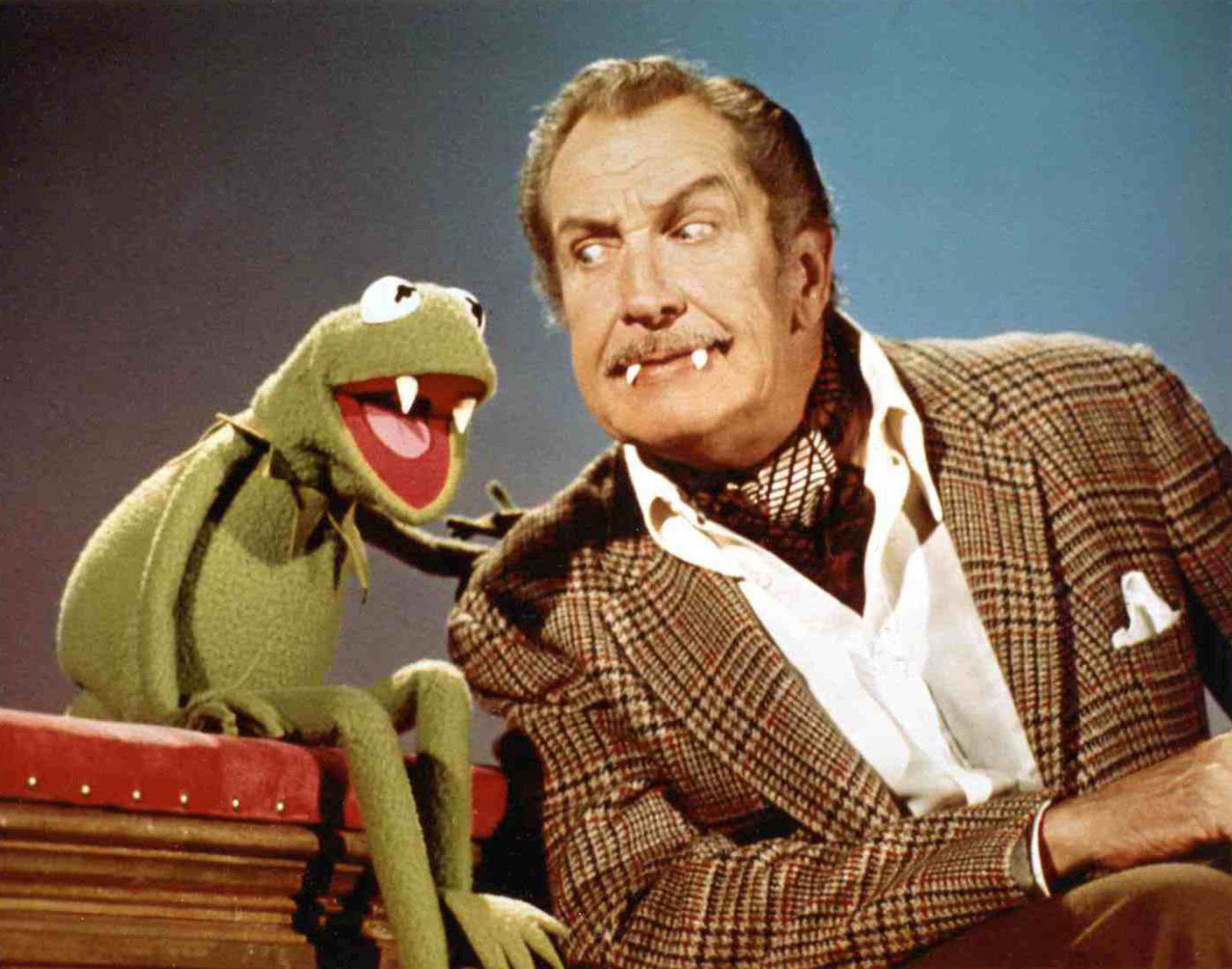
In the 1970s, Price made The Abominable Dr. Phibes (1971), its sequel Dr. Phibes Rises Again (1972), and Theatre of Blood (1973).  He also appeared in less violent fare, such as The Muppet Show and The Hilarious House of Frightenstein.

If he is known at all today by the average person, it's probably either by his voice acting on Michael Jackson's hit song "Thriller" or his last work on film, Tim Burton's Edward Scissorhands (1990).

A fantastic career on film, yes, but what about old time radio, you ask? Vincent Price spent the years 1947 to 1951 playing Simon Templar, otherwise known as The Saint. The three episodes will will listen to today have Price in less than saintly circumstances, which is really how we prefer him, no?

First up is an episode of a BBC show called The Price of Fear. It ran from 1973 to 1983. The show's episodes are all based upon the fictional adventure of a man named...Vincent Price! This episode is called "The Waxwork," and it is based on the A.M. Burrage short story. Price bumps into an old writer friend at a pub. The man has been invited to spend all night in the "Chamber of Horrors" at the local waxwork museum. One of the statues is of one Doctor Bordet, a serial killer better known as the "Terror of Paris." He escaped from the asylum he was sent to, but the authoritues presume him to be dead...and there's no reason to doubt the authorities is there?

Next is an episode of Suspense from 1959. Based on the short story by Ambrose Bierce, "An Occurrence at Owl Creek Bridge" is the tale of a man being executed during the American Civil War. He is to be hung from a railroad bridge. When he falls from the bridge, the rope breaks, and he makes his escape through Owl Creek. He tries to make it back to his wife, but his journey is a waking nightmare. Will he make it back home? What are the strange constellations he sees in the sky and the unknown language he hears whispered in his ears?

Last, we have my favorite Vincent Price radio performance. "Three Skeleton Key" is based on the 1937 short story by French author Georges-Gustave Toudouze. It was adapted for the radio many times; this particular performance is from Escape. Three men tend a lighthouse off the coast of French Guiana. An abandoned ship crashes onto the island and from it come a ravenous horde of rats. The rats swarm over the lighthouse, and the men must engage in a life-and-death struggle to survive. As the tagline for The Texas Chain Saw Massacre goes: "Who will be left...and what will be left of them?"

Sunday, October 23, 2022

Blog-o-ween 2022: Suspense

On July 22, 1940, the Columbia Broadcasting System aired an episode of Forecast, which was used by CBS to test new show ideas. On this particular evening, Forecast brought its listening audience a thriller directed by Hollywood's newest resident, Alfred Hitchcock. The play Hitchcock chose was an adaptation of one of his early films, The Lodger: A Story of the London Fog (1927). Hitchcock's take on the Jack the Ripper story was a big hit, and it set the tone for the radio show that CBS developed afterwards.

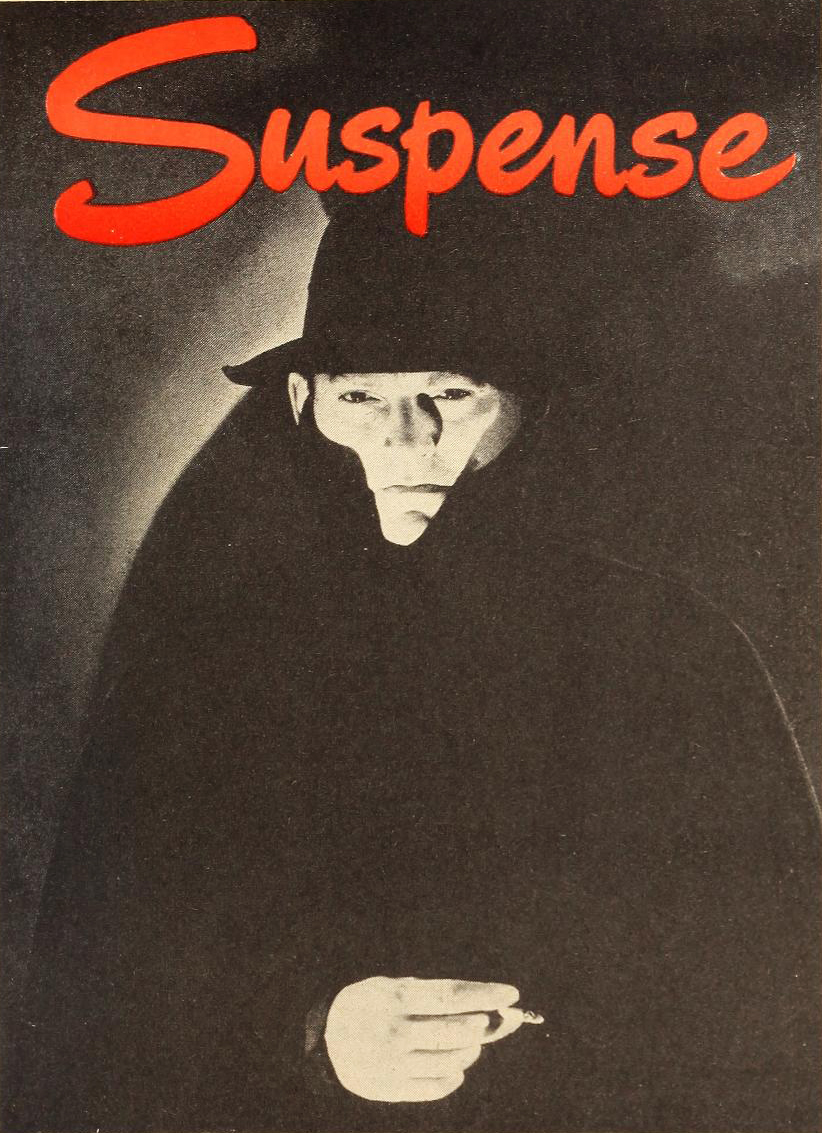
Suspense became one of the most successful programs of the Golden Age of Radio and its twenty-two year run is testimony to that. Subtitled "Radio's Outstanding Theater of Thrills," Suspense drew an impressive array of talent to its microphone over the the years. In addition to Alfred Hitchcock, listeners heard the talents of Cary Grant, Lucille Ball, Rita Hayworth, Peter Lorre, Vincent Price, Charles Laughton, Loretta Young, Lillian Gish, Gene Kelly, Alan Ladd, Ida Lupino, Olivia de Havilland, Orson Welles, James Stewart, and many, many more! Many of these talented people were attracted to Suspense because it allowed them to play against type. Where else could you hear Jack Benny and Eve Arden play scheming killers?

While Suspense had many sponsors over the years, I think most old time radio fans tend to associate Roma Wines with the program. From 1943 to 1948, the Fresno, CA-based wine company hawked its wares to Suspense's audience by assuring listeners that Roma Wine was “America’s largest selling wine” and was “Made in California for enjoyment throughout the world.”

Today, we have three episodes of Suspense's more horror-centric stories. First up is "Fugue in C Minor," written by Lucille Fletcher and starring Vincent Price and Ida Lupino. Ol' Vinnie plays a widower looking to make Ms. Lupino his new wife. Good news: Price owns a very large house. Bad news: said house is built around a enormous pipe organ. Worse news: Price's children tell Lupino that they think their father murdered their mother and the woman's ghost inhabits the organ!

Next is a two-parter -- "Donovan's Brain," based on the Kurt Siodmak novel and starring Orson Welles. Welles portrays Dr. Patrick Cory, who has been experimenting recently on keeping the brains of dead monkeys alive. A nearby plane crash brings the ruthless robber baron, William Donovan, into Cory's life and his lab. Cory succeeds in keeping the industrialist's brain alive, but Donovan doesn't let the fact that he doesn't have a body stop him from taking over Cory's mind.


Last, we have what an early entry into the found-footage genre: "Ghost Hunt." Ralph Edwards plays Smiley Smith, a radio deejay who records his night in a house where four people are known to have committed suicide.

Sunday, October 31, 2021

31 October: A Trio of Old Time Radio Thrills


Well, we done did it, good people. We made it through another October, and now it’s Halloween. We’ve spent the last month together sharing movie, book, and audio suggestions thanks to Cinematic Void’s 31 Days of Voidoween. It’s been a blast talking up my spooky selections, and I loved seeing what other people were up to, too. Thanks to folks using #cinematicvoid and #voidoween on Twitter, I’ve got a list the length of my arm filled with movies I can’t wait to check out.

Cinematic Void is ending Voidoween with a wild card. It’s up to each of us to choose a personal Halloween favorite. I’ve decided to end things with a bang - three of ‘em to be exact! Follow the links below, turn your lights down low, and enjoy some good ol’ fashioned radio drama.

First up is a trip in the wayback machine to 1948 where we’ll listen to a classic episode of Wyllis Cooper’s Quiet Please: “The Thing on the Fourble Board.” I don’t want to give too much away on this one. All I will say is that a “fourble board” is the working platform on an oil derrick. Everything about this episode - the writing, the acting, the sound design - is sheer horrific perfection. And the story’s ending is absolutely unforgettable.

Let’s go back a couple of years to 1946 and listen to an episode of one of the premier radio programs of radio’s Golden Age, Suspense. “The House in Cypress Canyon” is considered by many people to be the scariest radio program of all time. Written by Robert L. Richards, directed by William Spier, and starring Robert Taylor and Cathy Lewis, it’s the story of a young couple – James and Ellen Woods – who move into a small house in the titular canyon. From their first night in their new home, the Woodses are haunted by inhuman cries in the night. There is no explanation for what happens next. What befalls James and Ellen could happen to anyone at any time. Why, it could happen to you...

Last up is an episode of Beyond Midnight, a radio program from South Africa that ran from 1968 to 1970. The episode is an adaptation of a classic Christmas ghost story by A.M. Burrage. It is called “Smee,” and it is my very favorite ghost story. It’s has a simple story-within-a-story construction. The outer story concerns a group of friends who are preparing to play a post-dinner game of hide-and-seek on Christmas Eve. One of the party refuses to play. Jackson had a bad experience some years before at another friend’s house playing a similar game:

‘I wonder if any of you have played a game called “Smee”. It’s a great improvement on the ordinary game of hide-and-seek. The name derives from the ungrammatical colloquialism, “It’s me.” You might care to play if you’re going to play a game of that sort. Let me tell you the rules.

‘Every player is presented with a sheet of paper. All the sheets are blank except one, on which is written “Smee”. Nobody knows who is “Smee” except “Smee” himself—or herself, as the case may be. The lights are then turned out and “Smee” slips from the room and goes off to hide, and after an interval the other players go off in search, without knowing whom they are actually in search of. One player meeting another challenges with the word “Smee” and the other player, if not the one concerned, answers “Smee”.

‘The real “Smee” makes no answer when challenged, and the second player remains quietly by him. Presently they will be discovered by a third player, who, having challenged and received no answer, will link up with the first two. This goes on until all the players have formed a chain, and the last to join is marked down for a forfeit.’

The group encourages Jackson to tell the whole story, and we move into the inner tale, which is where Beyond Midnight begins its episode. The radio program uses the rules of the game – the large house, the silence, the solitude – to chilling effect. “Smee” has a wonderful ending that, although you may see it coming, is still powerful enough to elicit a shudder. Along the way, there are many moments where Jackson and his fellow players rub up against the uncanny and outré. One moment, in fact, on a staircase, involving the accidental (?) miscount of the number of players in the game made the bottom fall out of my stomach.

I hope you’ve had a good time this month following along with me. I’ve had a blast talking up my favorite Halloween tricks and treats. Stay tuned to this blog for more talk about the TV shows Wings and Tucker’s Witch. Come tomorrow, I’ll be taking part in National Novel Writing Month, and I’ll keep you up to date with how that is going. I am continuing my work on a giallo-esque thriller. I'm about 10 chapters into it, and it's been a blast so far.

So...until next time...enjoy the Horrorthon and...Happy Halloween... 

Monday, June 21, 2021

LARPing Real Life Versus Leiningen Versus the Ants

Last year, just as the first COVID lockdown was happening, we had a bug problem in our apartment.


No, nothing as serious as Mr. Pratt's houseguests. Our bugs were of the ant variety.


Well, maybe it just felt like the problem was that big. My wife and I certainly had to take some drastic measures.


Okay, it was just me wiping everything down in our kitchen with lemon juice and shaking cinnamon everywhere until I could find out where the little buggers were coming from. Then I went out and bought some ant traps. Happy? Sheesh!


One of the things that popped into my mind while I was looking up ways to fight off this tiny, invading army was "Leiningen Versus the Ants." How could I not think of this classic "Humanity vs. Nature" story that I'd first encountered in a junior high English class? (I seem to recall also being introduced to Jack London's "To Build a Fire" - another classic of the genre - and Edgar Allan Poe's "The Masque of the Red Death" at about the same time. What a trifecta of terror!)


Written by Austrian-born German Carl Stephenson in 1938, "Leiningen Versus the Ants" is an old-style adventure yarn, a short story genre that has fallen out of favor in more literary circles. Modern readers may be surprised to discover that Stephenson's story was published alongside Ernest Hemingway in the December 1938 issue of Esquire.

(Now's not the time or the place to get into the whole "genre vs literary fiction" debate, so I will simply recommend that you check out Michael Chabon's introduction to his 2001 book of essays, Maps & Legends. "Trickster in a Suit of Lights: Thoughts on the Modern Short Story" pretty much says it all as far as I am concerned.)


The story is simple: A government official makes a special and urgent call to Leiningen's plantation in the middle of the Brazilian rainforest. The purpose of his visit? To bring warning of an oncoming nightmare: "Ten miles long, two miles wide--ants, nothing but ants!" Leiningen's spread is directly in the ants' path, and if the plantation owner and his 400 workers don't clear out pronto, then they risk being eaten alive.

Leiningen thanks the official for his visit, but he doesn't plan on going anywhere. His plantation represents three years of hard work, and he won't leave it for love or money...or ants.

The rest of the story tells of Leiningen's attempts to thwart the insectoid tidal wave. Moats are dug, petrol is splashed liberally about, and in the end it's up to Leiningen himself to face the six-legged onslaught.

Told you the story was simple.


One of the things that will probably strike modern readers (and maybe infuriate them, too) is that Leiningen isn't the "bad guy" in the story. Sure, he's obstinate and maybe a bit arrogant, but he isn't some mustache-twirling, cigar-chomping villain that will make readers actively root for the ants. He's just a guy who wants to save his life's work from going down the gullet of a bunch of insects. Should "Leiningen Versus the Ants" get a remake, then I can see Leiningen being protrayed as an eco-colonizer who is exploiting the land and his workers for profit. The ants would be recast as a miles-long and wide swarm of tiny avenging angels. 

I'm not saying I wouldn't enjoy watching that movie, and I'm also not saying that the questions that movie would ask aren't pertinent to our present-day eco-crisis, but I think it's also interesting to view this story from the perspective of the times in which it written. For right or wrong, "Leiningen Versus the Ants" is a story about problem solving and overcoming obstacles. It's about heroism in the face of an elemental force, or as the government official says, "an act of God." Reading the story with that frame of mind might allow the more skeptical reader to enjoy Stephenson's story as it was intended -- a simple action-adventure yarn.


While "Leiningen Versus the Ants" might not be at the same level as, say, "The Most Dangerous Game" in terms of number of adaptations, there are still quite a few very good versions that have been turned out over the years.

The radio program Escape churned out a few adaptations in the late-40s with William Conrad as Leiningen. Conrad's voice carried such gravitas over the radio. By his own estimate, he portrayed more than 7,500 roles during his radio career, the most famous being Marshal Matt Dillon on Gunsmoke. Conrad's Leiningen is determination and resourcefulness personified.


Not to be outdone, the radio show Suspense also brought Leiningen to America's ears in the late-1950s. Once again, William Conrad stepped into Leiningen's petrol-soaked shoes for a 1957 broadcast. Two years later, Suspense was at it again, only this time Mexican-born actor Luis van Rooten portrayed the plantation owner.


The movies got in on the act in 1954 with the release of The Naked Jungle. Produced by George Pal and directed by Byron Haskin, it starred Charleton Heston as Leiningen and introduced a love interest (played by Eleanor Parker) into the equation -- as is Hollywood's wont.


If you aren't into big screen adaptations, how about a Leiningen-esque story from the small screen? Back in 1985, everyone's favorite improv action-adventure hero, Macgyver, battled a horde of ravenous ants in the Brazilian rainforest in the episode called "Trumbo's World." Who knew duct tape and a Swiss army knife were the jungle ant's natural enemies?


Finally, if you like the funny books more than anything, then we got you covered, baby. Strange Suspense Stories #20 published a comic version of "Leiningen..." -- er, I mean "Van Mohl Versus the Ants" back in 1954. This version of the story is the one most modern readers would prefer, with Van Mohl portrayed as a big fat jerk who gets his comeuppance in the most EC Comics' Tales from the Crypt sort of way. It's very satisfying to see Van Mohl's fate in that last panel.


So, I hope you are all better prepared now to handle your next ant invasion. Because, as I'm sure you're now well aware, it's a matter of "when" not "if."


Besides, I'm much happier now that I've made my peace with our new ant overlords. I may not understand what the heck is going on...but it's certainly a funkier world.

Sunday, October 18, 2020

It is 18 October. There are 13 days until Halloween.

I live in Los Angeles. Driving around the city as a TV and movie fan, I am constantly pointing out familiar streets, houses, and buildings to my wife. It’s exciting and surreal to casually drive the same length of road where Rita had her car accident in David Lynch’s Mulholland Drive or pass by the Doyle and Wallace houses from John Carpenter's Halloween in the middle of Hollywood.


Of all the places my wife and I enjoy driving, I think the canyons are my favorite. The Santa Monica Mountains separate the San Fernando Valley from the city center of Los Angeles. Running through the various canyons of those mountains are numerous narrow, tree-lined roads with more curves than a Major League Baseball pitcher’s arsenal. Small, residential streets branch off from the main roads and take you up the steep sides of the canyons. Houses line the walls of the canyons – some clinging like barnacles, others jutting straight out into space with only a few spindly support beams to hold them up. At night, in the dark, the canyons roads seem a million miles away from the teeming cities of Hollywood and Studio City. The trees seem to lean over the roads, blanking out what few stars can be seen in the light-polluted night skies.


They are spooky places, the canyons.

And if you are an old-time radio lover, then you hope to never find a canyon by the name of Cypress or see a house there with the number 2256. Because if there is such a canyon and such a house, then you know what is waiting for you in the closet…


“The House in Cypress Canyon” is considered by many people to be the scariest radio program of all time. Considering all the really fine work that was done during radio’s Golden Age, you’d be forgiven for thinking that ranking to be mere hyperbole. Written by Robert L. Richards, directed by William Spier, and starring Robert Taylor and Cathy Lewis, “The House in Cypress Canyon” is indeed a finely constructed tale of terror. Broadcast in December 1946 (another example of the spooky winter’s tale!), it tells the story of a young couple – James and Ellen Woods – who move into a small house in the titular canyon. From their first night in their new home, the Woodses are haunted by inhuman cries in the night that James writes off as the cry of a wildcat. Ellen is unsure. Soon thereafter, Ellen discovers a pool of blood oozing from beneath a mysteriously locked closet door.

“The House in Cypress Canyon” is a wonderful example of the ways writers in post-war America were updating the trappings of the traditional ghost story. The house that the Woodses find isn’t some old mansion or ancient castle. It’s a newly built house without a history. What haunts the Woodses isn’t an unhappy spirit looking for revenge. There is no explanation for what happens – or for the final twist in the tale. Ambiguity reigns supreme. What befalls James and Ellen could happen to anyone at any time. It could happen to you.


Listen to “The House in Cypress Canyon” here. You can follow the action with a copy of the script here. If you are interested in an understanding of what was happening in post-war America when Suspense first broadcast this program, you can read this Brad Stevens article written in 2014 for the BFI.