Tuesday, October 12, 2021

12 October: Big Trouble in Little China


“When some wild-eyed, eight-foot-tall maniac grabs your neck, taps the back of your favorite head up against the barroom wall, and he looks you crooked in the eye and he asks you if ya paid your dues, you just stare that big sucker right back in the eye, and you remember what ol' Jack Burton always says at a time like that…”

Today is all about “Martial Arts” on the Cinematic Void’s 31 Days of Voidoween, and I am very excited to see what other people taking part in this challenge choose, because I was hard-pressed to think of a horror movie that comes with a kung fu chaser. So, I went with my gut and picked the first movie that popped into my head: John Carpenter’s 1986 fantasy-fu classic Big Trouble in Little China.

Yeah...I know, I know...I can hear the grumblings already: Big Trouble in Little China isn’t a horror film! I have the same misgivings, but here’s my rationale: Big Trouble was directed by John Carpenter (big time horror director, no?), it stars Kurt Russell (who starred in Carpenter’s The Thing), and it’s got great special effects. Bonus reason: I feel like Big Trouble in Little China is the Call of Cthulhu RPG adventure my players would create if I ever set a scenario in San Francisco.

Horror films have monsters, don’t they? Well, Big Trouble has got monsters galore! Hairy beasts that kidnap pretty ladies…

...big bugs that live underground that we are promised will come out no more…

...and chubby blobs made of eyeballs that float in the air...

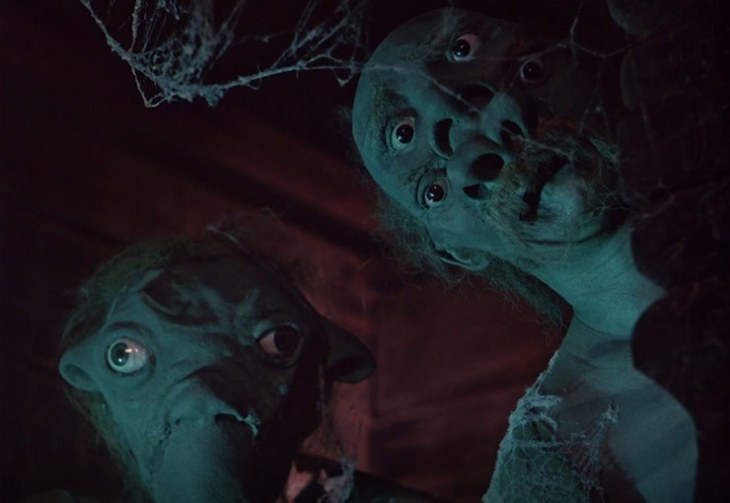
Big Trouble has got it goin’ on monster-wise. And who can forget this guy...

...and this guy…

What can I say? It’s a slow news day ‘round these parts. I think I’ll just kick back and enjoy the schtick-fu of Big Trouble in Little China. Think of it as a palette cleanser for the horrors to come.

Monday, October 11, 2021

11 October: I Walked with a Zombie


“Everything seems beautiful because you don't understand. Those flying fish, they're not leaping for joy, they're jumping in terror. Bigger fish want to eat them. That luminous water, it takes its gleam from millions of tiny dead bodies. The glitter of putrescence. There's no beauty here, only death and decay...Everything good dies here. Even the stars.”

Yesterday, we took a trip to Ukraine on the back of a horse drawn cart. Today, we are sailing in style to a tiny island in the Caribbean to discuss the 1943 RKO picture I Walked with a Zombie. And you thought you were just going to stay at home this Halloween! Today’s topic for Cinematic Void’s 31 Days of Voidoween is “Val Lewton.” In 1942, Lewton was given the reins to RKO Studios’ horror unit. He was also given three simple rules by his bosses: each film had to be made for less than $150,000, each was to have a runtime under 75 minutes, and the studio would give Lewton the film titles.

Within those strictures, Lewton produced a remarkable string of pictures beginning with Cat People in 1942. Using directors like Jacques Tourneur, Robert Wise, and Mark Robson, Lewton’s pictures all have a fairy tale, dream-like quality. Shadows are deep, dark, and dangerous. Because these were low-budget affairs, the “monsters” were usually kept in the dark, which allowed the audience to fill in the blanks.

I Walked with a Zombie roughly follows the narrative of Charlotte Brontë’s 1847 novel Jane Eyre. Lewton’s film, written by Curt “The Wolf-Man” Siodmak and Ardel Wray (no relation to Fay), follows nurse Betsy Connell (Frances Dee) to the island of Saint Sebastian. There she is charged with the care of Jessica (Christine Gordon), wife to sugar plantation owner Paul Holland (Tom Conway). Jessica meanders around the plantation in a stupor. Some say that her condition is due to a serious illness that left her without any willpower, but a local calypso singer croons a different story: Jessica was about to run away with her husband’s brother, Wesley (James Ellison), when she was struck down. Some say voodoo is to blame. To cure her patient, Betsy takes Jessica into the sugar cane fields, past the zombie-like guard Carrefour (Darby Jones), to visit the local houngan, or voodoo priest. Horrors ensue!

I Walked with a Zombie, like all the best horror films, serves up a multi-textual treat for viewers. There are shocks and shivers aplenty. Betsy’s and Jessica’s nighttime trip through the cane fields is one of the spookiest scenes ever. Below the horrors, however, is a presentation of the history of slavery and racism in the New World. The symbol of Saint Sebastian pierced with arrows, presented in the form of the old slave ship’s figurehead Ti-Misery, speaks to the history of lynchings in America. Pretty powerful stuff for a simple, 75-minute B-picture.

Sunday, October 10, 2021

10 October: The Viy

Today for the Cinematic Void’s 31 Days of Voidoween, make sure your papers are in order, because we are crossing the border and venturing into the realm of “Foreign Language Horror.” We will be traveling by plane, train, and mule cart to old Mother Russia to talk about the first Soviet-era horror film to be officially released in the USSR, Mosfilm’s 1967 adaptation of a Nicolai Gogol novella, The Viy.

While on his way home from the seminary, Khoma Brutus and two friends spend the night at an out of the way farmhouse. During the evening, an old woman puts Khoma under a spell and rides him through the air. After landing, Khoma beats the old woman with a stick. During the beating, the old crone becomes a young woman.

So far, it sounds like a usual night in Kiev.

Upon returning to his monastery, Khoma is told that his presence has been requested by a rich Cossack. The man’s daughter is dying, and she personally asked for Khoma Brutus to come and pray for her soul. At the Cossack’s estate, Khoma is locked in the chapel with the girl’s body. She is the same young woman who was the witch who rode Khoma’s back.

Again, nothing out of the ordinary so far as I can tell.

For three nights, Khoma is locked in with the corpse, and for three nights the corpse comes to life to torture the young priest. Each night is worse than the one before until, on the final night, the young woman calls on skeletons, demons, and imps to attack Khoma. Finally, after all else fails, the corpse calls on Viy - a horrific monster that even scares the other demons - to come for the priest.

I love the special effects in this picture. They have a simple, rough-and-ready feel that is incredibly inventive and imaginative as well as transparent in how they pulled it off. You have a lot of rear projection, moveable stage backgrounds to mimic travel through the countryside, forced perspective, stop-motion -- you name it, the filmmakers tossed it on the screen. The final demonic attack is especially effective. The make-up on the actors is very creepy and weird. All in all, The Viy is terrific tale of terror that transcends its budgetary limitations. 

Saturday, October 9, 2021

9 October: Silver Bullet


Knock, knock!
Who’s there?
Ahh.
Ahh who?
Ahh whooooo….werewolves of London!

The classics really are the best.

The movie I’ve chosen to sink my teeth into today for the Cinematic Void’s 31 Days of Voidoween may not be much of a classic, but it still holds a special place in my heart. Today’s topic is “Werewolf,” and we’re gonna look at the film adaptation of Stephen King’s Cycle of the Werewolf -- 1985’s Silver Bullet.

Silver Bullet is one of those movies that I wish I could break through the screen and live in. First off, I’d be living in Stephen King country, the land of perpetual autumn. Second, I’d get to hang out with Marty Coslaw (Corey Haim) and his gasoline-powered wheelchair that was built by his cool Uncle Red (Gary Busey). Third, I’d get to flirt with Marty’s sister and film’s narrator, Jane (Megan Follows). Umm...I’d also be the 14-year-old I was when the movie came out and not the 50-year-old I am now which makes the flirting with Jane thing seem not as creepy as it sounds.

And, most importantly, there’d be werewolves! Not the best looking werewolves ever committed to film, but werewolves nonetheless. Ahh-ooooo!

Silver Bullet played a lot on TV in the late 80s and early 90s. I seem to remember always catching it on a Saturday afternoon. It’s got a great mid-80s horror vibe with its nice combination of comedy moments and spooky moments. The performances of Haim and Follows as brother and sister are wonderful and heartfelt. Throw Gary Busey being Gary Busey into the mix, and you get a movie that always makes me smile.

Do yourself a favor and pick up King’s original book. The Berni Wrightson illustrations are especially fine and really tie the room together, so to speak. I can remember my mom (bless her heart) buying it for me when I was a kid. I spent a lot of time looking at those pictures and wondering if the pastor at my church had a similar secret he was hiding from the world.

On a non-werewolf-related topic, track down the audio version of J. Sheridan Le Fanu’s erotic vampire tale, Carmilla. Megan Follows does a bang-up job narrating Le Fanu’s Gothic Victorian story.

Friday, October 8, 2021

8 October: The Blair Witch Project

It’s 8 October. While I sit at my desk pondering today’s challenge for Cinematic Void’s 31 Days of Voidoween -- “Slow Burn” if you’re scoring at home -- I have the windows open and can happily say that it officially feels like fall here in SoCal. The air is slightly cooler, the leaves are turning colors, and the stick figures are hanging from the bare branches of trees like some kind of eerie fruit. Well, maybe that last one is only happening in the woods surrounding Burkittsville, MD, the site of today’s movie: The Blair Witch Project.

Released in 1999, The Blair Witch Project was, at the time, a movie like no other. Made for a measly $60,000, it was a purported found-footage documentary filled with jerky camera work, a mixture of 16mm film and video, and really bad hiking decisions made by three young, independent filmmakers. (I do not encourage would-be visitors to the woods to kick their map into a creek.)

Was it really a documentary, though? Certainly the film’s website and an hour-long special aired on the SciFi Channel, Curse of the Blair Witch, made it out to be so. It was hard to separate the fact from the fiction, because the fiction -- official looking police reports, newsreel-style footage, interviews with family and friends of the missing filmmakers -- was so convincingly presented as fact. By the time viewers sat in their seats at their local multiplex, their heads had been so turned around by the film’s marketing campaign that they were ready to believe anything.

In 1999, I was one of those people. While I didn’t visit the website or see the SciFi Channel faux-doc, The Blair Witch Project worked on me like no movie had done so before (or since, if I’m being honest). I knew what I was seeing was only a movie, but everything -- the camerawork, the performances, the “texture” of the footage, the slow build-up of little events over the length of the film culminating with that final scene in the basement -- felt so darn real. I was shaking when I walked out of the theater. That night, I did not sleep a wink. At all. I lay in bed all night thinking of the movie, the characters, and...the witch.

I’ve never been so terrified in all my life.

I can’t think of higher praise for a movie.

Thursday, October 7, 2021

7 October: The Perfume of the Lady in Black

Today is 7 October. It’s an atypically grey day here in sunny Southern California. The type of day made for staying in and watching horror movies. Of course, everyday is made for staying in and watching horror movies as far as I am concerned. But what type of horror movie should we watch? Our friends at the Cinematic Void have decreed today to be “Giallo” day in their 31 days of Voidoween Movie Challenge. And who am I to argue...because there’s always room for giallo!

That’s right. I said it.

The giallo I’ve chosen for today is an odd one. That’s saying a lot for a genre that is filled to overflowing with “odd ones.” I’ve picked the 1974 Francesco Barilli film The Perfume of the Lady in Black. It stars the beautiful Mimsy Farmer, who in my opinion has never looked more beautiful or more haunted...or more delicious (nudge, nudge...wink, wink).

In a nutshell, the film follows Silvia (Farmer), a manager at a local chemical company, as her past seems to catch up with and overtake her. It seems that as a child Silvia caught her mum having sex with a man who wasn’t Silvia’s dad. Mum then took a header off a balcony. Reality and fantasy intermingle in Silvia’s mind until she -- and the viewer --  is unable to discern between the two. There is talk of modern day witch cults and human sacrifice. Silvia goes to the zoo. Silvia goes to a seance. Silvia goes to a taxidermist. Silvia speaks to her younger self. Then, things get weird.

I won’t go into the weirdness. I want you to experience it for yourself. The ending of the films is a bizarre as they come. “Out of left field” doesn’t even begin to describe it. If you like your gialli with a dash of illogic and a soupçon of surrealism, then The Perfume of the Lady in Black is for you.

Also, if you are fan of giallo music, then picking up the Death Waltz Recording Company release of the soundtrack by Nicola Piovani should be for you, too. It's like the movie: beautiful, haunting...and delicious!

Wednesday, October 6, 2021

6 October: Abbott & Costello Meet Frankenstein

It’s 6 October, and it’s a little too early in the Cinematic Void’s 31 Days of Voidoween to feel like I am under the gun. I’ve still got nearly a month to go! How am I going to be feeling come the 16th or the 26th?

You and me both, Captain Rhodes.

So, let’s keep today’s entry short and/or sweet. We got “Monsters” to discuss. When you say “Monsters,” I think of that original pantheon of creatures great and small: the Universal Monsters. And when you say “Universal Monsters,” the images of Dracula, Frankenstein’s Monster, and The Wolf-Man trading blows and barbs with Bud Abbott and Lou Costello springs to mind. So, let’s talk 1948’s Abbott & Costello Meet Frankenstein.

It was the tail-end of the horror movie cycle that had started with 1931’s Dracula and Frankenstein. The monsters were pretty played out. They’d been sequelized and mashed together so often that by 1948 they just weren’t scary anymore. The only thing left to do was to play them for laughs.

Abbott & Costello, too, were nearing their sell-by date. The comedy duo had been going strong since first teaming up on the stage in 1935. They then brought their talents to radio, first to The Kate Smith Hour, then to their own show which was a summer replacement for Fred Allen in 1940. Soon, Hollywood beckoned, and the team began their string of hits for Universal Studios. By 1948, however, Abbott & Costello’s career, like Frankenstein’s Monster, was in need of a jolt.

Abbott & Costello Meet Frankenstein was just what the mad doctor ordered. It is one of the most successful horror-comedies of all time. It works well because the laughs and the screams come in equal measure. When it is funny, it’s really funny, and when it needs to get spooky, it gets very spooky. The scenes in the underground chambers in the castle are very well shot. The shadows are deep and dark, the moisture on the walls glistens in the torchlight. The battle between Dracula and The Wolf-Man culminates in a terrifying shot of ol’ Wolfie diving off the balcony to grab Drac in bat form. He does so, but the two plummet to their deaths (?) on the rocky shoreline below.

The comedy is spot on, too. There are gags aplenty throughout. Costello does the sliding candle bit that had worked well in earlier movies (1941’s Hold That Ghost). My favorite comedy scenes are the ones where Bud and Lou play with Lon Chaney’s melancholy character Lawrence Talbot. My personal favorite gag plays out at the costume party near the end of the film:

Larry Talbot: I know you'll think I'm crazy, but in a half an hour the moon will rise and I'll turn into a wolf.

Wilbur: You and twenty million other guys.

Larry Talbot: [slamming Wilbur into a locker with Chick going in behind him] Listen! I might tear you limb from limb!

Wilbur: [turning to Chick in the locker] Is that serious?

Chick Young: He'll murder ya!

Wilbur: [turns to Talbot] That's serious.

The success of Abbott & Costello Meet Frankenstein meant that the comedy pair had to meet the other monsters - The Invisible Man, Dr. Jekyll & Mr. Hyde, The Mummy - in subsequent films. They’re entertaining, but never did they hit the heights this picture did.

Tuesday, October 5, 2021

5 October: "Good Morning, Captain"


It’s 5 October, and by my watch -- and Cinematic Void’s 31 Days of Voidoween -- that makes it time to talk “Seaside Horror.” My past two entries have switched it up a bit. Voidoween was meant to be a movie watching challenge during the month of October, but ‘round these parts Halloween is much more than movies. There’s TV shows and books and short stories and radio programs and, like today’s choice, music. Let’s take a listen to one of the scariest songs I’ve ever heard: Slint’s “Good Morning, Captain” from their 1991 album Spiderland.


I’ll be honest, I don’t know how seaside-y “Good Morning, Captain” really is. The lyrics are pretty cryptic. There’s mention of a shipwreck and death in the first verse: “Scattered remnants of the ship could be seen in the distance/Blood stained the icy wall of the shore.” There’s someone named “the captain” who is perhaps the lone survivor of the wreck? There’s a child who haunts the captain in some way:
From behind the edge of the windowsill,
There appeared the delicate hand of a child.
His face was flush and timid.
He stared at the captain through frightened eyes.

The captain reached for something to hold on to,
“Help me,” he whispered, as he rose slowly to his feet...
As I say, it’s all pretty cryptic and weird.


Adding to the feelings of weirdness is the music itself. Considered by many to to be one the earliest post-rock records, Spiderland is filled to overflowing with odd syncopation, whispered vocals, and guitarwork that runs from quietly plucked chords to screeching, distorted runs. On “Good Morning, Captain,” the post-rock machine is running on all cylinders: Britt Walford’s drum playing is more akin to a guitar riff, while David Pajo’s guitar and Todd Brashear’s bass lay down a driving, hypnotic rhythm. Behind this, Brian McMahan sing-speaks his vocals, delivering the story of the captain as though it were a campfire tale. At the end, his screams of “I miss you!” are haunting and chilling.


Listen to “Good Morning, Captain” at night by candlelight on a good pair of headphones and you’ll see why I included it in this year’s Voidoween. Heck, listen to the whole Spiderland record from start to finish if you have the time...and the nerve. It’s as good as any spooky Edgar Allan Poe short story collection.

Monday, October 4, 2021

4 October: Harvest Home


It’s 4 October, and we are proceeding at a steady pace towards Halloween. Before you know it, we’ll all be on the phone to our local TV stations, screaming at them at the top of our lungs to stop it, Stop It, STOP IT!


But that’s for later. For now let us continue down the path that L.A.’s Cinematic Void prepared for us. According to The 31 Days of Voidoween, today is all about “Folk Horror,” that somewhat newish genre of film that seems to be everywhere nowadays. It’s kind of like film noir. It’s a critics’ term that was defined well after the films that serve as its prime examples were released. If you’re interested, I’ve got more to say about the genre in an earlier entry on this blog -- check out my discussion of Nigel Kneale’s “Murrain.” Today, I want to talk about a folk horror novel that I think should be read much more than it seems to be. Let’s talk Harvest Home by Thomas Tryon.


In the late-1970s, Stephen King had this to say about Tryon’s novel:
"It isn't a great book, not a great horror novel, not even a great suspense novel ... Never mind the best seller list. Mind this, instead: Sentence by sentence, paragraph by paragraph, it is a true book; it is an honest book in the sense that it says exactly what Tryon wanted to say. And if what he wanted to say wasn't exactly Miltonian, it does have this going for it: in forty years, when most of us are underground, there will still be a routine rebinding once a year for the library copies of Harvest Home.”
I think ol’ Stevie maybe got it backwards, because I think Harvest Home is a pretty terrific (in all senses of the word) book that very few people read anymore, let alone are even aware of. (I’d be interested to know the condition of the book at my local library and whether or not it is lovingly rebound year after year.) When I went to see Ari Aster’s Midsommar a few years ago, I was somewhat surprised by the amount of people who thought it was so original and daring. I said to my wife at the time, “It’s like no one’s ever heard of The Wicker Man or Harvest Home.” She turned to me and said, “What’s Harvest Home?”

See what I mean?

Harvest Home is an example of what I like to call the “Return to Nature” genre that became very popular in the 1970s. RtN texts usually concern a person or group of people who decide that they can’t live in the city anymore. It’s just too dangerous and dirty and anti-human. So, they pull stakes and split the scene and make for the countryside. You know, where people are more “real” (whatever that means) and where they can live off the land. So far, we can consider Green Acres to be part of the Return to Nature genre.


Where things usually go off the rails on this crazy train and send us into Folk Horror territory is that we eventually discover that the good townsfolk who welcomed us with open arms are actually cultists of some sort who are looking for fresh blood for their arcane, eldritch rituals. Oh, well, at least the air is fresh, right?

Such is the case in Harvest Home. Ned Constantine moves his wife Bethany and their daughter Kate from New York City to the Connecticut village of Cornwall Coombe. The Coombe seems to be utterly isolated (uh-oh), and the villagers like it that way. They are also very proud that they keep to the “old ways" (UH-oh). They also partake in many festivals throughout the year, culminating with the most important one, “Harvest Home,” which only takes place once every seven years.

UH-OH!


Need I say more? You know what’s comin’. Your Aunt Suzie knows what’s comin’. You know who doesn’t know what’s comin’? Ned. The big dummy just has to see what happens during the Harvest Home festival. I won’t say more, but rest assured that it’s a little more complicated than corn mazes.

If you don’t feel like sitting down with Tryon’s novel, then track down the made-for-TV movie that was made in the 1970s starring Bette Davis as Widow Fortune, the town’s matriarch.


Fun fact: before he turned his talents to writing, Thomas Tryon was an actor. He appeared on Broadway, TV, and movies in the 1950s and 1960s. Monster kids may recognize his face, if not his name, from the classic I Married a Monster from Outer Space!