Thursday, October 6, 2022

Blog-o-ween 2022: The Witch's Tale

The past few entries of Blog-o-ween 2022 have focused on more recent old time radio thrills. Today, let's jump into the wayback machine and travel to a time when commercial radio was young. In 1931, WOR and the Mutual Radio Network in New York City began to broadcast a radio program that would become one of the most influential pop culture artifacts of the 20th century. You may never have heard the raspy cackle of Old Nancy, the Witch of Salem, or the gutteral yowls of her cat, Satan, but their impact is felt even today in comic books and television. Come...sit by the fire...and listen to...The Witch's Tale.

The Witch's Tale was created, written, and directed by Alonzo Deen Cole. Cole, like any good innovator, had to convince his bosses at WOR to allow him to try his hand at a supernatural drama show. Management was unsure if a spook show was the right thing to compete with other stations' musical programming at the same time slot. The Witch's Tale, of course, became a huge hit, especially with the kids in New York City, who loved imitating the bon mots of the show's host, Old Nancy.

Old Nancy (and her pussycat, Satan -- played by Cole himself, some say!) was one of the first "Horror Hosts" in popular cutlture. The horror host acted as an MC for the evening's entertainment, guiding the listener through the more grueling aspects of the grand guignol with a well-placed zinger and pun. Other radio shows followed suit, and the idea made the jump to television in the 1950s when the Shock! films package was made available in syndication. Soon, every TV station had its own Old Nancy -- Vampira, Zacherley, Svengoolie, Chilly Billy, and Ghoulardi, to name but a few.

Even the comic books got in on the act. Bill Gaines's seminal horror line for EC Comics -- Tales from the Crypt, The Vault of Horror, and The Haunt of Fear -- brought the horror host to the full-color page. More comic book horror hosts followed: Uncle Creepy, Cousin Eerie, and Squire Shade. Even today, actor David Dastmalchian uses a television horror host as the central character of his wonderful series Count Crowley: Reluctant Midnight Monster Hunter.

Old Nancy was originally played by stage actress Adelaide Fitz-Allen. When she died in 1935 at the age of 80, it left the show in the lurch.

No...not that Lurch...

Assistence came in the most unlikeliest of forms. One night, after a late night broadcast, 13-year-old radio actor Miriam Wolfe began doing her Old Nancy imitation for kicks right on the spot. Alonzo Deen Cole heard her and was so enchanted and horrified by her vocal abilities that he hired her to fill role!

Sadly, Cole, like so many others on the cutting edge of culture, did not see the value of his own work. He held on to the original acetate discs that all the shows were recorded on. (It was common at the time for smaller networks to do this so that the same programs could be syndicated across the country and the world.) He also was one of the first (if not the first) radio writer to copyright his stories, and he kept bound copies of 332 of his scripts. However, by 1961, Cole didn't think anyone actually cared about the show anymore, so he destroyed all of his recordings before moving across the country. Less than 10% of the recordings of The Witch's Tale survive.

So, let's stop and visit Old Nancy and Satan for a while. Maybe Satan will jump up in your lap and let you pet him while Old Nancy spins a tale of Aztecs and ouija boards, of reincarnation and possession..."The Knife of Sacrifice!"

Wednesday, October 5, 2022

Blog-o-ween 2022: Nightfall

Canada has given the world so much. From our friendly neighbors to the north, we've received the gifts of Rush, David Cronenberg, SCTV, Molson and poutine. Any one of those achievements by itself would have any other country bragging about how great they are. But does Canada go for any of that back-patting and self-aggrandizement. Heck, no, eh! They just keep on keepin' on, churning out the Soska Sisters, Drake, Pamela Anderson, back bacon, and Tim Hortons seemingly on their days off.

Well played, Canada! For you, there is beer on the sun!

Let's add another gold star next to Canada's name in the ol' gradebook, so to speak, and discuss one of the scariest radio programs ever, Nightfall.

Nightfall was created by Bill Howell and aired on CBC Radio from July 1980 to June 1983. The majority of the episodes were horror, but there were other styles and genres mixed in, including science fiction and mystery. Nightfall's opening voiceover ranks up there with the credit sequence for Tales from the Darkside for spine-chilling creepiness. Indeed, many listeners complained to the CBC that Nightfall was too scary and convinced certain affiliates not to run the program. If that isn’t a recommendation, I don’t know what is!

You can find many, if not all, of Nightfall’s 100 episodes on the Internet Archive. Later during Blog-o-ween, we will return to the airwaves of the Great White North to rhapsodize over Nightfall's adaptation of the W. W. Jacob's short story "The Monkey's Paw." Today, however, I want to focus attention on another fantastic adaptation: "Carmilla." Adapted by John Douglas and Graham Pomeroy from Irish writer J. Sheridan LeFanu's classic novella, this rendition has all the eerie trappings of a great Gothic story. You've got a remote castle, horse-drawn coaches, wind whistling through the trees, mysterious deaths, and lesbianism! As in other Nightfall productions, the sound design and music accompaniment hit all the right tones (pun intended!), and the acting is top notch. Indeed, the actress portraying the title character does a wonderful job of exuding sensuality and danger. At times, it feels as though we are listening to a Hammer Studios production -- which is perfect, because Hammer created an excellent cinematic version of LeFanu's story in 1970 as The Vampire Lovers.

You can listen to "Carmilla" here, and if you are interested in Hammer's film (and who in their right mind wouldn't want to see Ingrid Pitt strut her stuff as Carmilla -- and what stuff it is!) you can...look for it yourself. In the meantime, here's Ms. Pitt doing what she does best -- look Germanic and sexy!

Tuesday, October 4, 2022

Blog-o-ween 2022: Knifepoint Horror

Today feels like a good day to throw a joker into the deck, so to speak, and talk about the "New" Old Time Radio: podcasts. The concept of "asyncrhronous radio" was developed in the early-1990s, but it wasn't until the early-2000s that the artform we know as the podcast (a portmanteau of the words "iPod" and "broadcast," natch) began its rise to ubiquity. Unlike radio, which required listeners to tune in to a specific station on a specific day at a specific time to enjoy programming, the internet allowed listeners to grab any episode they wanted, anytime they wanted it, in the form of audio files. According to recent data, as of August, 2022, there are around 2.8 million podcasts (well over three-quarters of which are true crime related, I'm sure) with nearly 140 million episodes (none of which will play from oldest-to-newest on Apple's podcast app).

Now that I have the "boring details and stats that a child could look up" portion of this entry out of the way, let's jump right into one of the best horror podcasts out there, Knifepoint Horror.

Like yesterday's entry, The Black Mass, Knifepoint Horror consists of stories whose power and influence are mostly derived from the immediacy of their first-person narration and their sparse, yet effective, background sound design and music. Knifepoint Horror, like The Black Mass, gives the listener the sense that the narrator is spinning a yarn off the cuff by the campfire at night. This style of narration allows the story to cut through everything and stick in the listener's imagination.

Knifepoint Horror is the brainchild of writer Soren Narnia, who, except for an episode here and there, takes care of the narration duties, as well. Narnia's deadpan, matter-of-fact tone gives each story a dreadful life of its own. Narnia speaks as though the events he is recounting are still unfolding, as if the dark things he discovered are nipping at his heels. In a way, Knifepoint Horror's stories give me the same sense of utter weirdness as the songs from Slint's 1991 album Spiderland. Narnia's prose, like Slint's sounds, seem to come from some other, alien world. The cover to Spiderland could even serve as artwork to a Knifepoint Horror story. Maybe one called "quarry?"

The single-word, uncapitalized titles of the majority of the episodes also lend a layer of the uncanny to the proceedings. With titles such as "corpse," "eyes," "outcast," "rehersal," and "tunnel," each episode feels as though they are from a moldy manuscript found in the basement of a haunted house.

You can find all of Knifepoint Horror's episodes at their LibSyn page here. Feel free to dive in anywhere. Because Narnia releases Knifepoint Horror under the Creative Commons Attribution-NonCommercial-ShareAlike CC BY-NC-SA licensing agreement, you can probably also find many adaptations in many other formats -- short films, ASMR videos on YouTube, and graphic novels, for instance.

My choice for today's entry is one of the first stories I heard when I discovered Knifepoint Horror: "school." There's not much more I want to say about it except: wait until it gets dark, throw on some headphones, and let Soren Narnia's voice transport you to a different, haunting landscape.


Monday, October 3, 2022

Blog-o-ween 2022: The Black Mass

It's day three of Blog-o-ween 2022, and today we're again going to look at and listen to a radio program that was broadcast well outside of the usual agreed-upon Golden Age of Radio timeframe (1930s-1950s). The Black Mass aired 31 episodes on KPFA (Berkeley) and KPFK (Los Angeles) from 1963 to 1970. Produced by Erik Bauersfeld, The Black Mass differed from other radio dramas in that most episodes were simply first-person renditions of famous supernatural short stories instead of full-cast dramatic adaptations. This format gives The Black Mass the eerie feeling of a good old fashioned campfire tale. Stories were further enhanced by the sound design of KPFA's Production Director, John Whiting.

The Black Mass's strength lies in the immediacy of its tales' telling. The first-person narration works wonders with authors such as M.R. James, Edgar Allan Poe, and the writer of today's story, H.P. Lovecraft. The Black Mass's adaptation of "The Outsider" is spot on. The baleful echoes, dripping water, and screaming crowds in the background lends Lovecraft's tale the perfect accompaniment. You can listen to "The Outsider" and many other of Black Mass's episodes at Relic Radio.

Sunday, October 2, 2022

Blog-o-ween 2022: Beyond Midnight

For today's second installment of Blog-o-ween 2022, let's take a look at a specific radio program. Beyond Midnight is not one of the hallowed members of the Golden Age of Radio - that slice of time running from the birth of commercial radio (thank you, KDKA in Pittsburgh!) through to the 1950s, when television took hold of the public's imagination (and wallets). Running on Springbok Radio in South Africa from 1968 to 1970, Beyond Midnight was the brainchild of Michael McCabe, who acted as producer and writer for the series. McCabe and Co. produced 78 30-minute episodes of supernatural horror. Many of these stories were adaptations of tales by authors such as Ray Bradbury, Charles Dickens, A.M. Burrage, Robert W. Chambers, W.W. Jacobs, William Hope Hodgson, and Edith Nesbit.

Almost as scary as the stories featured on Beyond Midnight were the adverts from show sponsor Bio-Tex. The laundry soap and pre-wash powder manufacturer's tagline "Just soak, just soak, just soak in Bio-Tex" is often spoken in a deadpan manner by the show's host, giving the words a more chilling feel than was probably intended.

You can find many of Beyond Midnight's episodes at the Internet Archive, as well as the excellent old time radio resource Relic Radio. We will be featuring one of Beyond Midnight's episodes later this month, A.M. Burrage's Christmas ghost story "Smee." For now, enjoy this adaptation of English writer and poet Edith Nesbit's snort story "Man-Size in Marble." Here is "The Marble Knights."

Saturday, October 1, 2022

Blog-o-ween 2022: "A Day at the Dentist"

Well, well, well...we meet again. It is time for another month-long celebration of the strange, the spooky, and the just plain weird. If you're asking yourself, "Doesn't this blog do that the rest of the year, too?" then I can only answer with a definite...

While we are waiting for the tubes in the ol' Philco to warm up, let's drop the needle on a collection of some of the Golden Age of Radio's most terrifying tales. While there are scores and scores of radio programs that were recorded, saved, and made available for listening, the truth of the matter is that the majority of broadcasts are lost to us. Maybe some lucky sod on a rock orbiting Proxima Centauri got to hear them and was fast enough with the record button on their reel-to-reel (or whatever they got up there), but for us on Earth, we can only imagine what they sounded like. Because of this blasé attitude at the time towards "low" forms of media, some radio producers recreated their most famous programs decades later for posterity. Our first foray into Blog-o-ween 2022 is one such recreation. In 1962, one of the masters of radio horror, Arch Oboler, gathered a few friends together and recorded Drop Dead!: An Exercise in Horror! Let's start spooky season off right with a short, sharp story on side two of that Capitol Records LP. Let's go and spend "A Day at the Dentist."

It's a very simple story: Fred Houseman is in need of an emergency trip to the dentist. Unfortunately for Freddie, he is, like so many people are, a dentophobe - he is afraid of the dentist. He's chosen Dr. Charles's practice, because the good doctor advertises himself as "the painless dentist." Unfortunately (again!) for Freddie, Charles was bought out by a man who knows Freddie and his fear all too well. It seems that Freddie did something in the past to the new dentist's wife, something "very special...worth remembering, worth talking about, worth slobbering over." After the doc has strapped Freddie into the chair to keep him absolutely still - you know...for sake of keeping everything "painless" - the sound of the drill revs up and Freddie's frantics pleadings fill the air. Before you can ask "Is it safe?" the story ends.

We won't spend too much time right now discussing Arch Oboler and his impact on radio (Oboler will appear again later this month), but for now let's just say the man knew the power of suggestion and sound. In his book Danse Macabre, Stephen King singles out Oboler and his radio program Lights Out as the pinnacle of the genre. King says that

Oboler...utilized two of radio's great strengths: the first in the mind's innate obedience, its willingness to try to see whatever someone suggests it see, no matter how absurd; the second is the fact that fear and horror are blinding emotions that knock our adult pins from beneath us and leave us groping in the dark like children who cannot find the light switch. Radio is, of course, the 'blind' medium, and only Oboler used it so well or so completely.

Even though it is only a couple of minutes long, "A Day at the Dentist" is long enough for Oboler to use both of these tricks against the listener. Using sound and suggestion, Oboler first creates the most mundane of settings, a dentist's office, in the mind of the listener. Then, slowly, inexorably, this setting is turned into a theater of pain and horror.

Another strength of Oboler's work in general and "A Day at the Dentist" in particular, is that it forces the listener to consider a few important facets for him/herself. First off, what is it that Fred Houseman did to the dentist's wife, Mary, and what about it was "worth slobbering over?" Second off, where did the dentist apply his drill? Oboler does not offer any concrete answers to those questions. The mind of the listener, however, comes up with quite a few interesting possibilities, but mileage may vary depending on how well he or she understands ol' Freddie's trangressions. As Stephen King says in Danse Macabre,

My first thought was that the dentist had almost surely used the drill on one of Houseman's temples, murdering him with a little impromptu brain surgery.

But later, as I grew up and grew into a better comprehension of just what the nature of Houseman's crime had been, another possibility began to suggest itself. An even nastier one.

Hmmm...what could that be, I wonder? Why not listen for yourself and make up your own mind...

Friday, September 30, 2022

Super Duper October Halloweeny Blog-a-thon-a-rama!

Well, kiddies, it's that time of year again. It's time for all good ghoulies and ghosties to turn the page on the ol' calendar and hunker down for a month-long celebration of all things spookie and weird! Thirty-one fright-filled days...what's the worst that could happen?

Here at LARPing Real Life, we take the scary season seriously...albeit with forked tongue planted firmly in cheek. Last year, thinks to the fine folks at Los Angeles's prime purveyor of movie mayhem, Cinematic Void, we traipsed through the merry month of October, discussing a different topic every day. We talked movies, books, TV shows, and music; folk horror, ghosts, vampires, and gialli...if it was creepy, then we blogged about it.

This year, we are doing things a little differently. For Blog-a-ween 2022, LARPing Real Life is going to have a one track mind, and on that track runs the Old Time Radio Express!

She ain't much to look at, folks, but she'll get you to where you're going all the same.

Starting tomorrow and continuing until Halloween, we will be talking about some of the scariest, spookiest, weirdest radio shows ever spit out into space. We'll share links to episodes from Golden Age radio programs like Lights Out, Inner Sanctum, Quiet...Please, and The Witch's Tale. We'll talk hosts like Arch Oboler and Raymond Johnson. We'll listen to actors like Angnes Moorehead and Vincent Price strut their stuff. We'll even take a break when things get too scary and listen to a word from sponsors like Roma Wine and Bromo Seltzer.

So, stop by again tomorrow and the following thirty days to enjoy some old time radio thrills and chills. Until then...

Friday, June 10, 2022

Tucker's Witch, Ep. 2, "Big Mouth"

Hollywood gossip reporter Jewel Porter comes home one night to find that someone has left her a present in her bathroom. It isn't a lavender-scented candle — it’s a cobra! The next day, she contacts the Tuckers to investigate. She shows Rick and Amanda a threatening letter from the killer and tells them that these sorts of things are all part and parcel of the gossip game. Amanda suggests that since there was an attempt on Porter’s life then the police should be called, but her idea is nixed. Porter doesn’t want the police and the subsequent media attention their presence would bring. The gossiper doesn’t like to be gossiped about, natch.

Soon, however, due to some expertly placed explosives, the decision is made for Jewel Porter. The bodies begin piling up, as do the suspects and red herrings. There’s Porter’s personal assistant and would-be gossip reporter, Darren. Porter’s fellow gossip-monger Nathan Blye also makes the list of usual suspects. You have to suspect the husband, Terry, and his secretary/mistress, Christy. And because all of Jewel’s money goes to her daughter if she kicks the bucket, then Dawn, as well as her secret husband, Andre (Porter’s masseur) have to be in the line-up.

Will the Tuckers figure it all out? How is Amanda going to use her powers to crack the case? What does a cat statue have to do with it all? And who or what is the “alien force” that Dickens seems to think is sneaking into the Tuckers’ garbage cans at night?

There are two things I want to set straight right from the start. One, I understand the name of this episode is “Big Mouth,” but Martha Raye does not make an appearance, so don’t get your hopes up.

Two, the killer is Andre. Before you begin screaming “SPOILER ALERT!” at me, just know that we’re shown that Andre is up to no good from the very beginning. Unless Jewel Porter has a mongoose infestation in her bathroom, I can’t think of any reason outside of murder for Andre to leave a cobra in her bathtub. So, like the pilot episode, the viewer is privy to information that the Tuckers are not — namely, the killer’s identity — and the whole thrust of the story is to watch them unravel the clues and figure it all out.

That’s all well and good, but Andre’s identity as the killer could have easily been hidden from the viewer’s ken. I mean, that’s what POV camerawork and well-framed shots of the killer’s hands in black leather gloves are for, no?

The how-dunit/why-dunit formula works on Columbo, because we love watching the good lieutenant nag the suspect to death with his insights as he meticulously pieces all the clues together. I’m not so sure it works for Tucker’s Witch. This episode has enough would-be suspects that the viewer could have had a lot of fun working with the Tuckers to figure out who the killer is. Instead, because we know it’s Andre from the beginning, it isn’t as satisfying a watch. Rick and Amanda are a cute couple, but “cute” don’t cut it when we have to watch them work their way through clues and red herrings that we know ultimately don’t mean a thing.

Ahhhh…enough about what I think is wrong…let’s talk about what this episode gets right. Let’s start with our supporting players, Alfre Woodard and Barbara Barrie. Somewhere in the multiverse, in a world where Tucker’s Witch is a big, big hit, there are episodes - possibly in the third or fourth season - where Marcia (Woodard) and Ellen (Barrie) solve crimes, either as a team or separately, while Rick and Amanda are off on vacation somewhere. Instead, we have to make do with the few minutes per episode each is granted.

In this case, we get to watch Amanda’s mother, Ellen, try to outwit a “hostile alien force,” i.e. a raccoon that’s been getting into the trash every night. After speaking to someone from animal control about what to use as bait in the traps for this tiny invader, Ellen, a bit preoccupied, lets Amanda and Jewel Porter’s daughter, Dawn, know that there’s dessert to be had:

Ellen: I couldn’t find any marshmallows, so I had to use sardines.

[Amanda and Dawn look confused as Ellen walks away.]

Ellen [spinning back around]: Oh! I made a lovely cake. Would you like some?

It’s a sweet gag that highlights Ellen’s flibbertigibbetiness.

Back at the office, Marcia is used as an exposition dump, spitting out clues and motives. We also get a snippet of snark about Jewel Porter:

Rick: Where would we go to get a list of Jewel Porter’s professional enemies?

Marcia: The Academy Awards.

Boom. Thanks, Marcia.

What else is going on in this episode? Well, we’ve got one of my favorite mystery tropes: the typewritten note with off-set letters that lets the detective know exactly which typewriter was used. As he investigates one of the threatening letters Jewel Porter received, Rick notices some odd characteristics:

Rick: I tell you what I get…I get the letter M out of alignment. It’s a manual typewriter, not an electric. Some letters lighter, some letters darker, which tells me the person was using a hunt-and-peck method.

That’s some good, ol’ fashioned sleuthing!

There’s also an appearance of a guy in a gorilla suit. What’s more, it’s Andre, stalking the catwalks above Jewel Porter’s TV show like a hirsute Phantom of the Opera. After cutting the ropes on the lights over Porter’s head in hopes that she gets smooshed (spoiler: she doesn’t), Andre the Ape cuts and runs out of the studio and disappears into the Universal backlot. We get a great look at the false fronts of the buildings as Rick searches for the would-be killer.

Threaded throughout this episode are charming moments where Rick tries to piece together a “lost” evening. It seems ol’ Rick got a little tipsy at a party and mislaid his jacket…his sock…and much of his memory. It has nothing to do with the main plot, but it’s fun seeing Amanda and Marcia make fun of him as little by little his activities that night are revealed to him.

Rick: Why don’t you use your magic for something more useful like helping me find my jacket?

Amanda: You probably left it at Tina and Jerry’s last night. Boy, did you get blotto.

Rick: I was not blotto. I never get blotto. I was attacked. Whoever heard of Portuguese vodka? [Concerned.] Was I that bad?

Amanda: You were fine once you stopped bullfighting with the schnauzer.

Ah, it happens to the best of us, Rick!

In the “Hey, it’s him/her!” department, working the desk in Jewel Porter’s office is none other than Liz “Raquel Ochmonek” Sheridan. Sheridan should be a familiar face to TV viewers, especially fans of ALF. Sheridan made a career playing fussy, put-upon types, and this role is no different.

This has nothing to do with the show itself, but I did notice a moment where whoever digitized the original media for Tucker’s Witch failed to properly edit the image. During a scene at the Tuckers’ office, we get a shot of Amanda flanked by sprocket holes. As someone who used to work for a media preservation company, it’s a neat reminder that these shows don’t just live in the bodiless realm of the internet. They have an actual, physical form. It’s also a moment that makes me wonder if the company responsible for digitizing this show is hiring – I’m very detail-oriented!

That brings us to the end of another episode of Tucker’s Witch. Next time, we’ll be talking about episode three, “The Corpse Who Knew Too Much,” which may be one of the most overused titles in the mystery genre. Before I leave you, allow me to remind you what to do the next time you drink Portuguese vodka. In the words of Rick’s buddy, Andy, before you drink it, you want to take this much olive oil and three tablespoons of cream cheese, then you’re safe.

Words of wisdom, Andy. Words. Of. Wisdom.

Sunday, January 30, 2022

Wings, S02E3, "A Little Nightmare Music"


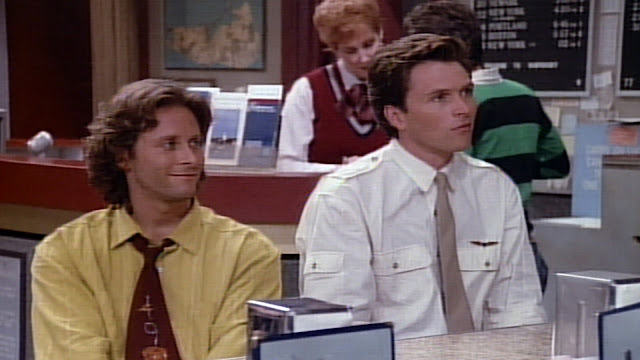
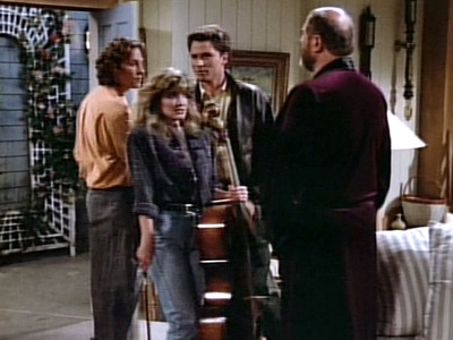
As disembarking passengers enter the terminal at Tom Nevers Field, Helen recognizes one as Edward Tinsdale, the famous conductor of the Minneapolis Philharmonic. At the behest of Joe and Brian, Helen returns Tinsdale’s “lost” luggage to him and asks for an impromptu audition in order to gauge her development as a cellist. Alas, the great man’s cutting feedback is hard for Helen to hear. Distraught, Helen reevaluates her life, wondering if all the years of practice she’s put into her music were worth it.

Meanwhile, Faye is practicing for her turn as “Madame Zorco - Fortune Teller” at the annual V.F.W. carnival. One of Faye’s…er…Madame Zorco’s predictions comes true for Lowell, so naturally Roy wants his fortune read, as well. Alas (there’s a lot of alasing in this episode), the cards determine that Roy’s future isn’t as rosy as Lowell’s.

Will Helen give up the cello? Will Roy’s luck ever turn around? What noise does Poppo the Clown’s stomach make when he gets socked in it?

So many questions!


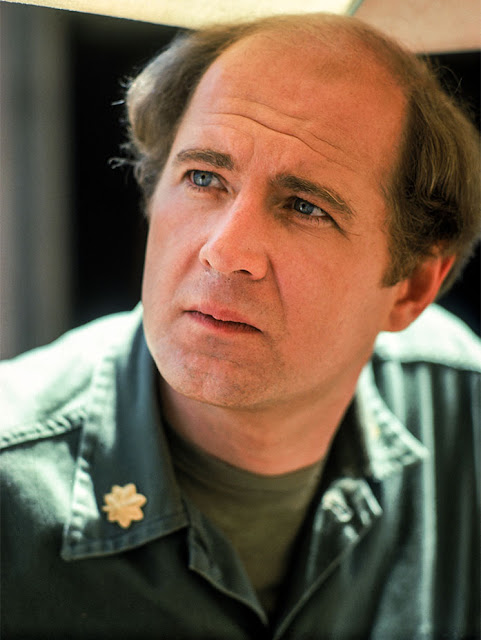
Edward Tinsdale is played by the one and only David Ogden Stiers. Television fans will recognize him as Major Charles Emerson Winchester III from M*A*S*H. His fussy and stodgey manner was always a nice foil to Hawkeye’s and Hunnicutt’s buffoonery. Fans of 1980s teen comedies may recognize Stiers from his role as John Cusack’s put-upon father in the classic Savage Steve Holland film Better Off Dead (1985). However and wherever you remember seeing him before, Stiers always carried himself and his characters with dignity and aplomb. Stiers was a veteran of the improv group The Committee, whose alumni also includes Howard Hesseman, Rob Reiner, and Peter Bonerz. He also attended Juilliard and was mentored by John Houseman (an actor who could pull off fussy and stodgey with the best of them!). He also was the associate conductor of the Newport (Oregon) Symphony Orchestra and the Ernest Bloch Music Festival, as well as guest conductor of over seventy orchestras from around the world. All that from a guy without any formal musical training!


Stier’s aforementioned fussiness is used well here. Tinsdale is just a guy who wants to enjoy his honeymoon (and seems to be doing just that, if you know what I mean, nudge-nudge, wink-wink). As Helen, Joe, and Brian continually barge in on the happy couple’s connubial bliss, Stiers’s weary, stiff-upper-lipped reactions make for great comedy, as do Mrs. Tinsdale’s (Kelly Miracco) off-camera reactions to the trio’s (coitus) interruptions

Tinsdale: Won’t you play for me again, please? 
Helen: Really? Are you sure? Because I think I could play much better than I did yesterday. I was very flustered…well, I wasn’t very flustered, but I was pretty flustered, that’s why I think I’m sure…well, I’m really sure that I think I could play much better because I’m not as flustered— 
Mrs. Tinsdale (yells from the bedroom off camera): Play the damn thing!

But Edward Tinsdale isn’t the only celebrity visiting the island. Though the viewer never sees him, it seems that Channel 8-TV’s own Poppo the Clown is in town. Lifelong fans Joe, Brian, and Lowell light up like the cathode ray clown’s pants at the mere mention of his name. Sadly, the scales fall from Lowell’s eyes when he realizes that “Poppo doesn’t really make that funny noise when you sock him in the stomach.” It’s hard meeting your heroes, folks.


While Helen and Lowell have their existential crises, Fay and Roy have a supernatural one. While getting ready for the V.F.W. carnival, Fay, aka Madame Zorco, gives Lowell a card reading that tells him that “a stranger is going to bring him unexpected good fortune.” Sure enough, later in the day, after Lowell returns a lost wallet to its owner, the man gives the mechanic a $20 reward. Naturally, Roy wants a piece of that action and asks Madame Zorco to do a reading for him. Things don’t go quite the way Roy wants. After twice revealing a run of cards, and twice quickly gathering them up, Fay promises to read Roy’s fortune later:

Fay: Roy, I’m not feeling very well. Why don’t we do this tomorrow? 
Roy: You saw something, Fay. Now what was it? 
Fay: No, no, no, nothing. Absolutely nothing. It wasn’t the death card— 
Roy (shocked): It was, too. It was the death card. 
Fay: No, it was the, uh, cheese card. 
Roy (incredulous): The cheese card? 
Fay: The cheese card. It means you’re going to buy more airplanes and become an even bigger cheese around here.

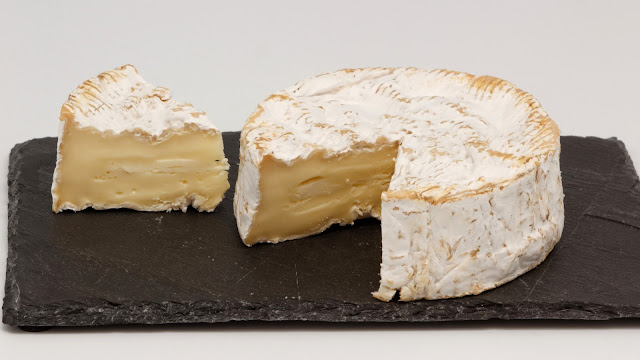
I wouldn’t mind getting the cheese card if it just meant I was gonna eat some yummy cheese. Sometimes a Camembert is just a Camembert, after all.


Later, after being critiqued by Tinsdale the second time, the gang is worried about how Helen is taking it:

Brian: Then, she finished playing, and he just stared at her, kinda like the way you stare at a bug after it splattered on your windshield. And then he told her: she played better the first time. 
Fay: Poor Helen. 
Joe: I’m worried about her. She must be totally devastated. 
Helen (cheerfully enters the terminal and walks behind the counter): Good morning! Isn’t it a beautiful day? 
Lowell: God, it kills me to see her like this.

What follows is an interesting scene, one whose premise I’ve thought often about. Helen goes on to tell everyone that Tinsdale’s brutally honest criticism of her playing has made her reevaluate her life. Instead of waking up and practicing for two hours, this morning she watched the sunrise, went for a walk, and took a bubble bath. After all that she still had time to enjoy the morning paper over breakfast.

Helen: I figured it out. Practicing two hours a day, I have put over 10,000 hours of my life into that cello. Do you realize how many hours that is? 
Lowell: Unless this is a trick question, I’d say…10,000?

Through Tinsdale’s assessment, Helen makes peace with the fact that she will never be part of an orchestra, never be a professional musician, and so, need never center her life around the cello. She can finally just enjoy life. Later, as he and his wife are preparing to board their plane, Tinsdale apologizes for his critique:

Tinsdale: I may have left you the other evening with the impression that your musical ability is non-existent. That is not quite true. I believe that you possess a glimmer of talent. 
Helen: A glimmer? 
Tinsdale: Yes. The tiniest of glimmers, but it is there. 
Helen: No. You cannot be saying this because, see, I just got my life back— 
Tinsdale: Of course, it means that you’ll have to practice four, maybe five, hours a day religiously, but I believe that there’s a chance over the next few years— 
Helen: You told me I stink. 
Tinsdale: Oh, but you don’t. 
Helen: Oh, yes, I do. Completely and totally. Pee-yew! You said no self-respecting orchestra would have me. 
Tinsdale: I exaggerated. I apologize. 
Helen: No, you can’t be saying this. You said that I didn’t have a chance. 
Tinsdale: But you do. 
Helen (grabs Tinsdale by the lapels): Take it back! You can’t give me hope! What kind of monster are you?

As someone who grew up being told I had loads of “potential” that I wasn’t living up to, I feel for Helen, I really do. I’m not sure which is worse: losing out on the fulfillment of a dream due to a lack of talent or having just enough talent to keep you chasing after that dream, but never reaching it. I love writing. I think, like Helen, I’ve the tiniest glimmer of talent at it. Will I ever have any success with it? Probably not. Are there days when I wonder what the use of it is? You betcha. Do I still do it? Yep. Why? I don’t know. I like the doing, I guess. I like sitting at a desk and pushing words around a page. I hope Helen likes the doing, although the end of the episode paints a rather shockingly downbeat and pessimistic picture:

Helen: What am I going to do? I’m cursed with a glimmer of talent. I’m going to be chained to that instrument for the rest of my life. Good-bye, walks on the beach. Good-bye, fingernails. Good-bye, life. 
(Helen exits.) 
Joe (to Brian): Think she’s going to be alright? 
Brian: She’ll be fine. 
Joe: I don’t know. I’ve never seen her like this before. 
Brian: You don’t think she’s going to do anything desperate? 
(Off-screen sound of scales being played on a cello.)

On that note, folks, if you look out the cabin windows, you’ll see that we are beginning our final descent. Please help our crew tidy up and make sure your seat backs and tray tables are in their full upright positions. Place your carry-on luggage beneath the seat in front of you or in the overhead bins, then securely fasten your seat belts. And please don’t sock Poppo in the belly. We’ve run out of airsickness bags.

Our next flight is Episode Four of Season Two, “Sports and Leisure.” See you then…